
Verify professional qualifications for pre-employment screening


Employers should verify professional qualifications during pre-employment screening whenever a candidate’s licence, certification, professional membership or regulated status is relevant to their ability to do the job. Verification should confirm the credential with the issuing body and establish whether the candidate is currently entitled to use it or practise under it.
A CV can tell you that a candidate claims to be chartered, licensed, registered or certified. It cannot establish whether that claim is accurate.
This distinction matters most when a qualification affects what somebody is legally or professionally permitted to do. Hiring teams need evidence that the credential belongs to the candidate and remains valid at the point of hire.
When should you verify professional qualifications?
Professional qualification verification should be based on the requirements and risks of the role.
For regulated positions, verification is often an essential part of pre-employment screening. A healthcare professional may need an active registration. An accountant may claim membership of a recognised professional body. An engineer may need a particular licence or chartered status for the work they will undertake.
Verification can also be relevant outside formally regulated professions. Employers may require technical certifications, trade qualifications or memberships because they demonstrate that a candidate meets an internal standard for the role.
The key question is straightforward: would it materially affect the hiring decision if this qualification were false, expired or subject to restrictions? If the answer is yes, it should be verified.
This risk-based approach also avoids adding unnecessary checks to every hire. Veremark's guide to background checks for employment covers the wider checks employers can combine according to the responsibilities of a role.
What should a professional qualification verification confirm?
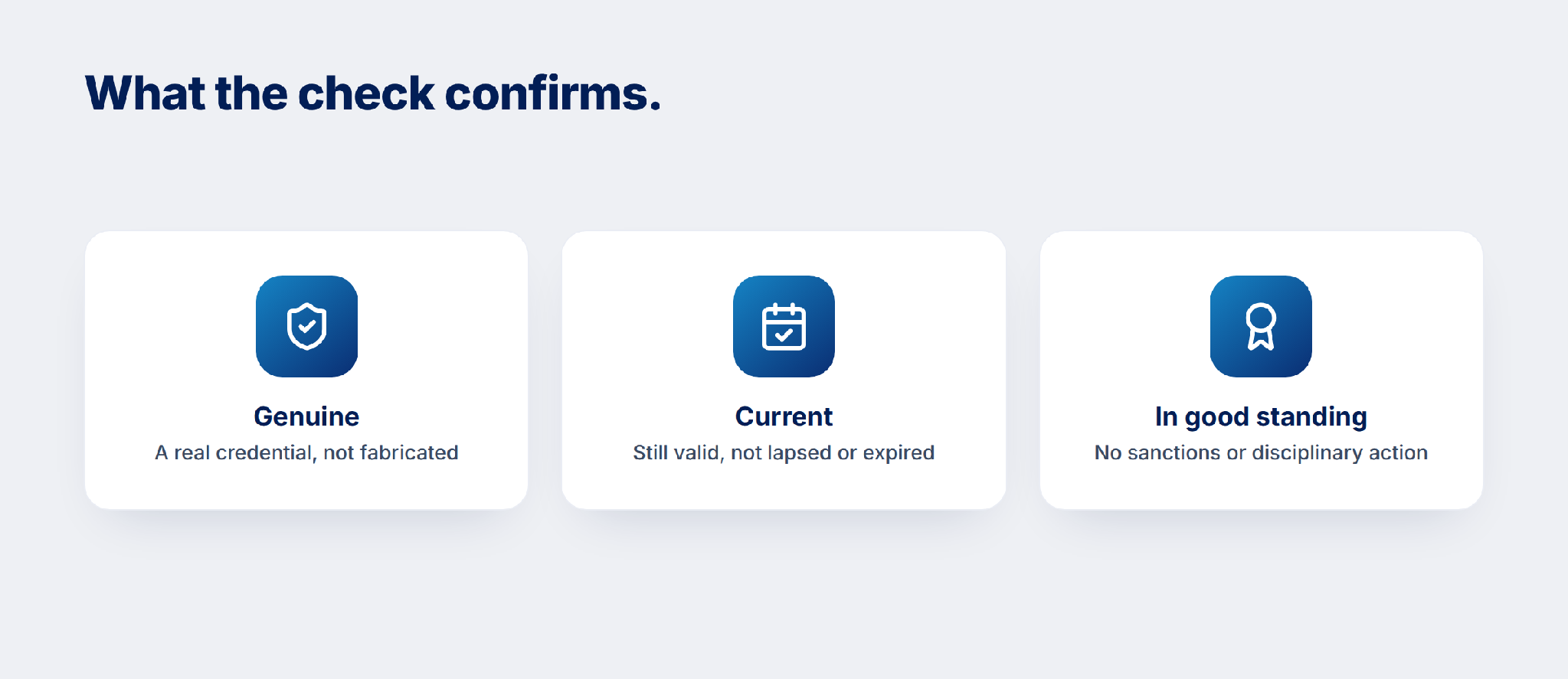
When you verify professional qualifications, the result needs to establish more than whether a qualification once existed.
Screening should confirm the name of the qualification or membership, the candidate associated with it, its current status and any relevant restrictions recorded by the source.
Current status can be particularly important. A genuine qualification does not automatically mean somebody remains authorised to practise. Registration may have expired, membership may have lapsed or a professional body may have imposed restrictions.
That is why you should assess the status recorded by the relevant issuing organisation rather than relying on the certificate presented during recruitment.
Why check the issuing body?
The strongest evidence usually comes from the organisation responsible for the credential.
A certificate supplied by a candidate is evidence to assess, rather than independent confirmation. Digital documents can be altered and an old certificate may no longer reflect somebody's current professional status.
Checking the issuing body gives the employer a source against which the candidate's claim can be compared.
That principle applies across pre-employment screening. An academic achievement check, for example, verifies education claims against relevant records rather than treating the CV as the final source.
The same logic applies to professional qualifications.
Which jobs commonly require qualification checks?
Healthcare is an obvious example because registration can determine whether someone is permitted to practise. Similar requirements exist across financial services, legal work, engineering, construction, education, aviation and a range of skilled trades.
The exact credential will vary between countries and professions.
An international employer may therefore need to identify both the qualification required for the role and the authority responsible for verifying it in the country where the candidate qualified or will work.
The check should follow the role requirement. Screening every candidate against the same fixed package can create unnecessary work while missing checks that matter for specific positions.
Employers hiring across several jurisdictions can use Veremark's global background screening coverage to see where different employment checks are available.
Qualification fraud is worth checking for
You should not assume that professional or academic claims have already been checked elsewhere in the recruitment process.
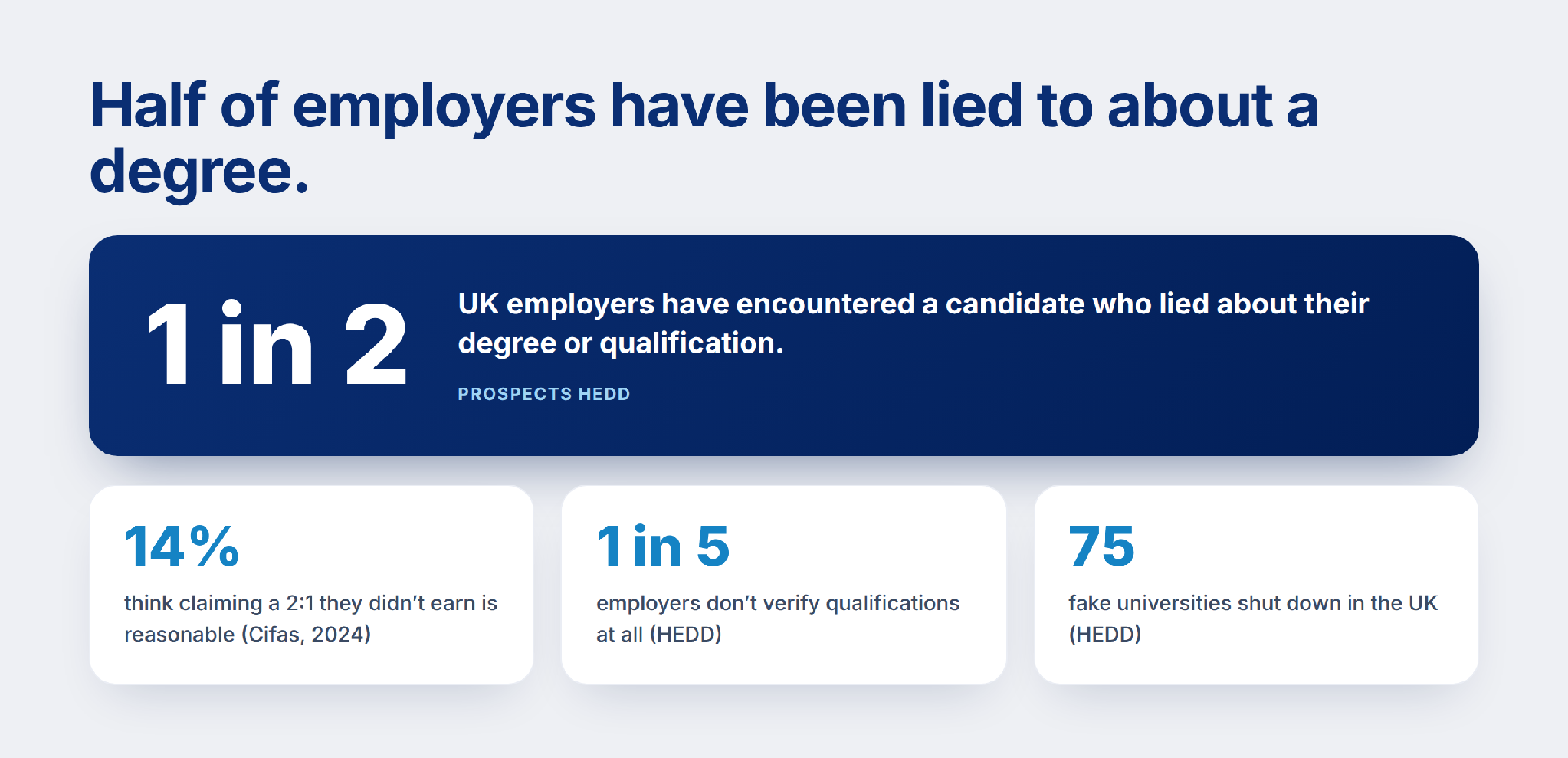
Research published by Prospects found that around half of UK employers surveyed had encountered candidates who lied about a degree or qualification. Cifas also reported in 2024 that 14% of people surveyed considered it reasonable to claim a 2:1 degree they had not earned.
Veremark's 2026 screening data provides another reason to pay attention to credentials. Its analysis of close to half a million background checks found education checks producing discrepancy rates of around 15 to 21%, depending on the dataset and category examined.
Those figures do not mean every discrepancy represents deliberate fraud. They do show why qualification claims deserve independent confirmation when they matter to the role.
Where qualification verification fits into pre-employment screening
A professional qualification check answers a specific hiring question: does this candidate hold the professional credential required or claimed for this job?
Other checks answer different questions.
An identity check helps establish who the candidate is. Employment verification can confirm where they worked and when. Criminal record, sanctions, right-to-work and other checks may be appropriate depending on the position, jurisdiction and employer's responsibilities.
Together, those checks give hiring teams evidence against the claims and requirements that matter for a particular appointment.
For a regulated professional, qualification verification deserves particular attention because an incorrect result can affect whether the person is eligible to carry out the work at all.
How Veremark verifies professional qualifications
Veremark allows employers to include professional qualification verification within their wider pre-employment screening process.
The employer requests the relevant check and supplies the credential information required.
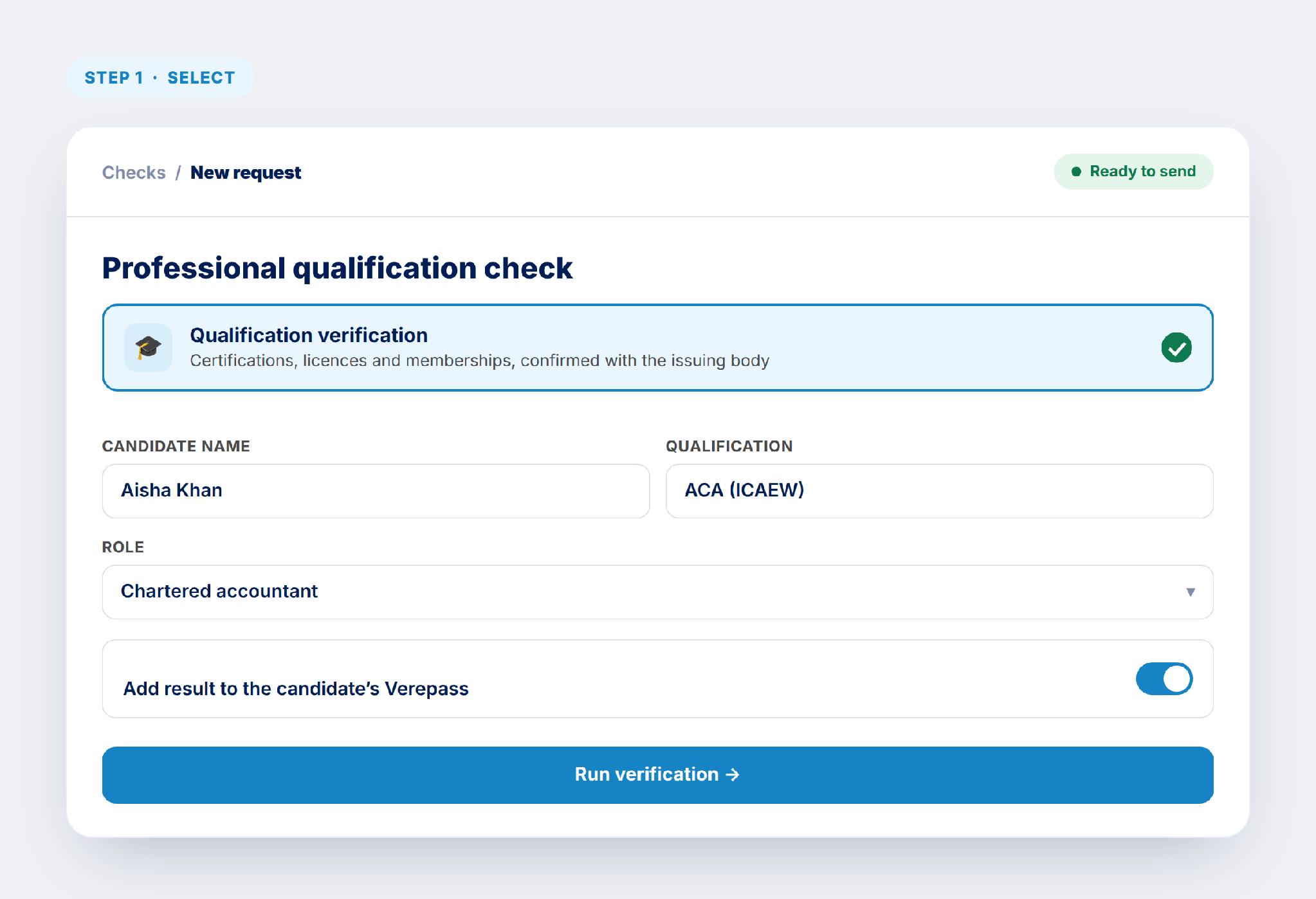
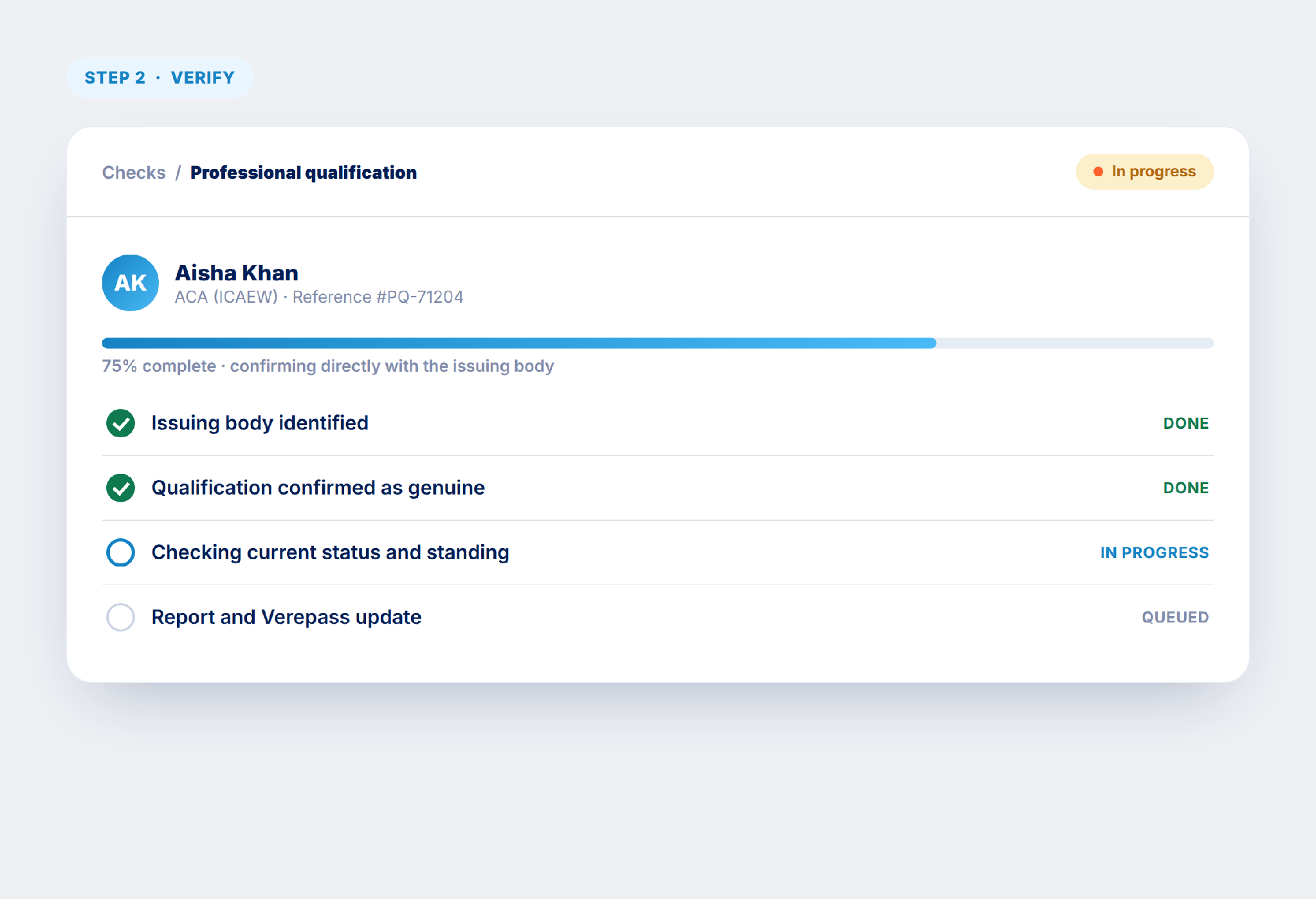
Verification is then carried out against the appropriate source, with the resulting status returned through the screening platform.
Candidates can also retain verified career credentials through Verepass, allowing verified information to be securely managed and shared again where appropriate.
For employers, the objective is simple: verify professional qualifications before relying on them in a hiring decision.
A claimed credential can influence whether somebody reaches an interview, receives an offer or is permitted to perform a regulated job. If the qualification matters enough to affect the decision, it matters enough to check.
Verification is then carried out against the appropriate source, with the resulting status returned through the screening platform.
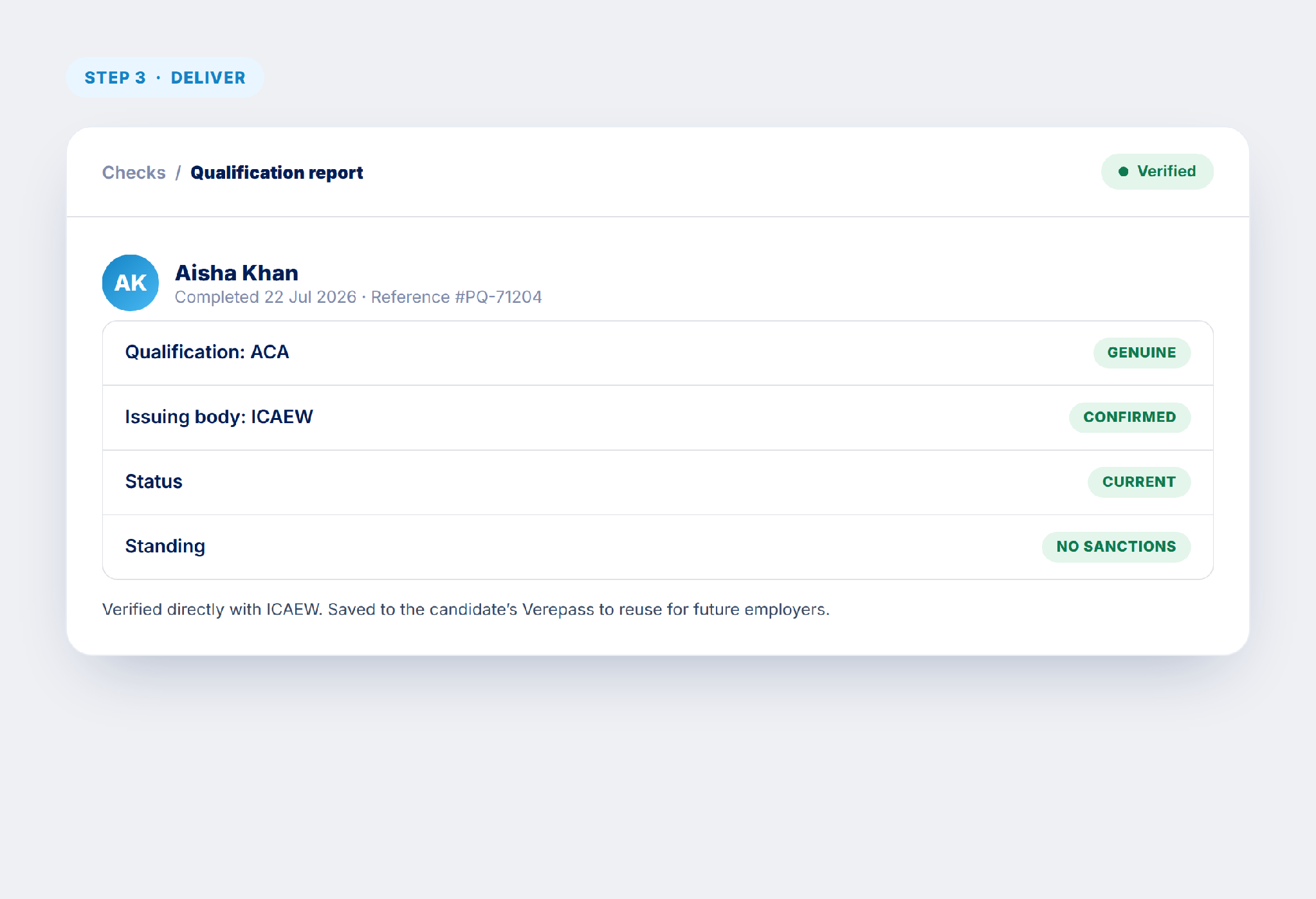
You get a clear verified result, and the candidate can keep it in their Verepass career passport to reuse with future employers, so nobody re-verifies the same qualification twice.
It's GDPR and PDPA compliant, pay-as-you-go with no lock-in, works with issuing bodies across the markets you hire in, and plugs into your ATS and the rest of your screening.
.png)
Read More




.jpg)
FAQs

This depends on the industry and type of role you are recruiting for. To determine whether you need reference checks, identity checks, bankruptcy checks, civil background checks, credit checks for employment or any of the other background checks we offer, chat to our team of dedicated account managers.
Many industries have compliance-related employment check requirements. And even if your industry doesn’t, remember that your staff have access to assets and data that must be protected. When you employ a new staff member you need to be certain that they have the best interests of your business at heart. Carrying out comprehensive background checking helps mitigate risk and ensures a safer hiring decision.
Again, this depends on the type of checks you need. Simple identity checks can be carried out in as little as a few hours but a worldwide criminal background check for instance might take several weeks. A simple pre-employment check package takes around a week. Our account managers are specialists and can provide detailed information into which checks you need and how long they will take.
All Veremark checks are carried out online and digitally. This eliminates the need to collect, store and manage paper documents and information making the process faster, more efficient and ensures complete safety of candidate data and documents.
In a competitive marketplace, making the right hiring decisions is key to the success of your company. Employment background checks enables you to understand more about your candidates before making crucial decisions which can have either beneficial or catastrophic effects on your business.
Background checks not only provide useful insights into a candidate’s work history, skills and education, but they can also offer richer detail into someone’s personality and character traits. This gives you a huge advantage when considering who to hire. Background checking also ensures that candidates are legally allowed to carry out certain roles, failed criminal and credit checks could prevent them from working with vulnerable people or in a financial function.
Trusted by the world's best workplaces




APPROVED BY INDUSTRY EXPERTS
.png)
.png)


and Loved by reviewers


Transform your hiring process
Request a discovery session with one of our background screening experts today.