
Outsource or manage background checks in-house: which delivers better ROI?


Your organisation is growing and you're considering outsourcing your background checks, but first, you need to review the cost.
The supplier fee is easy to see, but the internal cost is easier to miss. HR hours, slower hiring and the financial impact of a bad hire all belong in the calculation.
The best option for your business depends on what your current screening process really costs. An in-house approach can work well for some organisations, while outsourcing may make more financial sense for others. The difference usually comes down to hiring volume, HR capacity, screening speed and the risk attached to poor hiring decisions.
That is why the cost of background checks should be measured beyond the price of each individual check.
Limited HR resource vs a rapidly growing organisation
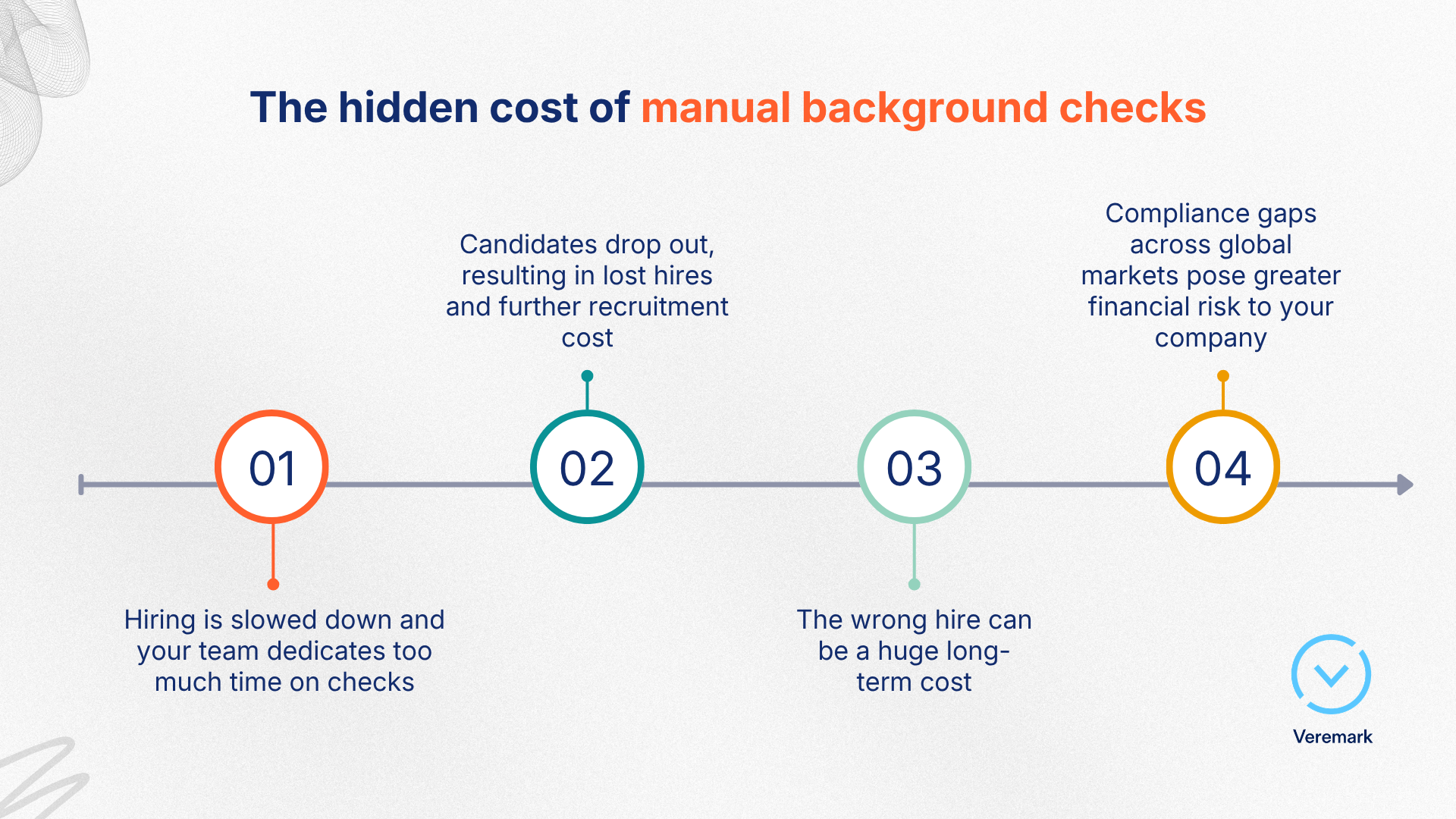
When screening sits in-house, someone needs to collect candidate information, request checks, chase missing documents, follow up with third parties, monitor progress and record the outcome. None of those tasks sounds particularly demanding on its own. Multiply them across dozens or hundreds of hires and they start consuming a serious amount of time.
This becomes especially noticeable when your organisation grows faster than your HR function.
You might have managed 20 hires comfortably last year. If that becomes 100 hires across several countries, the same process can quickly become a bottleneck. Hiring volume goes up, while the number of hours in your team's week stays stubbornly the same.
There is also an opportunity cost. Every hour an experienced HR professional spends chasing a reference is an hour they cannot spend improving retention, supporting managers or solving more difficult workforce problems.
Once you put a monetary value on those hours, "doing it ourselves" can look rather less economical.
The hidden cost of manual background checks
Candidates don't stop talking to other employers because you have made them an offer. If your preferred candidate is waiting days for someone in HR to chase a reference, verify a document or manually check the status of their screening, another employer has plenty of time to move first. That makes screening speed a recruitment issue, rather than an administrative detail.
For senior hires and people with scarce skills, the risk is particularly obvious. You can spend weeks sourcing, interviewing and persuading the right person to join, then introduce an avoidable delay at the final stage. If they walk away, you are back to sourcing candidates, scheduling interviews and keeping a hiring manager happy while the vacancy remains open.
A more efficient screening process can help you keep momentum after the offer. It also gives candidates a better experience. They know what is required, can provide information promptly and are less likely to spend days wondering whether anything is happening.
The cost of background checks therefore should include the cost of unnecessary hiring delays. That figure will not appear on an invoice, but your recruitment team will certainly feel it.
A cheap process doesn't consider the cost of a bad hire
Saving money on screening is a poor victory if the person you hire turns out to be an expensive mistake.
Our own analysis of the true cost of a bad hire points to recruitment expenses, training, replacement hiring and temporary cover as some of the direct costs businesses can face.
Then there is the disruption around them. A poor hire can take up a manager's time, reduce team productivity and create more work for colleagues. In customer-facing or senior positions, the consequences can spread further.
Our ROI model uses an estimated replacement cost of around 150% of salary. On that basis, the numbers become uncomfortable very quickly. A bad £60,000 hire could represent a £90,000 replacement cost. For Financial services this is even greater.
Against figures like that, shaving a few pounds from the price of screening starts to look like the wrong optimisation.
This is the part of the cost of background checks calculation that deserves the most attention. Screening should earn its keep by helping you reduce hiring risk, rather than simply being as cheap as possible.
The benefits of outsourcing
Outsourcing gives you a clearer division of labour.
Your HR team decides what needs to be checked and makes the hiring decision. A specialist provider handles much of the repetitive work required to get you there.
That can mean less chasing, fewer manual steps and a more consistent process for candidates.
It also makes scaling easier. Hiring another 100 people does not have to mean finding hundreds of additional hours inside HR to administer their checks. This is particularly valuable if you recruit internationally, where different types of checks and local requirements can make an informal process difficult to maintain.
Veremark also gives you one place to request checks and monitor their progress. For an HR director, that means better visibility without needing your team to build and maintain the process themselves.
You still need to choose the right checks and act appropriately on the results. What you gain is time and a screening operation that can grow with the organisation.
- A clearer vision of labour and easier scaling
- Background checks are immediately under way, whilst your team focus on everything else in the hiring process
- A greater experience for your candidates
- A single online portal for your team to track progress and view documents
- Global expertise from a company that runs thousands of checks each week

Run the numbers before you decide
There is no sensible answer based purely on whether an external screening provider looks expensive or cheap. Work out what your current process actually costs.
Count the HR hours involved. Look at your annual hiring volume, average salaries, attrition and the financial impact of replacing a bad hire. Consider what screening delays are doing to your recruitment process too. Then compare those numbers with the external cost.
For a small organisation making a handful of straightforward hires, keeping screening in-house may still stack up. As hiring becomes more frequent or more international, the economics can change quickly.
If you want to see how the figures compare for your organisation, use Veremark's online ROI calculator to calculate the potential return from outsourcing your background checks.
.png)
Read More
.jpg)


.png)

FAQs

Yes, Veremark specialises in providing comprehensive and compliant background checks that meet all UK legal requirements. Our processes are designed to be thorough, ensuring that your business adheres to regulatory standards efficiently.
The Ministry of Manpower (MOM) has a strict system in place to ensure the authenticity of the applicant’s qualifications. Veremark is a MOM-accredited background screening agency that can provide the verification proofs - such as education verification and institution accreditation checks, needed to apply for Employment Pass.
Partnering with specialised providers like Veremark allows financial institutions to access expert and up-to-date screening services, ensuring accuracy, compliance with global regulations, and streamlined processes that enhance the speed and efficiency of background checks.
Trusted by the world's best workplaces




APPROVED BY INDUSTRY EXPERTS
.png)
.png)



and Loved by reviewers


Transform your hiring process
Request a discovery session with one of our background screening experts today.