
A bad hire in financial services can cost 10x salary


.png)
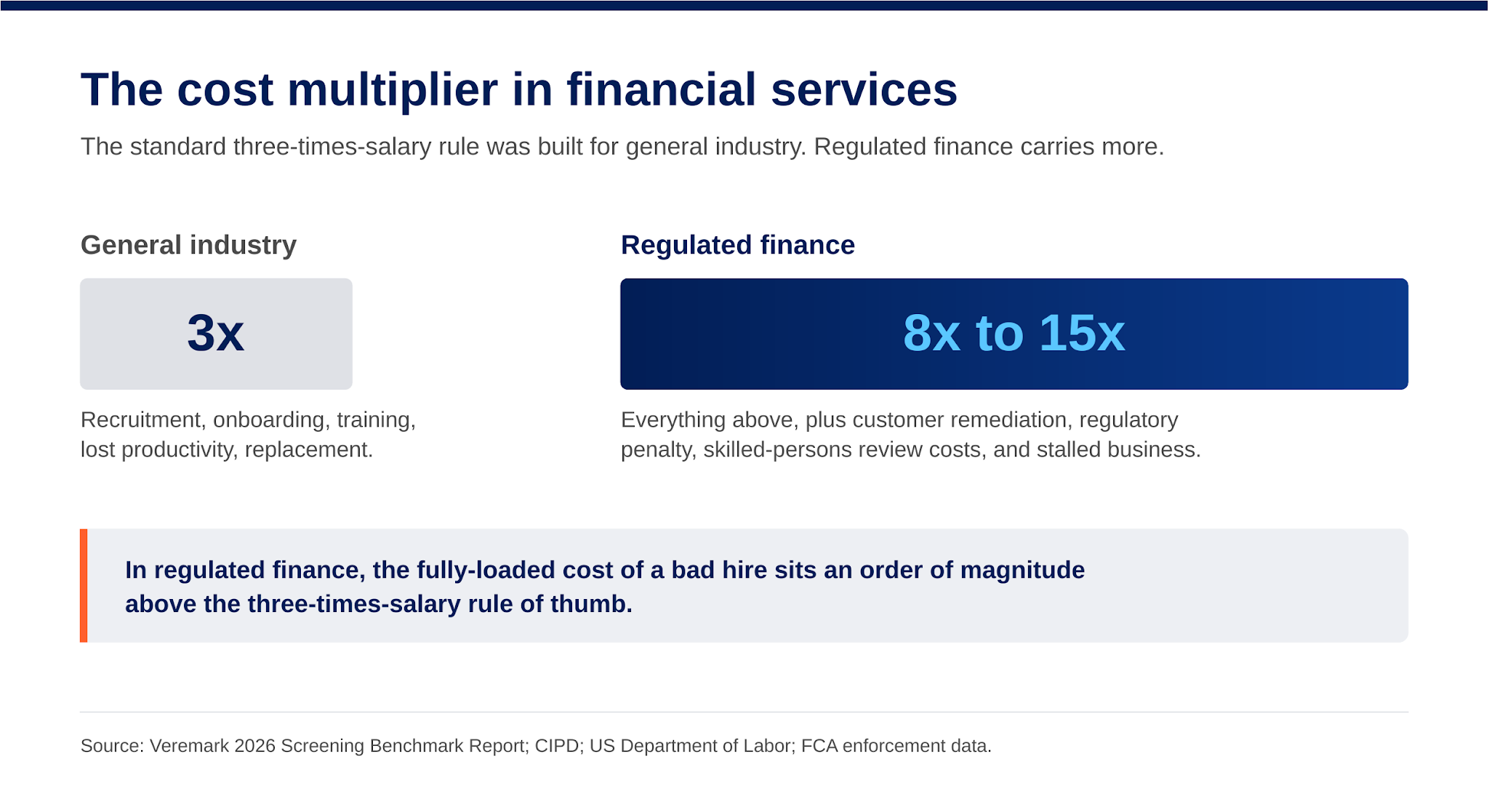
Ask most HR teams what a bad hire costs and you'll hear a version of the same figure: three times salary. It's the rule of thumb in CIPD research, in recruitment industry guidance, and in the original Veremark report on the cost of a bad hire. For general industry it holds up reasonably well, capturing recruitment cost, onboarding, training, lost productivity, and replacement.
For financial services, it falls short by an order of magnitude.
The reason is structural. In most industries, a bad hire is an HR problem with a financial cost. In regulated finance, a bad hire is a regulatory problem with an HR cost. The order is reversed, and so is the size of the bill.
What the three-times rule actually captures
The standard figure was built from components that apply in any sector. Recruitment and onboarding cost. Training and certification. Lost productivity while the wrong person is in the seat. Severance, and the cost of recruiting again. CIPD research puts this between 30% and 50% of first-year salary for most hires, and the US Department of Labor uses a similar 30% baseline, rising to 50% for managerial roles.
These components are real, and they don't disappear in financial services. The problem is that they're only the first two lines of a much longer ledger.

The four components financial services adds
Beyond direct HR cost and lost productivity, regulated finance carries four more cost components that general industry rarely sees. Customer remediation comes first. Where a hire's conduct results in customer harm, the firm bears the cost of putting it right. The H2O Asset Management settlement reached €250m to investors. The FCA's Consumer Duty has made scope-of-harm assessment a board-level expectation, which means remediation programmes now run into seven figures even for mid-sized firms.
Regulatory penalty comes next. Where a hire's actions trigger a regulatory finding, fines apply at firm level. The FCA issued 27 enforcement actions worth £176m in 2024, up 230% on the previous year. In 2025, Barclays was fined £42m for financial crime risk management failures and Nationwide £44.1m for AML systems and controls failures.
Skilled-persons review costs follow. Where the FCA loses confidence in a firm's controls, it commissions a review under Section 166 of FSMA, and the firm pays. The FCA's published average is around £500,000 per engagement, with mid-tier reviews routinely higher. These costs are recoverable nowhere.
The indirect cost of stalled business closes the ledger. Lending freezes, paused product launches, delayed M&A while remediation runs. It's the hardest cost to size and often the largest single item. Banks operating under voluntary requirements following enforcement action routinely lose 12 to 24 months of growth optionality across affected lines.

The real multiple
Add the six components together and the picture changes sharply. For a mid-level hire in regulated finance, the fully-loaded cost routinely sits at 8x to 15x salary once customer remediation, regulatory penalty, and skilled-persons review costs are attributed back to the original decision. For senior or certified-regime roles, where a single individual can trigger firm-wide harm, the multiple climbs higher still.
In financial services, the fully-loaded cost of a bad hire sits an order of magnitude above the three-times-salary rule of thumb. The original screening cost, by comparison, is a rounding error.
Why this matters for screening investment
The practical implication is straightforward. If the downside of a bad hire in financial services is 10x salary or more, the screening that reduces that risk should be measured against the full ledger, not against an HR-only view of cost.
Most financial services screening budgets are weighted towards database checks, which account for around 80% of screening volume but flag discrepancies under 1% of the time. The verification checks that catch the most material findings, CV gap analysis, education verification, and employment verification, sit largely outside standard packages. Reallocating budget toward them raises detection without raising overall cost. The 2026 Veremark Screening Benchmark Report sets out the full picture.
Three times salary was a useful shorthand when it was first coined. In regulated finance, it leads teams to under-invest in the one control that sits between a hiring decision and a multi-million-pound consequence.
Go deeper
The full report, The true cost of a bad hire in financial services, breaks down the six-component cost framework, five real enforcement cases, and a screening stack built for the financial services hiring lifecycle.




FAQs

This depends on the industry and type of role you are recruiting for. To determine whether you need reference checks, identity checks, bankruptcy checks, civil background checks, credit checks for employment or any of the other background checks we offer, chat to our team of dedicated account managers.
Many industries have compliance-related employment check requirements. And even if your industry doesn’t, remember that your staff have access to assets and data that must be protected. When you employ a new staff member you need to be certain that they have the best interests of your business at heart. Carrying out comprehensive background checking helps mitigate risk and ensures a safer hiring decision.
Again, this depends on the type of checks you need. Simple identity checks can be carried out in as little as a few hours but a worldwide criminal background check for instance might take several weeks. A simple pre-employment check package takes around a week. Our account managers are specialists and can provide detailed information into which checks you need and how long they will take.
All Veremark checks are carried out online and digitally. This eliminates the need to collect, store and manage paper documents and information making the process faster, more efficient and ensures complete safety of candidate data and documents.
In a competitive marketplace, making the right hiring decisions is key to the success of your company. Employment background checks enables you to understand more about your candidates before making crucial decisions which can have either beneficial or catastrophic effects on your business.
Background checks not only provide useful insights into a candidate’s work history, skills and education, but they can also offer richer detail into someone’s personality and character traits. This gives you a huge advantage when considering who to hire. Background checking also ensures that candidates are legally allowed to carry out certain roles, failed criminal and credit checks could prevent them from working with vulnerable people or in a financial function.
Trusted by the world's best workplaces




APPROVED BY INDUSTRY EXPERTS
.png)
.png)



and Loved by reviewers


Transform your hiring process
Request a discovery session with one of our background screening experts today.