
AI for background checks: the compliance risk for employers in 2026


If you’re considering using AI for background employment checks, you are not alone, and on paper, the benefits are compelling. For organisations growing at scale, the ability to streamline checks is especially attractive.
The challenge for HR directors and compliance leaders is finding the right balance between efficiency and risk management. While AI can improve speed and reduce manual workload, relying on automation alone can leave organisations exposed to compliance gaps and inaccurate screening outcomes.
This is why many employers are evaluating how AI fits into a broader screening and compliance strategy - and where working with a trusted background screening partner can provide the oversight, expertise, and compliance support that technology on its own cannot.
Why some HR teams are considering AI background checks
AI tools can scan candidate data quickly. They can compare CVs with employment records, identify gaps, detect duplicate information and highlight details that need review. Natural language processing can also help sort unstructured material, such as references, online profiles and uploaded documents.
For HR teams dealing with high application volumes, this is useful. Faster checks can reduce admin, improve time to hire and help recruiters focus on cases that need judgement.
But AI is most effective as a support layer - not as the foundation of a screening strategy.
Background checks involve far more than data matching. They involve identity verification, consent handling, local compliance rules, source validation and judgement. These are areas where human oversight remains essential.
Candidate fraud is getting harder to spot
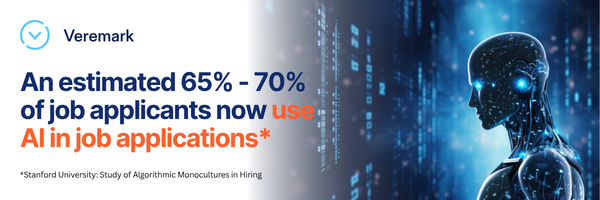
Generative tools can help applicants create polished CVs, rewrite employment histories and produce consistent answers across forms, profiles and interviews. That does not mean most candidates are dishonest. It does mean that weak screening processes are easier to exploit.
A candidate can now create a more convincing false story with less effort. They can smooth out career gaps, inflate responsibilities, generate fake references or present documents that look credible at first glance.
The 2026 Veremark Screening Benchmark Report found that CV gap checks were flagged in more than half of all cases and most standard screening packages don't include these checks.
That creates a problem for employers using AI screening. If false information is consistent across several sources, automated tools may treat that consistency as reassurance. In some cases, AI may validate the fraud rather than expose it.
The risks are practical:
- hiring someone with false qualifications or experience
- missing identity concerns
- increasing exposure to insider threat
- delaying action until after onboarding
- creating compliance issues if decisions cannot be explained
This is why screening has to move beyond pattern recognition. Employers need verification from trusted sources, supported by human review when the facts do not line up.
Veremark’s identity checks are a good example of where this matters. Identity is the foundation of the screening process. If that check is weak, every later result is weaker too, and more importantly, your business could be at risk.

Global hiring raises the stakes on background screening
Global hiring makes background checks more complex. Different countries have different rules on consent, data access, criminal record disclosure, employment verification and privacy.
An AI tool built around one market will not automatically understand those differences. Even where data exists, it may not be accessible in the same way. Some records are digitised. Others are not. Some checks require local authorisation. Others need specific candidate consent or cannot be carried out for certain roles.
This matters for HR and compliance leaders because responsibility stays with the employer. Outsourcing the technology does not outsource the duty to process candidate data lawfully or make fair hiring decisions.
A global screening programme needs local knowledge. It also needs a clear process for deciding which checks are appropriate for each role, country and risk level.
Veremark supports checks across more than 180 countries, which is where technology and local screening expertise need to work together. The value is not only in running checks faster. It is in knowing which checks are valid, proportionate and legally sound.
The limits and risks of AI screening
AI has clear and potentially catastrophic limits in employment screening.
It can miss context. A candidate may have a gap in employment for a legitimate reason. A job title may differ across countries or industries. A company may have changed name, merged or closed. A criminal record check may depend on local rules about disclosure and rehabilitation.
AI can also create false positives. A system may flag a candidate because of a name match, incomplete data or a formatting issue. Without review, that can slow hiring, damage candidate experience and create fairness concerns.
There is also the issue of explainability. If an employer rejects or delays a candidate based on an AI-generated risk score, they need to understand how that decision was reached. “The system flagged it” is not a defensible hiring process.
That is why AI for background employment checks should be viewed as a triage for decision-making rather than a solution. Screening needs evidence, judgement and a clear audit trail.
What a screening partner adds
A background screening partner gives employers structure around the technology.
That usually includes access to trusted data sources, local screening knowledge, candidate consent handling, manual review and documented results. It also gives HR teams a consistent process across markets, rather than leaving each region to solve screening on its own.
The strongest screening models use some automation where it helps and human review where it matters. Tech can speed up document handling, case routing and inconsistency checks. People should review complex cases, verify sources and manage exceptions.
Veremark’s background checks are built around that balance: digital screening supported by processes and intelligence of different roles and global regulations.
For regulated or higher-risk roles, this becomes even more important. Checks such as criminal records, sanctions, financial regulation or professional qualifications carry more weight than a simple employment confirmation. Employers need confidence that the check is appropriate, current and legally valid.
Speed, cost and control
We understand that most employers look at screening through three pressures: speed, cost and control. Whilst AI appears to aid all three. The view to consider it as a replacement is too narrow, and too risky.
Speed is useful only when results are reliable. A cheap check becomes expensive if it misses a serious issue. Control does not mean owning every tool internally. It means having governance, records, escalation routes and confidence in the process.
A screening partner can help employers keep the benefits of speed and control while reducing the risks. HR teams get faster workflows without having to build country-by-country expertise, compliance processes and exception handling from scratch.
Your commercial case also needs to include the cost of poor hiring decisions. Veremark’s background screening ROI calculator can help employers assess the financial impact of a more structured screening process.
The perfect solution to solving your cost, speed, and compliance needs in screening
The future of screening is not AI-only. It is controlled automation with human-led, experienced expertise
For HR directors and compliance leaders, the question is not whether to use AI. It is where to use it, where to limit it and how to evidence the decisions that follow. Employers that get this right will move faster without lowering standards. Employers that treat AI as a shortcut will carry more risk than they remove.
Modern background screening partners will provide a system that integrates with your workflows and existing HR software to speed up your background screening - without removing the human element.

Read More
.jpg)



.webp)
FAQs

AI can spot some patterns and inconsistencies, but it can also miss well-prepared or AI-assisted fraud. Human review and trusted source verification are still needed.
It depends on how it is used. Employers still need lawful processing, candidate consent, fair decision-making and clear records, especially when hiring across borders.
Background checks are crucial for HR and recruitment agencies because they help verify candidate information, reducing the risk of hiring unqualified or potentially harmful employees. This ensures a safer and more trustworthy workforce.
Trusted by the world's best workplaces




APPROVED BY INDUSTRY EXPERTS
.png)
.png)


and Loved by reviewers


Transform your hiring process
Request a discovery session with one of our background screening experts today.