The rise of AI hiring fraud: Are you hiring the right person or just the right CV?


AI is changing the way candidates apply for jobs, but it's also making it harder for employers to distinguish genuine experience from clever presentation. In a recent webinar, Veremark and Allegis Global Solutions explored what this means for recruitment teams and how employers can protect themselves without making hiring unnecessarily complicated.
There's nothing particularly new about candidates exaggerating their experience on a CV. But artificial intelligence has made it considerably easier to do, and much harder to spot.
Today, a candidate can use AI to rewrite their CV around a job description, prepare convincing interview answers and present themselves as an almost perfect match for a role.
For HR and talent acquisition teams, that creates an uncomfortable question: how much of what you're seeing represents genuine skills and experience?
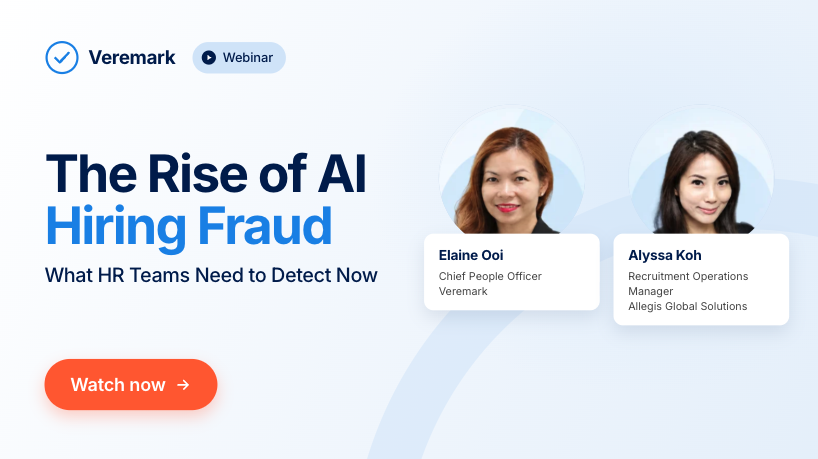
That's what Veremark's Chief People Officer, Elaine Ooi, and Alisa Koh, Recruitment Operations Manager at Allegis Global Solutions, explored during our recent webinar, The Rise of AI Hiring Fraud: What HR Teams Need to Detect Now.
Their discussion highlighted a growing challenge for employers: balancing the opportunities AI offers candidates with the need to make confident, evidence-based hiring decisions.
Here are some of the most important insights from the conversation.
AI hasn't invented hiring fraud. It's made it harder to recognise.
Using AI to help prepare a CV or practise for an interview isn't necessarily a problem. In fact, these tools can help genuinely talented applicants present their experience more effectively.
The difficulty comes when AI is used to create a version of a candidate that doesn't accurately reflect their capabilities.
Alisa highlighted an increasingly common challenge in recruitment: candidates using AI to tailor their CVs so closely to job descriptions that they appear to meet almost every requirement.
For recruitment processes that rely heavily on keyword matching, this presents a particular problem. A candidate might appear exceptionally well suited to a position on paper, even when their real experience doesn't quite measure up.
The distinction between preparation and misrepresentation is therefore becoming more important.
Helping someone explain work they've genuinely completed is one thing. Claiming responsibility for projects, skills or achievements they don't actually possess is quite another.
And as Elaine and Alisa discussed, recruiters need to look beyond how convincingly a candidate presents themselves and focus on the evidence supporting their claims.
A polished interview doesn't necessarily mean a capable candidate
The interview has traditionally provided an opportunity to test the experience described on a CV.
But AI-assisted interview preparation is changing that too.
Candidates can now generate answers to common competency questions, anticipate likely follow-ups and rehearse responses that sound knowledgeable and confident.
That doesn't mean everyone using these tools is being dishonest. However, it does mean that traditional interview questions may be less effective at distinguishing between someone who understands a subject and someone who has genuinely applied that knowledge.
Alisa shared the importance of asking questions that move beyond rehearsed examples and encourage candidates to explain their personal involvement in real situations.
Rather than simply asking someone to describe a successful project, recruiters can explore what happened when things didn't go according to plan.
What difficult decisions did they personally make? Which stakeholders challenged their approach? How did they respond? And what would their colleagues say they contributed?
These questions encourage candidates to move beyond polished summaries and demonstrate the depth of their experience.
The takeaway for recruiters isn't to become suspicious of every well-prepared candidate. It's to recognise that confidence and competence aren't necessarily the same thing.
A strong interview process should be designed to uncover genuine understanding, not simply reward the person with the most impressive answers.
Are your background checks actually uncovering discrepancies?
One of the most interesting points raised during the webinar concerned the effectiveness of different background screening checks.
Elaine referenced Veremark's screening benchmark data, drawn from approximately half a million cases, to demonstrate why employers should pay closer attention to the checks that uncover discrepancies.
The figures revealed some notable differences:
- 51.7% of cases involving CV gap analysis returned a discrepancy.
- More than 21% of education verifications identified discrepancies.
- More than 15% of employment verifications flagged discrepancies.
- Less than 1% of database checks identified discrepancies.
Importantly, these figures don't mean that every discrepancy represents fraud. Differences can arise from administrative errors, incomplete records or genuine misunderstandings.
However, they illustrate why organisations shouldn't assume that all background checks deliver the same level of insight.
For employers concerned about exaggerated experience or fabricated qualifications, independently verifying employment history and education credentials can provide valuable evidence that interviews and CV reviews simply cannot.
Elaine highlighted employment verification as a particularly important consideration for organisations reviewing their screening priorities.
After all, if a hiring decision is based heavily on someone's previous responsibilities, achievements and experience, it makes sense to establish whether those claims are accurate.
The broader lesson is that effective screening isn't necessarily about conducting more checks. It's about choosing the checks most relevant to the risks associated with a particular role.
Why waiting until the end of recruitment can be a costly mistake
Another important theme was the timing of background screening.
In many organisations, verification happens relatively late in the recruitment process, often after a candidate has already received or accepted an offer.
By that point, considerable time and resources may have been invested in sourcing, interviewing and selecting someone.
Discovering a significant discrepancy at this stage can mean restarting the process, delaying onboarding and potentially losing other qualified candidates.
Alisa discussed the value of moving certain verification activities earlier, rather than treating screening as a final administrative step.
For example, organisations might consider introducing identity or qualification verification before making an offer, where appropriate, or conducting employment and education checks in parallel.
This doesn't mean subjecting every applicant to an extensive screening process from the outset.
Instead, employers can take a more proportionate approach, considering the responsibilities and risk profile of each position.
A fully remote employee with privileged access to sensitive systems might warrant different verification requirements from someone entering a lower-risk role.
By identifying those requirements earlier, HR teams can reduce the likelihood of unexpected issues emerging just as they're preparing to welcome a new employee.
Stronger verification shouldn't mean a worse candidate experience
Of course, introducing additional checks raises another concern: could more thorough screening make recruitment slower and more frustrating?
This was an important consideration throughout the discussion.
Candidates generally understand why an employer needs to verify their identity, qualifications or previous employment. What tends to create frustration is being asked repeatedly for the same information, encountering unexpected delays or receiving little communication about what's happening.
The solution isn't necessarily to remove checks. It's to make the process better organised.
Clear communication, sensible sequencing and technology that reduces manual administration can help organisations conduct thorough verification without placing unnecessary demands on applicants.
It's also important that employers avoid treating every unusual career history as a potential warning sign.
A career break, unconventional career progression or a candidate's decision to use AI when preparing an application doesn't automatically indicate dishonesty.
The goal should be to establish the facts fairly and consistently, rather than make assumptions based on how someone's application looks.
Hiring confidence shouldn't stop on day one
While much of the conversation focused on identifying potential misrepresentation before hiring, Elaine also raised an important question about what happens after an employee joins an organisation.
Background screening is still commonly treated as a one-time event.
Yet an employee's circumstances, responsibilities and access to sensitive information can change considerably throughout their employment.
Elaine highlighted research suggesting that only around 15% of organisations conduct post-hire screening.
This creates a potential gap for employers that rely exclusively on checks completed when an employee first joined.
Professional licences can expire, conflicts of interest may emerge and internal promotions can give employees access to information or systems that weren't relevant to their original role.
For organisations thinking more strategically about workforce risk, this reinforces the importance of considering verification throughout the employee lifecycle.
Risk-based rescreening, where appropriate and supported by clear policies, can help employers maintain confidence in their workforce as roles and responsibilities evolve.
The future of recruitment is about better evidence, not greater suspicion
If there was one message to take away from the webinar, it was that AI shouldn't make recruitment teams distrust every candidate.
The technology has genuine benefits for jobseekers and employers alike. But as it becomes easier to create convincing applications, organisations need to ensure their recruitment decisions are supported by something more substantial than a well-written CV and an impressive interview.
That means asking better questions, independently verifying important claims and rethinking where background screening fits into the hiring journey.
Most importantly, it means recognising that compliance and hiring confidence aren't always the same thing.
Completing a standard set of checks may satisfy an organisation's existing process. Understanding whether those checks genuinely address the risks associated with a role is what makes them valuable.
The objective isn't to make recruitment harder. It's to make it more reliable, without losing the speed and candidate experience that modern hiring demands.
Watch the webinar on demand
Want to hear more from Elaine Ooi and Alisa Koh?
Watch The Rise of AI Hiring Fraud: What HR Teams Need to Detect Now for practical insights into recognising candidate misrepresentation, improving interview techniques and strengthening your approach to background screening.
Or, if you're ready to review how your organisation verifies candidates, speak to Veremark's team about building a faster, more effective background screening process.
Read More




FAQs

This depends on the industry and type of role you are recruiting for. To determine whether you need reference checks, identity checks, bankruptcy checks, civil background checks, credit checks for employment or any of the other background checks we offer, chat to our team of dedicated account managers.
Many industries have compliance-related employment check requirements. And even if your industry doesn’t, remember that your staff have access to assets and data that must be protected. When you employ a new staff member you need to be certain that they have the best interests of your business at heart. Carrying out comprehensive background checking helps mitigate risk and ensures a safer hiring decision.
Again, this depends on the type of checks you need. Simple identity checks can be carried out in as little as a few hours but a worldwide criminal background check for instance might take several weeks. A simple pre-employment check package takes around a week. Our account managers are specialists and can provide detailed information into which checks you need and how long they will take.
All Veremark checks are carried out online and digitally. This eliminates the need to collect, store and manage paper documents and information making the process faster, more efficient and ensures complete safety of candidate data and documents.
In a competitive marketplace, making the right hiring decisions is key to the success of your company. Employment background checks enables you to understand more about your candidates before making crucial decisions which can have either beneficial or catastrophic effects on your business.
Background checks not only provide useful insights into a candidate’s work history, skills and education, but they can also offer richer detail into someone’s personality and character traits. This gives you a huge advantage when considering who to hire. Background checking also ensures that candidates are legally allowed to carry out certain roles, failed criminal and credit checks could prevent them from working with vulnerable people or in a financial function.
Trusted by the world's best workplaces




APPROVED BY INDUSTRY EXPERTS


and Loved by reviewers


Transform your hiring process
Request a discovery session with one of our background screening experts today.