10 essential background checks for hiring foreign nationals in Dubai


Dubai attracts professionals from across the world, making international recruitment a fundamental part of workforce planning for businesses operating in the UAE.
But hiring foreign nationals brings additional responsibilities for employers. From immigration compliance to verifying overseas qualifications and employment histories, HR teams need to understand which checks are legally required and which can help reduce hiring risks.
So, what background checks should Dubai employers conduct when hiring foreign nationals?
While the UAE has established requirements for work permits and residency, there is no single mandatory background screening package for every employer. Requirements vary depending on the role, industry and whether a business operates on the mainland or within a free zone.
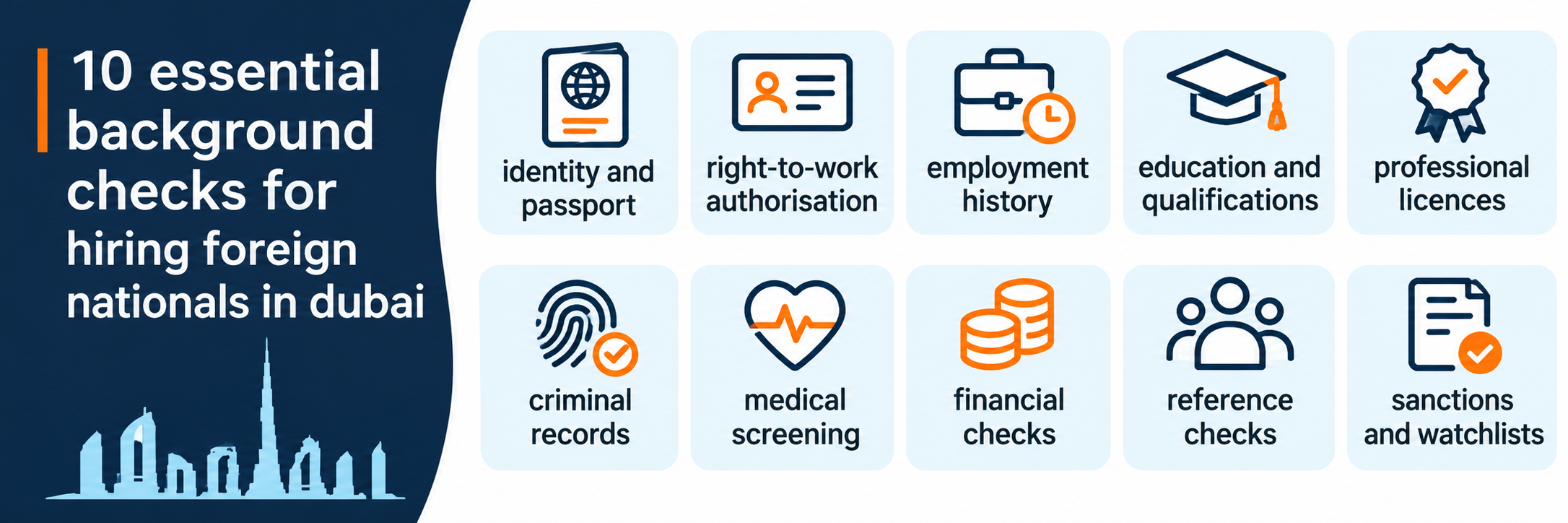
Here are 10 essential checks employers should know about.
1. Identity and passport verification
Status: Required documentation, with additional identity screening recommended.
Verifying a foreign national's identity is one of the first steps in the hiring process.
Under UAE employment procedures, foreign workers generally need a passport with at least six months' validity when applying for an initial work permit.
However, checking that a passport exists is only part of the process. Employers can also use digital identity verification to establish whether a document is authentic and belongs to the individual presenting it.
This is particularly valuable when recruiting remotely, where HR teams may have limited opportunities to verify a candidate's identity in person.
2. Right-to-work and immigration status checks
Status: Mandatory.
Foreign nationals must hold the appropriate legal authorisation to work in Dubai.
For mainland private-sector employers, the Ministry of Human Resources and Emiratisation (MoHRE) oversees work permits. Free zones operate their own employment and permit procedures, so businesses must follow the requirements of the relevant authority.
Employers should establish:
- Whether the candidate has the appropriate work authorisation.
- Whether the proposed role meets the applicable permit conditions.
- Whether any existing visa or employment status needs to be changed.
Employing someone without the appropriate authorisation can expose both the employer and employee to legal consequences.
The UAE Government's guidance on work permits outlines the applicable requirements.
3. Medical fitness screening
Status: Mandatory for adult residence visa applicants.
Foreign nationals aged 18 and over must undergo medical fitness screening when applying for a UAE residence visa.
These government-administered assessments focus on specified communicable diseases and determine whether an applicant satisfies the relevant residency health requirements.
Additional testing requirements may apply to certain occupations, including domestic work, food handling and childcare.
Employers should recognise that immigration medical fitness screening is separate from occupational health assessments, which may be appropriate for particular roles.
The process should be managed through authorised healthcare and immigration channels, with appropriate safeguards for sensitive medical information.
4. Education and academic qualification verification
Status: Mandatory for certain roles; recommended for others.
For foreign nationals applying for skilled or professional positions, academic qualifications can form part of the UAE work permit application.
Certain positions require officially attested certificates. However, document attestation and independent education verification serve different purposes.
Attestation establishes the authenticity of a document through an official authentication process. An education background check independently confirms information such as the institution attended, qualification awarded and dates of study.
For employers recruiting internationally, this distinction matters. A candidate may have studied in one country, worked in another and applied for a position in Dubai.
Verifying qualifications directly with the relevant institution provides an additional layer of assurance.
5. Professional licence and registration checks
Status: Mandatory for regulated professions.
Certain professions in Dubai require employees to hold specific licences, registrations or approvals before they can legally practise.
Healthcare provides a clear example. The Dubai Health Authority (DHA) requires eligible healthcare professionals to complete processes that include primary-source verification of relevant credentials and professional standing.
Dubai's Knowledge and Human Development Authority (KHDA) also establishes appointment requirements for staff working in private schools.
For regulated positions, employers should verify that the candidate holds the appropriate qualifications and that any required licence or registration is current.
A professional qualification check can help establish whether the credentials presented are legitimate and remain valid.
6. Employment history verification
Status: Recommended for most employers; mandatory in certain regulated sectors.
International recruitment can make employment history verification more complicated.
A candidate might have worked for several organisations across different countries, with employment records held in multiple languages and jurisdictions.
Employment history checks help confirm whether an applicant's claimed job titles, employment dates and previous employers are accurate.
These checks can also identify discrepancies or unexplained gaps that warrant further clarification.
For certain regulated businesses, employment verification is a formal requirement. For example, the Central Bank of the UAE's Know Your Employee (KYE) standards for licensed exchange businesses require previous employment to be verified.
For other employers, employment history screening remains an important tool for making informed hiring decisions.
7. Criminal record and police clearance checks
Status: Mandatory in certain sectors; otherwise dependent on role and employer policy.
A common misconception is that every foreign national working in Dubai must provide a Police Clearance Certificate as part of their employer's background screening process.
In reality, there is no general requirement for every private-sector employer to obtain a separate criminal background check.
However, some regulated industries have specific obligations.
For example, Dubai's private-school appointment requirements include good-conduct evidence, while the Central Bank's standards for licensed exchange businesses require police clearance as part of their KYE procedures.
Employers may also consider criminal record checks in a candidate's home country or previous countries of residence, where legally permitted and relevant to the position.
Because criminal record accessibility differs between countries, businesses recruiting internationally should ensure their screening procedures comply with applicable local laws.
8. Professional reference checks
Status: Generally recommended; may be required under specific sector rules.
Employment verification establishes whether someone has worked where they claim. Professional references can provide additional context about their previous responsibilities, experience and suitability.
For employers recruiting foreign nationals, references can be particularly useful when candidates have spent most of their careers outside the UAE.
A structured reference-checking process might explore:
- The candidate's previous responsibilities and level of seniority.
- Their experience working in relevant environments.
- Professional strengths and areas for development.
- Any role-related concerns that can be assessed fairly and lawfully.
References should supplement independently verified employment information rather than replace it.
9. Sanctions and international watchlist screening
Status: Mandatory in certain regulated businesses; otherwise risk-based.
Dubai is an international business hub, making sanctions compliance particularly relevant for organisations operating across multiple jurisdictions.
For certain regulated financial businesses, sanctions screening extends to prospective employees.
The Central Bank's KYE standards for licensed exchange businesses explicitly require sanctions checks before an applicant is employed.
Other organisations may choose to conduct global sanctions screening for positions involving financial transactions, sensitive information or significant decision-making authority.
Employers should use reliable screening sources and investigate potential matches before making employment decisions. A name match alone does not establish that an applicant is a sanctioned individual.
10. Financial integrity and adverse media checks
Status: Risk-based, particularly for senior and sensitive positions.
For certain roles, employers may need a broader assessment of financial or reputational risk.
Financial background screening may be relevant for employees with access to substantial company funds, payment systems or financial decision-making authority.
Similarly, adverse media screening can identify publicly reported information that may warrant further investigation, particularly when recruiting executives or individuals into positions of significant trust.
These checks should be proportionate to the role and conducted only where there is an appropriate lawful basis.
Employers should also distinguish between verified findings, allegations and outdated or irrelevant information.
Building a compliant background screening process in Dubai
For businesses recruiting internationally, the challenge is establishing a consistent screening process while accommodating differences between jurisdictions.
A sensible approach begins by separating mandatory immigration and regulatory requirements from additional employer-led checks.
HR and Compliance teams should also consider where the candidate has previously lived and worked, the responsibilities of the position and the level of risk associated with the role.
Data protection is equally important. Employers must account for applicable UAE privacy requirements, including distinct rules where relevant, such as those operating within the Dubai International Financial Centre (DIFC).
Ultimately, the right screening package depends on the individual role and the regulatory environment in which the business operates.
Simplify international background checks with Veremark
Hiring foreign nationals in Dubai often means verifying information held across multiple countries, institutions and employers.
Veremark helps businesses streamline international background screening, with employment, education, identity, criminal record and other verification services available across 180+ countries.
Our platform enables HR and Compliance teams to manage screening requirements through one centralised system, with checks tailored to the candidate's background, location and role.
Want to build a more consistent, reliable background screening process for international hires?
Book a demo with Veremark to discover how we can support your organisation's hiring and compliance needs.
Read More





FAQs

This depends on the industry and type of role you are recruiting for. To determine whether you need reference checks, identity checks, bankruptcy checks, civil background checks, credit checks for employment or any of the other background checks we offer, chat to our team of dedicated account managers.
Many industries have compliance-related employment check requirements. And even if your industry doesn’t, remember that your staff have access to assets and data that must be protected. When you employ a new staff member you need to be certain that they have the best interests of your business at heart. Carrying out comprehensive background checking helps mitigate risk and ensures a safer hiring decision.
Again, this depends on the type of checks you need. Simple identity checks can be carried out in as little as a few hours but a worldwide criminal background check for instance might take several weeks. A simple pre-employment check package takes around a week. Our account managers are specialists and can provide detailed information into which checks you need and how long they will take.
All Veremark checks are carried out online and digitally. This eliminates the need to collect, store and manage paper documents and information making the process faster, more efficient and ensures complete safety of candidate data and documents.
In a competitive marketplace, making the right hiring decisions is key to the success of your company. Employment background checks enables you to understand more about your candidates before making crucial decisions which can have either beneficial or catastrophic effects on your business.
Background checks not only provide useful insights into a candidate’s work history, skills and education, but they can also offer richer detail into someone’s personality and character traits. This gives you a huge advantage when considering who to hire. Background checking also ensures that candidates are legally allowed to carry out certain roles, failed criminal and credit checks could prevent them from working with vulnerable people or in a financial function.
Trusted by the world's best workplaces




APPROVED BY INDUSTRY EXPERTS



and Loved by reviewers


Transform your hiring process
Request a discovery session with one of our background screening experts today.