What separates a good background screening company from a bad one?


A good background screening company should give you confidence in the accuracy of its findings, the consistency of its processes and its ability to manage regulatory requirements across jurisdictions. A weaker provider may deliver the same standard checks while leaving significant gaps in verification quality, compliance controls and operational accountability.
For HR and compliance leaders, the challenge is determining whether a screening partner can consistently deliver the level of assurance your organisation requires.
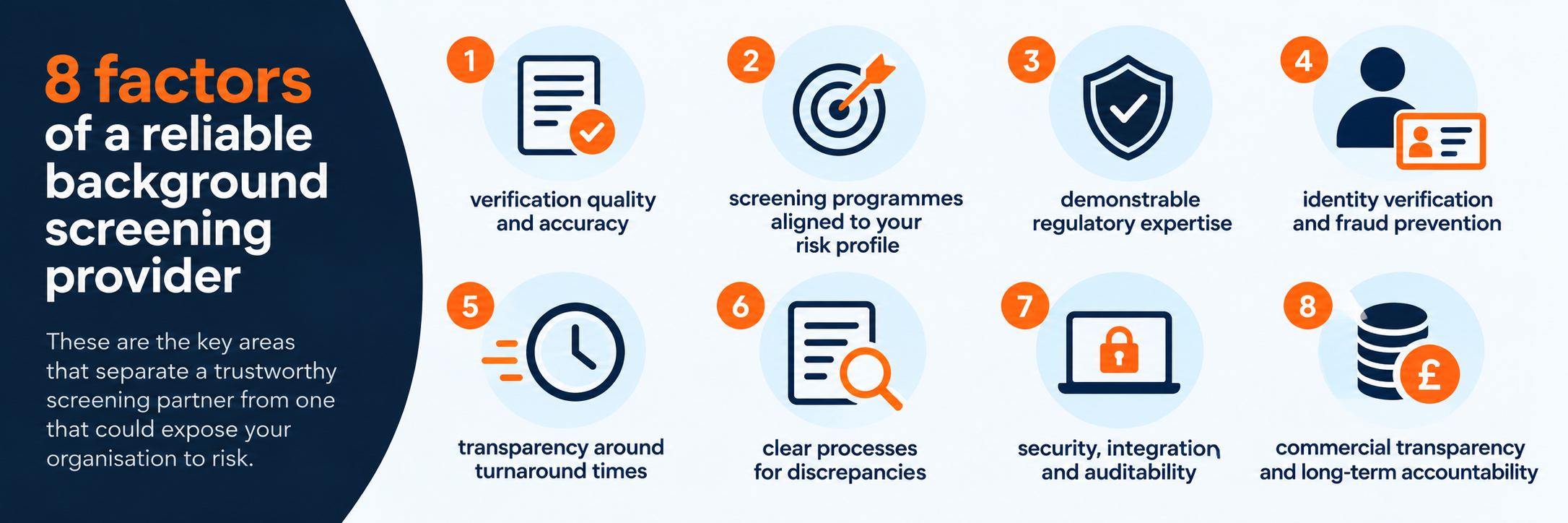
Here are eight factors that distinguish a reliable screening provider from one that could expose your organisation to unnecessary risk.
Verification quality and accuracy of results
The effectiveness of your screening programme depends on the reliability of the underlying checks.
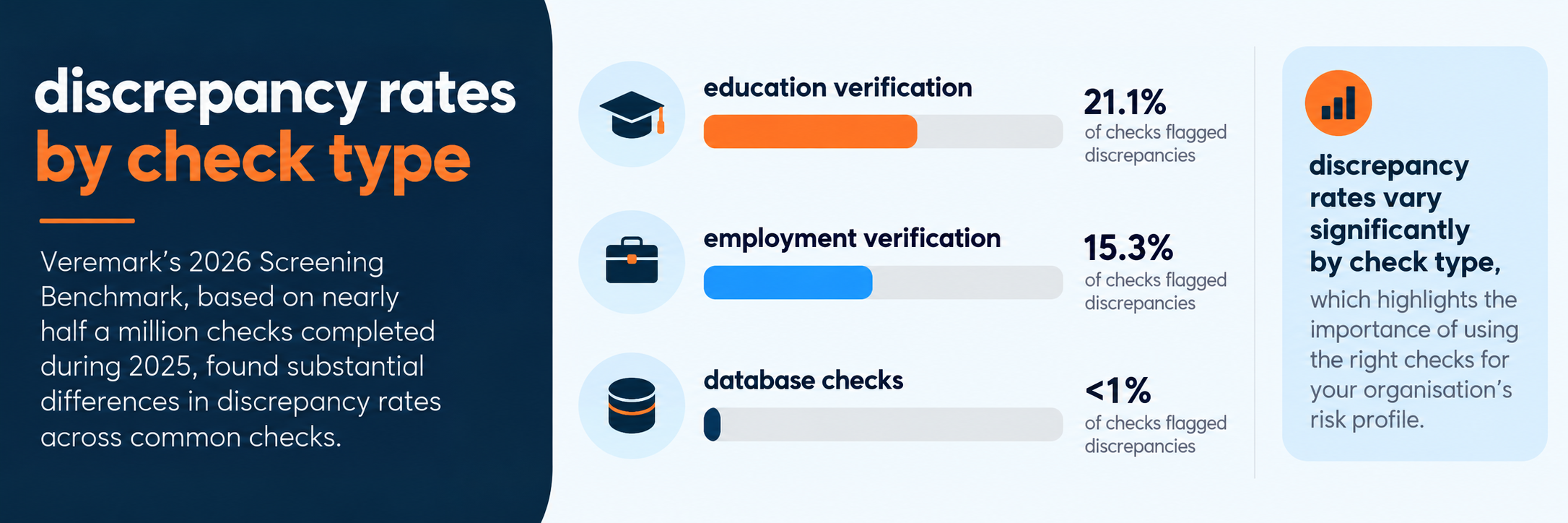
Veremark's 2026 Screening Benchmark, based on nearly half a million checks completed during 2025, found substantial differences in discrepancy rates. Education verification flagged discrepancies in 21.1% of checks, while employment verification flagged 15.3%. Database checks identified discrepancies in fewer than 1% of cases.
These differences raise questions about how organisations allocate their screening budgets and whether their chosen checks adequately address hiring risks.
A credible provider should be transparent about data sources, verification methodologies and how discrepancies are investigated.
Ask for evidence of screening quality, including how inconclusive results, disputed findings and potential false positives are managed. Discrepancy rates alone cannot establish a provider's effectiveness, particularly when candidate populations and check types differ.
Screening programmes aligned with your risk profile
Standardised screening packages may be convenient, but they can create gaps when applied across roles with different risk exposures.
Your provider should understand how screening requirements change according to job responsibilities, access privileges, regulatory obligations and geographic location.
For example, candidates entering regulated financial services roles may require additional verification of professional qualifications, regulatory history or financial integrity.
An experienced provider should support risk-based screening policies and help identify where your existing coverage may be insufficient.
The ability to adjust screening requirements as your organisation expands into new markets is equally important.
Demonstrable regulatory expertise
Compliance capabilities should be a central consideration when evaluating providers, particularly if you recruit internationally.
Screening requirements differ across jurisdictions, including restrictions on criminal record searches, financial background checks, candidate notifications and personal data processing.
A provider should be able to demonstrate how its processes account for these differences.
This includes supporting compliance with applicable UK GDPR requirements, the Fair Credit Reporting Act in the US and relevant local employment legislation.
You should also expect clear documentation covering data retention, lawful processing, candidate rights and procedures for disputed findings.
Our global background screening checklist examines how employers can maintain consistent screening controls across international operations.
Ultimately, your organisation remains accountable for its hiring decisions. Your screening partner should provide the evidence and procedural support needed to defend those decisions.
Identity verification and fraud prevention capabilities
Candidate identity has become an increasingly significant consideration, particularly for organisations recruiting remotely.
Employment and qualification checks can confirm that credentials exist. Their value depends on establishing that those credentials belong to the individual being assessed.
A screening provider should be able to explain how identity verification is incorporated into its process, including document authentication, biometric verification where appropriate and controls against impersonation.
Consider whether these capabilities can support your existing recruitment procedures and provide an appropriate level of identity assurance.
This becomes especially relevant when candidates will receive remote access to sensitive systems or commercially valuable information.
Transparency around turnaround times and service performance
Turnaround times remain an important operational measure, although headline averages rarely provide enough information for a meaningful comparison.
The performance of criminal record searches, employment verification and international checks can vary significantly depending on third-party response times and local processes.
Ask potential providers for turnaround data segmented by check type and jurisdiction.
Where possible, examine completion rates, exceptions, service-level performance and how delays are communicated.
You should also understand how turnaround times are calculated, particularly when checks require additional information from candidates or external sources.
A dependable provider should offer sufficient visibility for your recruitment teams to identify potential delays before they affect planned start dates.
Clear processes for discrepancies and adverse findings
How a provider manages exceptions often reveals more about its service quality than routine screening results.
Discrepancies require appropriate investigation, particularly where findings could influence an employment decision.
Your provider should have documented processes for resolving conflicting information, correcting inaccurate records and supporting candidate disputes.
You should also establish how findings are presented to your internal teams.
Reports need to distinguish verified information from inconclusive results and provide sufficient context for HR and compliance to assess relevance.
Automatic rejection based on an unexplained discrepancy creates unnecessary legal and reputational exposure.
The provider should also support any applicable candidate notification requirements while leaving employment decisions with your organisation.
Security, integration and auditability
A screening provider becomes part of your organisation's wider data processing arrangements.
Its security controls, system architecture and integration capabilities therefore deserve scrutiny beyond a standard product demonstration.
Assess how candidate information is collected, stored, accessed and deleted. Review relevant security certifications, data processing agreements, subcontractor arrangements and incident response procedures.
Integration with your ATS or HRIS should also support consistent workflows and reliable record-keeping.
For compliance teams, access to detailed audit trails is particularly valuable. You should be able to establish when checks were initiated, what information was verified, how exceptions were resolved and when results were shared.
Poor integration can lead to manual workarounds that increase administrative effort and make screening records harder to audit.
Commercial transparency and long-term accountability
Price per check is a useful comparison point, although it rarely reflects the full cost of a screening programme.
International verification fees, additional searches, failed checks and administrative requirements can materially affect expenditure.
Request an itemised pricing structure and establish how costs change with screening volume, geographic coverage and service requirements.
You should also examine the provider's contractual commitments, escalation procedures and approach to account management.
For organisations with established screening programmes, future requirements deserve consideration too.
Changes in employee responsibilities, regulatory obligations or access to sensitive information may justify periodic rescreening or ongoing monitoring, subject to applicable law.
A provider that can support these requirements may offer greater long-term value.
Our guide on assessing your current background checks provider provides further guidance on evaluating supplier performance and ongoing suitability.
Is your screening provider meeting your organisation's needs?
Choosing a background screening company requires more than comparing service catalogues, prices and turnaround promises.
The strongest providers can demonstrate verification quality, regulatory competence and operational accountability. They give HR and compliance teams the information required to make defensible decisions and maintain effective screening controls as organisational requirements change.
If you're reviewing your current provider or considering a new screening partner, Veremark can help you assess your existing processes and identify opportunities to improve screening coverage and efficiency.
Book a demo with our team to discuss your screening requirements and see how Veremark can support your organisation's compliance and hiring objectives.

Read More






FAQs

This depends on the industry and type of role you are recruiting for. To determine whether you need reference checks, identity checks, bankruptcy checks, civil background checks, credit checks for employment or any of the other background checks we offer, chat to our team of dedicated account managers.
Many industries have compliance-related employment check requirements. And even if your industry doesn’t, remember that your staff have access to assets and data that must be protected. When you employ a new staff member you need to be certain that they have the best interests of your business at heart. Carrying out comprehensive background checking helps mitigate risk and ensures a safer hiring decision.
Again, this depends on the type of checks you need. Simple identity checks can be carried out in as little as a few hours but a worldwide criminal background check for instance might take several weeks. A simple pre-employment check package takes around a week. Our account managers are specialists and can provide detailed information into which checks you need and how long they will take.
All Veremark checks are carried out online and digitally. This eliminates the need to collect, store and manage paper documents and information making the process faster, more efficient and ensures complete safety of candidate data and documents.
In a competitive marketplace, making the right hiring decisions is key to the success of your company. Employment background checks enables you to understand more about your candidates before making crucial decisions which can have either beneficial or catastrophic effects on your business.
Background checks not only provide useful insights into a candidate’s work history, skills and education, but they can also offer richer detail into someone’s personality and character traits. This gives you a huge advantage when considering who to hire. Background checking also ensures that candidates are legally allowed to carry out certain roles, failed criminal and credit checks could prevent them from working with vulnerable people or in a financial function.
Trusted by the world's best workplaces




APPROVED BY INDUSTRY EXPERTS



and Loved by reviewers


Transform your hiring process
Request a discovery session with one of our background screening experts today.