
Global background screening checklist for new hires (including a workflow for HR)


Global recruitment has moved faster than many screening policies and the software that covers it. HR teams can now hire across borders in weeks, yet the compliance work still depends on local law, candidate consent, data handling, role relevance and defensible decision-making. A global background screening checklist gives HR teams and Talent managers a repeatable process. It stops screening from becoming a late-stage admin task and turns it into a controlled part of hiring governance.
For senior recruiters, the goal is simple: check what matters for the role, in the right country, with the right permissions, and keep a clear audit trail.
Global screening demands tighter control in 2026
Background screening is no longer a single-market process. Each hire can trigger different rules on criminal records, employment verification, credit checks, right to work, data transfer and candidate notification.
In the UK, employers must carry out right to work checks before employment begins, using the correct process for the worker’s circumstances. The Home Office guidance covers initial checks, follow-up checks and acceptable documents. (GOV.UK) In the US, employers using consumer reports for employment decisions must follow Fair Credit Reporting Act requirements, including notification duties if adverse action is taken based on a report. (Federal Trade Commission) In the UK and Europe, criminal offence data and personal data require particular care, and the lawful basis for processing cannot be treated as a box-ticking exercise. (ICO)
The risk for HR teams is inconsistency and slow progress, but the risk for the organisation could be financially catestrophic - Employers have been sued both for weak checks and for using checks in a way that breached candidate rights.
A better process starts before the offer is made.
The global background screening checklist
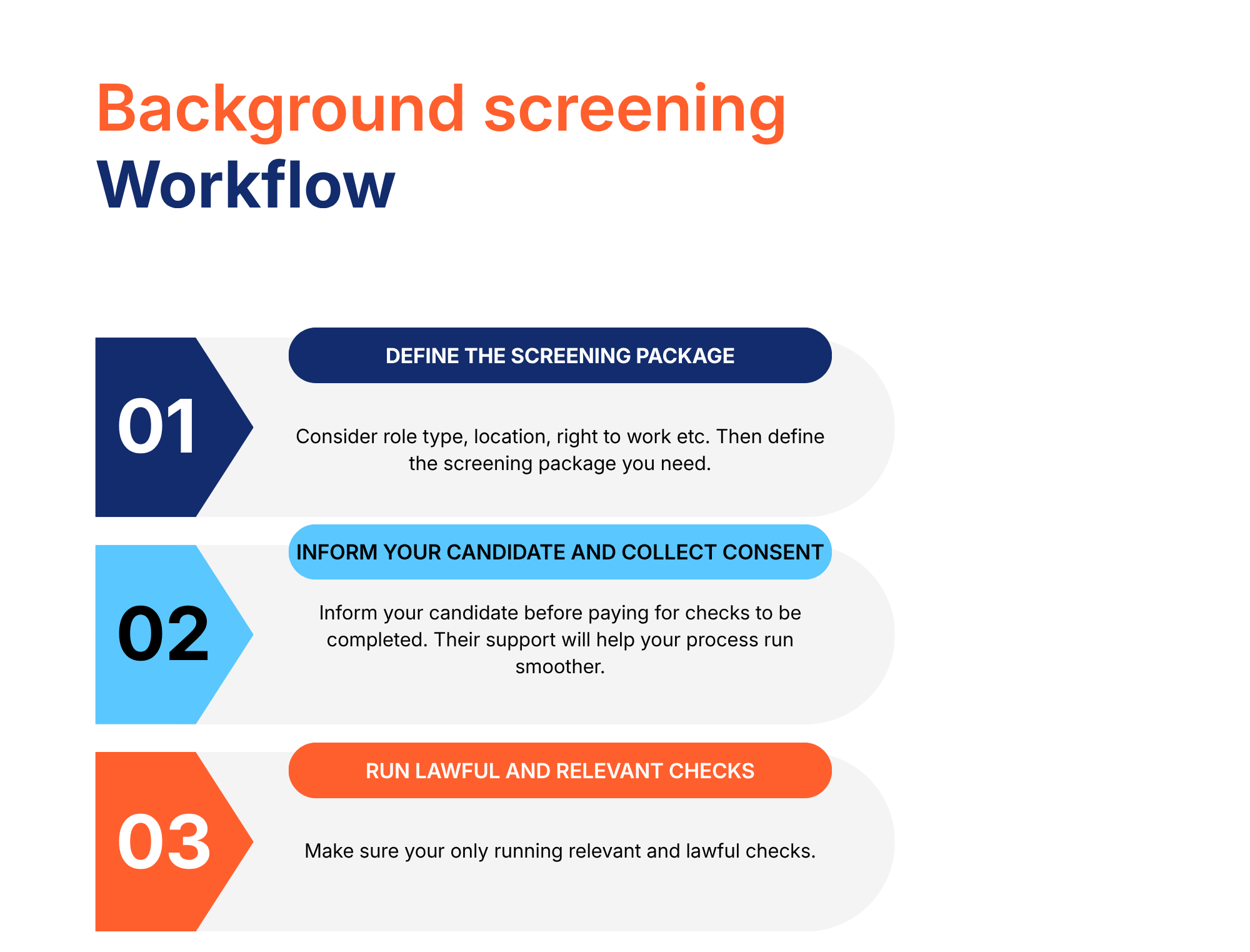
1. Confirm the hiring country and employment model
Start with where the person will work, not where your company is based. Screening rules usually depend on the candidate’s work location, local employment law and the nature of the role. This affects right to work checks, payroll obligations, data processing and what screening is reasonable.
Confirm whether the person will be:
- A direct employee
- A contractor
- A temporary worker
- Employed through an employer of record
- Working remotely across borders
2. Match you screening checks to the role
Screening should be proportionate. A finance director, warehouse operative, software engineer and school worker should not all go through the same package by default.
Veremark’s background checks page shows how different checks can be selected based on role, country and hiring risk.
3. Get candidate consent before checks begin
Consent and notification rules vary by country, yet the practical principle is consistent: candidates should know what will be checked, why it is needed, who will process the data and how the result may be used.
Do not rely on vague wording buried in an application form. Give candidates clear information before screening starts. For US hires, FCRA rules require employers to make specific disclosures and follow set steps when consumer reports are used for employment decisions. (Federal Trade Commission)
4. Check local restrictions before ordering criminal record checks
Criminal record checks are one of the highest-risk areas in global screening. Some countries restrict access to criminal records. Others only allow checks for certain roles. In some markets, spent convictions, rehabilitation periods or privacy rules limit what can be considered.
Before ordering a check, confirm: whether the check is lawful in that country and whether the role justifies it.
For roles where a criminal record check is relevant, Veremark’s criminal record check service gives HR teams a structured route rather than leaving recruiters to manage country-by-country processes manually.
5. Verify right-to-work before the start date
Different countries have their own immigration and work authorisation rules, especially for remote workers, cross-border workers and sponsored employees.
Your process should confirm:
- Work authorisation status
- Visa or permit conditions
- Expiry dates
- Follow-up check dates
- Any restrictions on hours, role type or location
Veremark’s right to work check includes consent, passport checks, ID validation, imposter checks and manual right to work review.
6. Set data retention rules before collecting reports
Screening reports contain sensitive personal information. HR teams should decide retention periods before collection, not after a candidate has been hired or rejected.
Under UK GDPR, criminal offence data needs a specific condition for processing, and consent may not be valid as the lawful basis in an employment context where the candidate has limited real choice. (ICO)
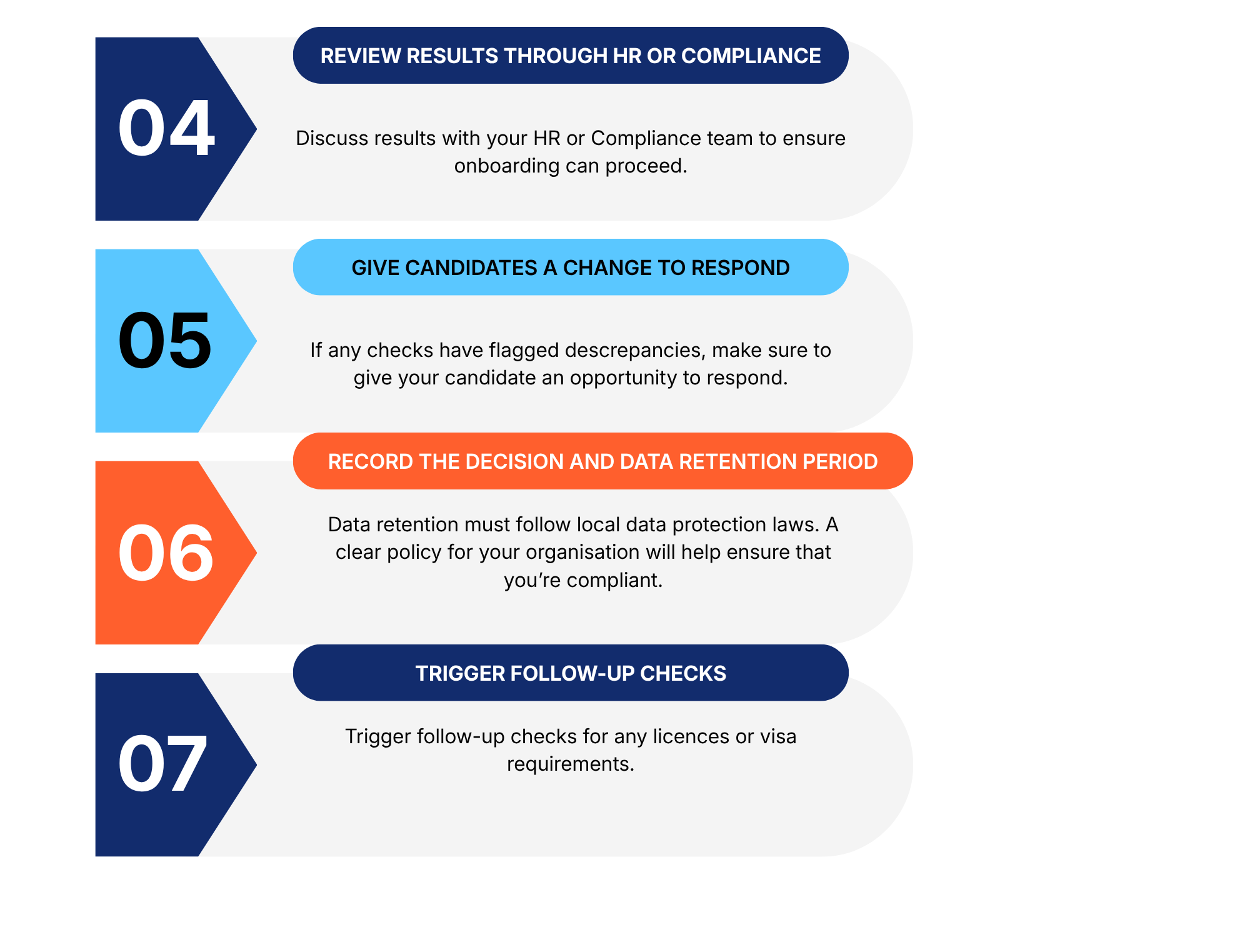
7. Build an adverse findings process
A screening issue should not automatically end a hiring process. The candidate may have an explanation. The record may be wrong. The finding may be irrelevant to the role.
Your adverse findings process should include:
- Internal review by HR or compliance
- A relevance assessment against the role
- Candidate notification where required
- Time for the candidate to respond or dispute the result
- A documented final decision
For US roles covered by the FCRA, employers must follow adverse action notice requirements when a decision is based on a consumer report. (Federal Trade Commission). Walgreens agreed to settle a class action concerning alleged Fair Credit Reporting Act breaches in its background screening process. The case alleged that some applicants were disqualified based on background reports without being given proper notice and time to respond before the decision was final. Walgreens did not admit wrongdoing.
Here's where most screening processes actually HR go wrong
Most screening failures come from process gaps rather than bad intent. The most common mistakes are ordering the same checks for every country, collecting more data than needed, screening too late, skipping local legal review and failing to document why a decision was made. Another frequent issue is treating global screening as a supplier task. A provider can run checks, but the employer still owns the hiring decision.
A global background screening checklist works best when it is linked to your applicant tracking system, offer process and onboarding controls. Recruiters should know which checks apply before they speak to the candidate about timescales. Hiring managers should know that a pending check means the hire is not yet cleared to start.
This gives recruiters speed without losing control. It also helps senior HR leaders show that screening decisions are consistent, fair and auditable.
A global background screening checklist will not remove every compliance risk. It will remove avoidable inconsistency. For HR teams hiring across borders in 2026, that is the difference between a fast process and a defensible one.
.jpg)


.webp)
FAQs

This depends on the industry and type of role you are recruiting for. To determine whether you need reference checks, identity checks, bankruptcy checks, civil background checks, credit checks for employment or any of the other background checks we offer, chat to our team of dedicated account managers.
Many industries have compliance-related employment check requirements. And even if your industry doesn’t, remember that your staff have access to assets and data that must be protected. When you employ a new staff member you need to be certain that they have the best interests of your business at heart. Carrying out comprehensive background checking helps mitigate risk and ensures a safer hiring decision.
Again, this depends on the type of checks you need. Simple identity checks can be carried out in as little as a few hours but a worldwide criminal background check for instance might take several weeks. A simple pre-employment check package takes around a week. Our account managers are specialists and can provide detailed information into which checks you need and how long they will take.
All Veremark checks are carried out online and digitally. This eliminates the need to collect, store and manage paper documents and information making the process faster, more efficient and ensures complete safety of candidate data and documents.
In a competitive marketplace, making the right hiring decisions is key to the success of your company. Employment background checks enables you to understand more about your candidates before making crucial decisions which can have either beneficial or catastrophic effects on your business.
Background checks not only provide useful insights into a candidate’s work history, skills and education, but they can also offer richer detail into someone’s personality and character traits. This gives you a huge advantage when considering who to hire. Background checking also ensures that candidates are legally allowed to carry out certain roles, failed criminal and credit checks could prevent them from working with vulnerable people or in a financial function.
Trusted by the world's best workplaces




APPROVED BY INDUSTRY EXPERTS
.png)
.png)



and Loved by reviewers


Transform your hiring process
Request a discovery session with one of our background screening experts today.