
How should HR handle a criminal record check result in Australia?


When you receive a criminal record check result in Australia, your next step should depend on what the result reveals, how it relates to the role and whether the information is accurate. A disclosed criminal history should never trigger automatic rejection unless a specific legal requirement makes the candidate ineligible. You need a consistent process that protects your organisation while giving candidates a fair opportunity to explain their circumstances.
The Australian Standard for Workforce Screening, AS 4811:2022, provides a framework for making these decisions. It encourages organisations to assess workforce risks through documented screening policies, with an emphasis on suitability throughout the employment lifecycle.
What does a criminal record check result actually mean?
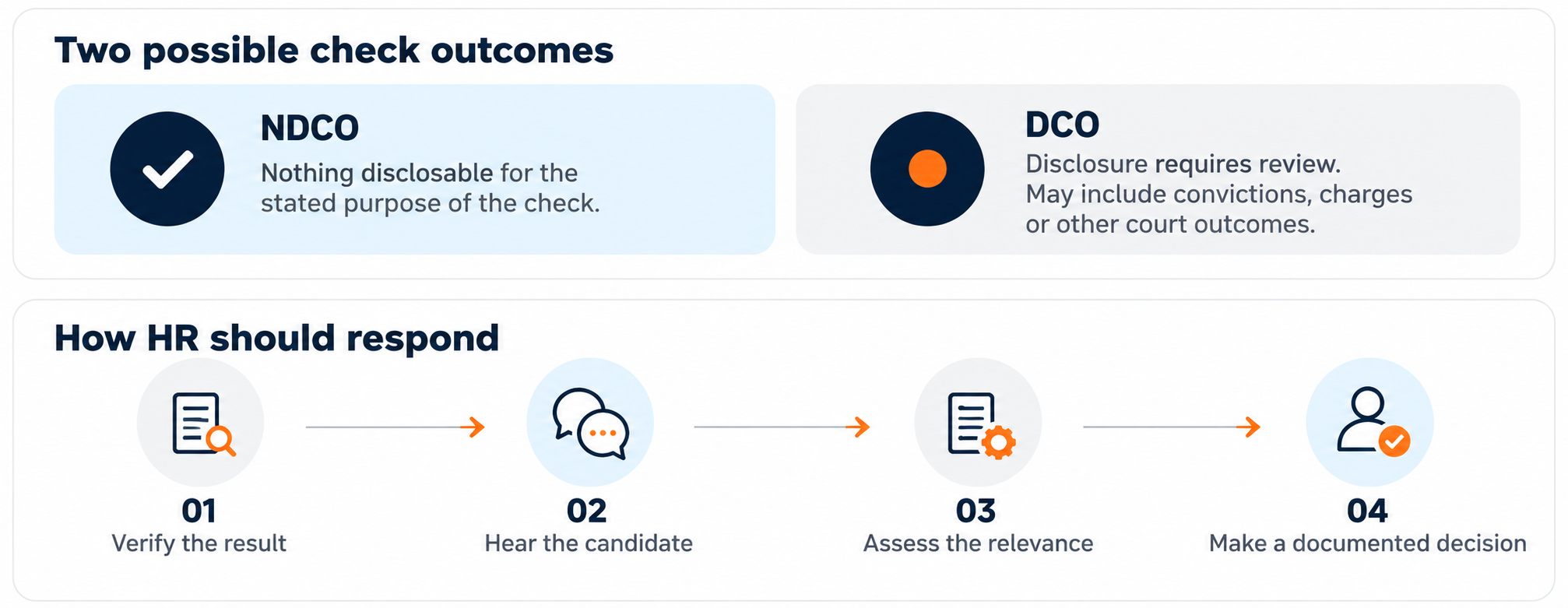
An Australian Nationally Coordinated Criminal History Check typically returns one of two outcomes:
- No Disclosable Court Outcomes (NDCO): No police information can be disclosed for the stated purpose of the check. This does not necessarily mean the individual has never had a criminal record.
- Disclosable Court Outcomes (DCO): Police information can be released, potentially including convictions, charges, findings of guilt without conviction, pending matters or certain court orders.
A DCO requires further assessment. It does not automatically establish that the candidate is unsuitable for employment.
According to the Australian Criminal Intelligence Commission (ACIC), approximately 30% of police checks are referred for further assessment because a potential match has been identified. These referrals can occur when applicants share similar identifying details with people in police databases.
A potential match is therefore not evidence of criminal conduct. HR should wait for the final verified result before making any judgement.
Even when the result is confirmed, you need to distinguish between convictions, pending charges and other disclosed information. A charge that has not been determined by a court should not be treated as a conviction.
How does the Australian Standard (AS 4811:2022) guide HR decisions around criminal record checks?
The Australian Standard AS 4811:2022 replaced the earlier AS 4811:2006 employment screening standard. Its scope extends beyond recruitment to workforce screening policies and ongoing personnel risk management.
The standard encourages organisations to establish screening processes that reflect the risks associated with particular positions and access to organisational assets.
For HR, this means deciding how to handle adverse screening findings before those findings occur.
Your policy should identify who reviews criminal history disclosures, how suitability is assessed, when legal advice is necessary and who has authority to make a final decision.
AS 4811:2022 is a voluntary Australian Standard. It does not override employment, privacy or anti-discrimination legislation, and following it alone does not establish legal compliance.
At Veremark, we recommend connecting your criminal record assessment to a wider screening policy that includes identity verification, employment history and relevant professional credentials. Our Australian workforce screening package is designed around the standard's risk-based approach.
Assess whether the criminal record is relevant to the role
The central question is whether the disclosed information affects the candidate's ability to perform the inherent requirements of the position.
Consider a candidate applying for a finance role involving direct access to client funds. A recent conviction for financial dishonesty may raise legitimate concerns requiring further assessment.
Now consider someone applying for an administrative role with an unrelated minor offence from 12 years ago. The connection to their responsibilities may be difficult to establish.
You should assess the nature and seriousness of the offence, how long ago it occurred, the candidate's age at the time and any evidence of subsequent rehabilitation. You should also consider the responsibilities of the position and any legal restrictions that apply.
The Australian Human Rights Commission recommends assessing criminal history against the inherent requirements of the particular job.
Criminal record discrimination is not generally unlawful under federal discrimination law, although the Commission can investigate employment complaints. Specific state and territory protections, including those in Tasmania and the Northern Territory, may also apply.
Certain regulated positions require additional care. Working with children, disability services and some licensed occupations have statutory screening requirements that can restrict eligibility regardless of an employer's own assessment.
A National Police Check also does not replace a required Working with Children Check or NDIS worker screening clearance.
For further guidance on these distinctions, see our article on building a compliant screening policy in Australia.

Give the candidate an opportunity to respond
Before making an adverse employment decision, speak privately with the candidate.
Explain which information has raised concerns and why it might be relevant to the position. Give them a reasonable opportunity to clarify the circumstances or identify inaccuracies.
For example, a candidate may explain that a disclosed charge was subsequently withdrawn, or that a matter recorded against them belongs to another individual.
The ACIC provides a formal dispute process for incorrect police check results. Candidates can raise disputes through the accredited screening provider or police agency that submitted the check.
Where accuracy is disputed, you should avoid finalising an adverse decision until the relevant information has been reviewed, unless a separate legal obligation requires immediate action.
This is also where consistency matters. Candidates with comparable findings applying for comparable positions should be assessed using the same criteria, while allowing for their individual circumstances.
Your responsibility is to make a reasoned decision using verified information.
Protect candidate privacy and understand spent convictions
Criminal history information is classified as sensitive information under Australia's Privacy Act 1988.
Under the ACIC's National Police Checking Service, candidates must provide informed consent for the check and its intended use.
Access to criminal history reports should be restricted to authorised personnel who genuinely need the information. Reports should be stored securely and retained only for an appropriate period, subject to applicable legal and contractual requirements.
Spent convictions require particular attention.
Under Commonwealth, state and territory spent convictions arrangements, certain older offences may no longer need to be disclosed. The applicable rules and exceptions depend on the jurisdiction and purpose of the check.
The Office of the Australian Information Commissioner explains that Commonwealth spent conviction protections can prohibit unauthorised disclosure and consideration of protected information, subject to exceptions.
If a candidate believes that a spent conviction has been incorrectly disclosed, refer the matter for review rather than relying on the information immediately.
Make a documented decision and communicate it clearly
Once the information has been verified and the candidate has responded, HR should make a decision based on the position's requirements and your organisation's screening policy.
Document the relevant facts, the job-specific risk assessment, the candidate's explanation and the reasons for the outcome.
Where a finding does not create an unacceptable risk or legal barrier, you can proceed with employment.
Where the risk remains material, consider whether reasonable controls, adjustments to duties or alternative positions could address it. In regulated roles, confirm whether those options are legally permitted.
If you decide to withdraw an offer or take action against an existing employee, obtain appropriate legal advice and communicate the decision respectfully. Existing employees may have additional contractual and employment law protections.
Veremark's guide to reading background check reports explains how HR teams can review findings and follow up on discrepancies before finalising decisions.
Build a repeatable approach to criminal record screening
Handling a criminal record check result in Australia should follow an established decision-making process rather than individual hiring managers' preferences.
AS 4811:2022 provides a useful foundation because it connects screening to the risks associated with a person's responsibilities and access. It also recognises that workforce suitability may need to be reviewed as circumstances change.
The ACIC confirms that a police check is a point-in-time assessment. A clear result today does not guarantee that circumstances will remain unchanged.
For HR, the practical priority is to maintain documented assessment criteria, review procedures and appropriate screening requirements for different positions.
That gives you a defensible basis for responding when criminal history information is disclosed, while ensuring each candidate receives a fair and properly considered assessment.
.png)
Read More
.jpg)




%20(2).jpg)
FAQs

This depends on the industry and type of role you are recruiting for. To determine whether you need reference checks, identity checks, bankruptcy checks, civil background checks, credit checks for employment or any of the other background checks we offer, chat to our team of dedicated account managers.
Many industries have compliance-related employment check requirements. And even if your industry doesn’t, remember that your staff have access to assets and data that must be protected. When you employ a new staff member you need to be certain that they have the best interests of your business at heart. Carrying out comprehensive background checking helps mitigate risk and ensures a safer hiring decision.
Again, this depends on the type of checks you need. Simple identity checks can be carried out in as little as a few hours but a worldwide criminal background check for instance might take several weeks. A simple pre-employment check package takes around a week. Our account managers are specialists and can provide detailed information into which checks you need and how long they will take.
All Veremark checks are carried out online and digitally. This eliminates the need to collect, store and manage paper documents and information making the process faster, more efficient and ensures complete safety of candidate data and documents.
In a competitive marketplace, making the right hiring decisions is key to the success of your company. Employment background checks enables you to understand more about your candidates before making crucial decisions which can have either beneficial or catastrophic effects on your business.
Background checks not only provide useful insights into a candidate’s work history, skills and education, but they can also offer richer detail into someone’s personality and character traits. This gives you a huge advantage when considering who to hire. Background checking also ensures that candidates are legally allowed to carry out certain roles, failed criminal and credit checks could prevent them from working with vulnerable people or in a financial function.
Trusted by the world's best workplaces




APPROVED BY INDUSTRY EXPERTS
.png)
.png)



and Loved by reviewers


Transform your hiring process
Request a discovery session with one of our background screening experts today.