
Build a clearer picture of workplace conduct management with benchmarking and board-ready analytics


Your board cannot oversee risks it cannot see. Yet information about staff conduct may be spread across inboxes, spreadsheets, HR files, survey data, exit interview data, insurance claims, and conversations with line managers. By the time it reaches directors, the detail may have been reduced to a case total or a short summary of the most serious incidents.
That leaves important questions unanswered. How quickly are disclosures being assessed? Which types of concerns are increasing? How many investigations remain open? Are cases being resolved consistently across your organisation? What part of the organisation is there a growing problem? Is the workplace safe?
Strong workplace conduct reporting gives you the insights to be ahead of these unknown risks, Veremark’s whistleblowing solution ticks all of those boxes. Allow me to explain…
Reporting volume alone tells you very little
A low number of disclosures may look reassuring. It may also indicate that your employees do not know where to report, find the process difficult or fear being identified.
You therefore need to give your board more context than a quarterly case total. Directors need to understand how employees can report concerns, how cases are handled and what outcomes are being recorded.
Industry benchmarks built in
Veremark’s industry benchmarks help you benchmark your organisation’s reporting volume and response times, for example, you might see an average of 1.4 disclosures per 100 employees in your industry.
.png)
Dashboard oversight
Useful oversight should include the number of open and closed reports, average triage and closure times, the categories of conduct being reported, the proportion of allegations that are substantiated and changes in volume over time.
The analytics dashboard gives you a clear view of:
- Total reports made this quarter, so you can monitor reporting volume and compare activity against industry benchmarks
- Time to triage, showing how quickly new disclosures are reviewed
- Time to close, helping you track investigation duration and identify delays
- Substantiation, showing how many reports are upheld following investigation
- Open cases, giving you an immediate view of the current caseload
- Category breakdown, helping you identify the most common types of misconduct being reported
Whistleblowing Management Standards (ISO 37002) makes clear that whatever your process is, however many systems or processes you have across your business - they need to coordinate with one another for your business to continually improve.
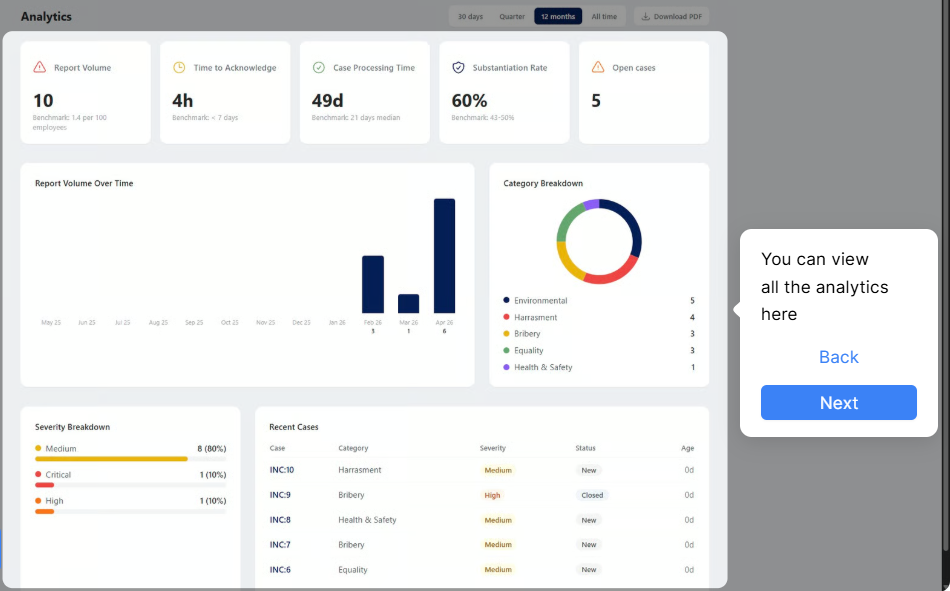
These measures help you explain what is happening beneath the headline figures. They can also expose operational weaknesses, including slow triage, inconsistent categorisation or a growing backlog of investigations.
Better analytics begin with an easier reporting process
The quality of your board reporting depends on the quality of the information entering your system.
Your employees need to be able to raise concerns without the complications of creating an account on yet another software, and they need to have the option to remain completely anonymous. Veremark’s system offers all of this, as well as visual category tiles and guided questions give them a clear route from initial concern to completed submission.
Easy reporting without the need to login
.png)
Our design supports higher reporting rates because employees can understand the process quickly and share information without unnecessary barriers. Guided questions also help you collect the details needed to assess a disclosure and decide what should happen next.
Guided questions help you immediately identify the serious nature of the report
.jpg)
You can read more about this approach in Veremark’s guidance on collecting high-quality information from whistleblowers.
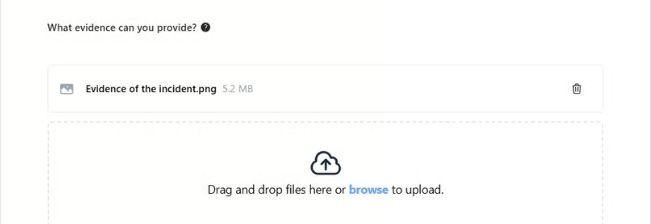
Anonymity does not have to end communication. Veremark allows you to communicate securely with the person who raised the concern while protecting their identity. Your investigators can request evidence, clarify dates or ask follow-up questions without compromising trust.
The complainant can upload evidence directly to the platform
Move from scattered case files to consistent oversight
Conduct cases can involve your HR, Compliance and Legal teams, as well as senior management and external investigators. When each group has different roles within that process, it becomes difficult for you to establish a single account of what happened and how the organisation responded.
A single place to triage and manage disclosures
Veremark gives authorised users one place to triage disclosures, manage investigations and record progress. Disclosures arrive categorised, helping your handling team assess the type of concern and route it appropriately.
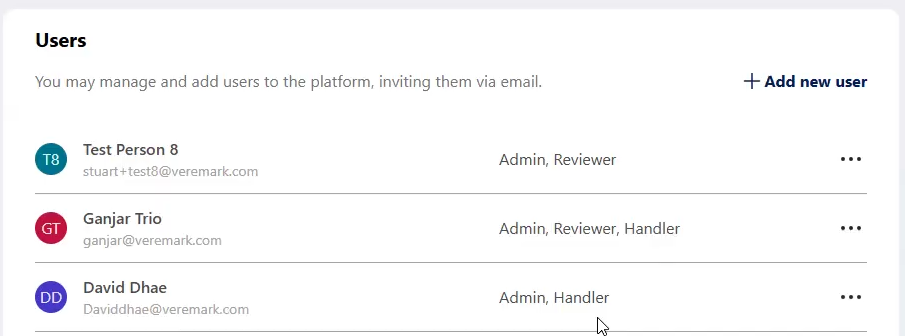
Employees are directed to categorise their incident report at the time they raise the incident. Your admin team can create your own categories during setup, and easily filter your reports. This view also shows you things like the status of the report and the deadline to closure.
Tailored configuration
You can configure the platform around your organisation’s structure, policies and regulatory duties. Core principles around security, anonymity and sound case handling remain protected, while workflows and programme materials can be adapted to suit your business.
.png)
This matters because workplace conduct reporting should support the way your organisation responds in practice. A generic form followed by manual case management often creates gaps between the initial disclosure and the final outcome.
A central record makes those gaps easier for you to find. It also creates a clearer audit trail showing when the report arrived, who assessed it, what action was taken and how the matter was resolved.
Give your directors a report they can understand
Your board needs enough detail to challenge management without receiving confidential case files or pages of operational data.
Veremark’s analytics dashboard gives you a clear summary of disclosure activity and case progress. You can then download the dashboard as a PDF for board reporting.
This gives you a repeatable way to present conduct information. It also helps your directors compare reporting periods and ask better questions.
A rise in harassment reports, for example, may justify a review of a particular function, location or management layer. Longer closure times may point to resource constraints or unclear responsibility for investigations. A high number of open cases may show that your investigation process needs additional capacity.
You can also use the same data to assess whether changes are working. After introducing manager training or updating a policy, you can monitor reporting patterns, case quality and resolution times rather than relying on anecdotal feedback.
Veremark’s case study on strengthening board oversight at GEO Pressure Systems shows how a single online channel can help directors track concerns and see how they have been handled from submission to resolution.
.png)
Treat reporting data as an early risk signal
Your conduct data should inform decisions before an issue becomes a public failure, regulatory breach or costly employment dispute.
Patterns across disclosures can point to wider weaknesses. Several reports involving the same team may suggest a management problem. Repeated delays may show that case ownership is unclear. A high number of unsubstantiated cases could indicate poor initial information, inconsistent assessment or a need for better employee guidance.
These signals become easier for you to identify when reports follow a consistent structure and remain connected to the investigation record.
Effective workplace conduct reporting also gives you a more credible basis for discussing culture. Employee survey results can show you how people feel, while disclosure data shows you which concerns people are prepared to raise and how your organisation responds when they do.
When reviewing your current reporting channel, Veremark’s guide to anonymous whistleblowing channels explains how secure reporting, structured information and case management work together.
Give your board a clearer view of conduct risk
Your reporting channel should do more than receive complaints. It should help you assess concerns promptly, manage investigations consistently and show directors where risk may be building.
Veremark connects an accessible employee reporting experience with secure case management and board-ready analytics. You gain clearer oversight, while your employees gain a reporting route designed to protect their identity and make speaking up easier.
When you rely on inboxes, spreadsheets or basic hotlines, gaps are harder to spot and explain. Better workplace conduct reporting gives you a usable record of concerns, responses and outcomes.
Let's connect
You connect with me on LinkedIn or Book a demo with me to see how the platform can support anonymous reporting, investigation management and clearer board oversight in your organisation.

Read More
.jpg)



.png)

FAQs

This depends on the industry and type of role you are recruiting for. To determine whether you need reference checks, identity checks, bankruptcy checks, civil background checks, credit checks for employment or any of the other background checks we offer, chat to our team of dedicated account managers.
Many industries have compliance-related employment check requirements. And even if your industry doesn’t, remember that your staff have access to assets and data that must be protected. When you employ a new staff member you need to be certain that they have the best interests of your business at heart. Carrying out comprehensive background checking helps mitigate risk and ensures a safer hiring decision.
Again, this depends on the type of checks you need. Simple identity checks can be carried out in as little as a few hours but a worldwide criminal background check for instance might take several weeks. A simple pre-employment check package takes around a week. Our account managers are specialists and can provide detailed information into which checks you need and how long they will take.
All Veremark checks are carried out online and digitally. This eliminates the need to collect, store and manage paper documents and information making the process faster, more efficient and ensures complete safety of candidate data and documents.
In a competitive marketplace, making the right hiring decisions is key to the success of your company. Employment background checks enables you to understand more about your candidates before making crucial decisions which can have either beneficial or catastrophic effects on your business.
Background checks not only provide useful insights into a candidate’s work history, skills and education, but they can also offer richer detail into someone’s personality and character traits. This gives you a huge advantage when considering who to hire. Background checking also ensures that candidates are legally allowed to carry out certain roles, failed criminal and credit checks could prevent them from working with vulnerable people or in a financial function.
Trusted by the world's best workplaces




APPROVED BY INDUSTRY EXPERTS
.png)
.png)


and Loved by reviewers


Transform your hiring process
Request a discovery session with one of our background screening experts today.