
Run checks to confirm a driver’s licence is valid, see the categories they’re entitled to drive, and see the penalty points you won’t find on a photocard.


The importance of DVLA checks
If someone drives for you, their licence is your exposure.
You have a duty of care for anyone driving for your business, whether in a company vehicle, a hire vehicle or their own car on a grey fleet.
That duty doesn’t pause between annual reviews. Your driver can accumulate points, or lose their licence entirely in the weeks after you last checked.
The practical failure is nearly always the same. The licence was checked once at onboarding, filed, and never looked at again.
A driving licence proves the person once passed a test. It doesn’t show current penalty points, recent disqualifications, motoring convictions, or whether the licence has since been revoked or expired. This means it tells you almost nothing about risk.
Meanwhile insurance terms assume you’re checking, and an incident involving an unlicensed or disqualified driver becomes a question about your process rather than theirs.
Checking against the DVLA record, rather than the plastic, closes that gap, and re-checking on a set cycle keeps it closed.
Here’s what a DVLA check returns
- Licence validity and type: Whether the licence is full, provisional, expired, revoked, suspended or disqualified.
- Vehicle categories: The classes the driver is entitled to drive, so you can confirm a candidate can legally operate an HGV, van, minibus or passenger vehicle before they start.
- Endorsements and offences: Current penalty points, the offence codes behind them, disqualification periods and endorsement expiry dates.
When should you consider a DVLA check?
- Pre-employment and periodic screening for any role that involves driving
- HGV, LGV, van and passenger vehicle drivers, where the category entitlement is the point
- Couriers, field engineers and mobile sales teams
- Anyone issued a company car or fuel card
- Grey fleet drivers using their own vehicle for work


Trusted by the world's best workplaces




PROVEN
.png)
.png)



and Loved by reviewers


See the live record
Checked against DVLA data, not a photocopy of a photocard.
Categories confirmed
Verify the driver is entitled to the class of vehicle the job needs.
Points and bans visible
See current endorsements and disqualifications, with expiry dates.
No credentials stored
The check code is time-limited and the licence data isn’t retained as loose credentials.
Scheduled re-checks
Set a recheck cycle by role rather than relying on someone remembering.
Part of the wider check
Run it alongside criminal record, right to work and reference checks in one request.
We check the driving licence against the DVLA’s own data. Using the check code that the driver generates on GOV.UK; we return licence status, categories they can drive, and endorsements in one single report.
We guide the driver through generating that code, collect it on the same form as the rest of their details, retrieve the record, and return a structured report to you.
Our DVLA check gives you:
- Licence status: full, provisional, expired, revoked or disqualified
- The vehicle categories the driver is entitled to drive
- Current endorsements, penalty points and disqualification history
- Licence and photocard expiry dates, so renewals don’t lapse unnoticed
How it works
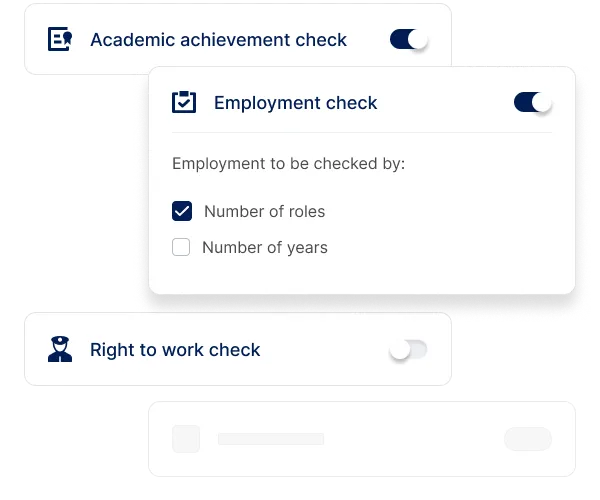
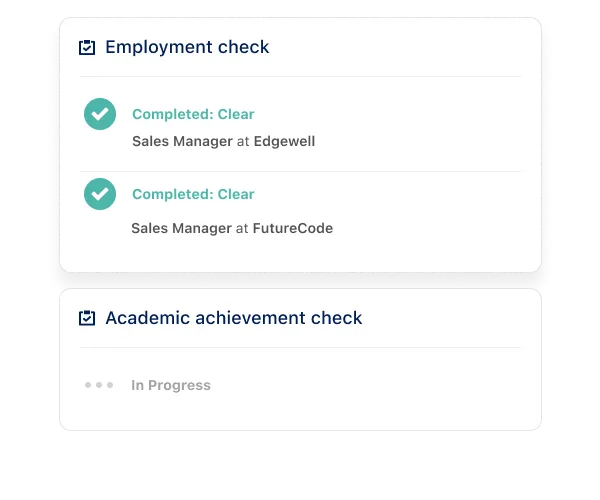
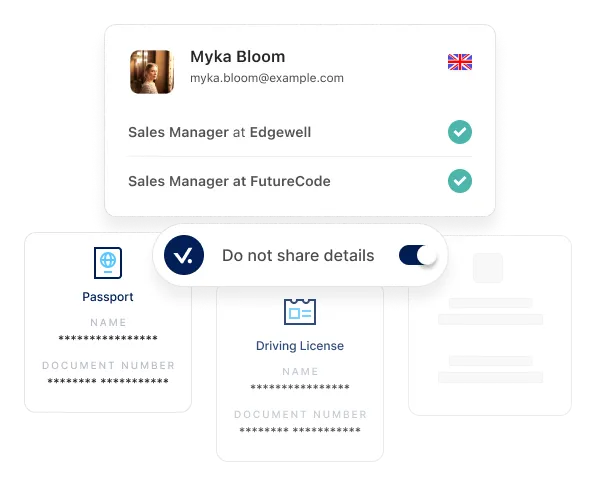


.jpg)


FAQs

A check of a driver’s official record held by the Driver and Vehicle Licensing Agency. It confirms licence validity, the vehicle categories they can drive, and any endorsements, penalty points or disqualifications.
A driving record is personal data, so the DVLA only releases it with the driver’s involvement. The driver generates a one-time code on GOV.UK that gives a named party temporary access to view their record. The code is valid for 21 days.
The postcode has to match the address the DVLA holds. Drivers who’ve moved and not updated their licence are the usual cause. The check flags the mismatch and Veremark’s support team works with the driver to resolve it.
Yes. That’s the main reason to run it. Photocards don’t display current endorsements, so points, offence codes and disqualifications are only visible on the DVLA record.
Once the driver has submitted their check code, the record is retrieved from the DVLA and returned to your dashboard.
Yes. Set a recheck cycle, for example quarterly for high-mileage or HGV drivers and annually for the rest, so licence status is monitored rather than assumed.
Driving licences in Northern Ireland are issued by the DVA, which operates separately from the DVLA. Confirm coverage before running checks on NI-licensed drivers.
The DVLA record covers GB licences. Drivers holding a licence issued elsewhere need a check in the country that issued it.
The driver generates the code and can view their own record on GOV.UK at any time. The report you receive is the same record, structured.
Yes. Order it on its own or as part of a package with criminal record, right to work, identity and reference checks in a single request.
Start with any check. Connect the rest.
Most clients start with one check and add the rest when they’re ready. Nothing has to be bought together to work together.