
Compare Veremark to traditional background screening providers


Background screening used to be the hiring equivalent of sending a fax and hoping for the best. A request went in, updates came slowly, and HR teams spent too much time chasing answers that should have been visible from the start.
That worked when hiring moved at a gentler pace. It works less well when candidates expect quick communication, hiring managers want start dates confirmed, and teams are recruiting across several countries at once.
The question of who to choose as your screening provider comes down to one thing: whether your screening process identifies real risk and helps hiring move forward, or quietly gets in the way.
What the industry is missing: the risks the data shows
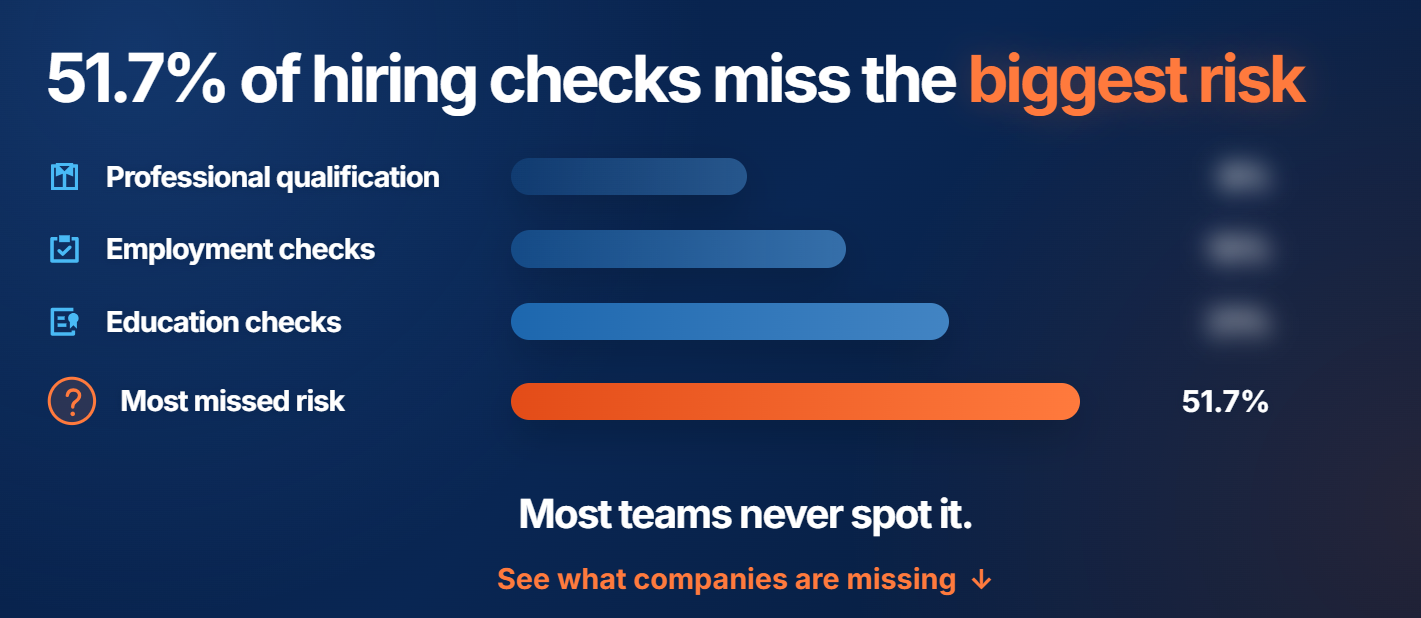
Veremark's 2026 Screening Benchmark Report drew on a snapshot of screening checks completed across the Veremark customer base in 2025. This report analyses close to half a million background checks throughout 2025. Five findings stand out.
A structural misalignment exists in how most screening programmes are weighted.
Database checks (sanctions, criminal record, ID verification, financial history, right to work) account for 58% of all screening volume, and up to 80% in Financial Services. These checks flag discrepancies under 1% of the time. Education and employment verification checks, which flag at 21.1% and 15.3% respectively, are treated as add-ons in many standard packages. The checks most programmes rely on most heavily are the checks least likely to catch anything.
More than half of all CV gap checks flag an unexplained discrepancy.
At 51.7%, this is the highest discrepancy rate of any check type in the dataset. Unexplained gaps in employment history are the single most common finding, and one of the most frequent indicators of a fabricated or embellished career narrative. Despite this, CV gap checks are rarely included in standard screening packages.
Screening depth varies fivefold across industries.
Capital Markets averages 13.1 checks per hire. Business Services, the highest-volume vertical by request count, averages 2.5. The difference reflects regulatory and risk environments, but many organisations have never compared their depth against an external benchmark.
81% of employers have no form of post-hire screening.
PBSA data shows only 19% of employers include any continuous monitoring. For the majority, the check completed at onboarding is the only verification that will ever be conducted, regardless of how long the person remains in the role or how their circumstances change. The FCA already requires annual reassessment under SM&CR. The UK Home Office requires ongoing right to work verification for time-limited permissions. The gap between what regulators expect and what most organisations actually do is significant.
Education checks flagged four times more discrepancies than any other check.
22,329 of 423,937 completed checks flagged a finding. That rate is an average across all check types. For education checks alone, the rate is four times higher. For CV gap checks, it is ten times higher.
Download the full benchmark report.
Out with the old, in with the new: The future of screening demands clearer insight and control for HR teams
Traditional screening providers were often built around heavy enterprise processes. They can handle large volumes, but the experience can feel slow, rigid and oddly mysterious. Like ordering a parcel with no tracking number, except the parcel is your new finance director.
For HR teams, the usual frustrations are familiar: unclear timelines, manual forms, slow support, fixed packages and limited visibility. None of these problems are dramatic on their own. Together, they create delays at one of the most sensitive points in the hiring process.
Veremark takes a more modern approach. Our background checks are digital, agile, and built to give teams clearer control over what is happening and when.
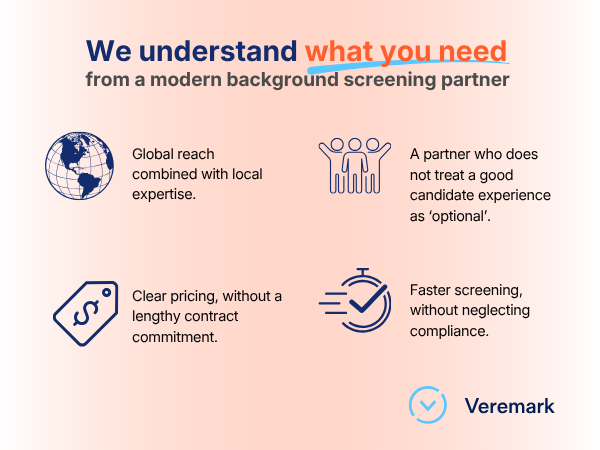
Global reach only matters if it comes with local compliance expertise
International hiring creates local obligations. Consent rules, data handling standards, document requirements and the availability of records differ by country. A provider with limited regional knowledge can create delays or expose the employer to avoidable risk.
Veremark’s position is clear: one platform, 180+ countries, local compliance built into the process. For hiring teams, that means fewer supplier handovers, fewer inconsistent candidate journeys and a clearer way to manage screening by role and location.
This is one of the main differences between Veremark and many traditional background screening providers. The value is not only that a check can be done overseas. The value is that the process is structured to reflect local rules, while still giving the employer a consistent operating model.
Candidate experience can not be optional
Candidates do not think, “This screening process is poor, but I’m sure the employer is excellent.” They experience it as part of the job offer.
If the process is clunky, repetitive or confusing, it reflects badly on the employer. That matters when a candidate may still be speaking to other companies, or wondering whether to accept the role. Veremark is designed to make the process clearer for candidates, with a simple digital experience that works without endless back-and-forth.
A good screening process should not feel like a test of patience before someone has even started the job.
Faster screening is essential for the organisation
Slow screening creates real problems. Start dates slip. Hiring managers get frustrated. Candidates lose confidence. HR teams become the unpaid support desk for a process they do not fully control.
Traditional providers can be slower because their workflows often rely on manual steps, older systems or regional handovers. Veremark focuses on faster turnaround, clearer status updates and fewer manual touchpoints.
That matters even more for international hiring. A process that seems simple in one country can become messy when checks need to happen across different markets. Veremark’s global screening coverage helps employers run checks across countries while keeping the experience consistent.
Clear pricing matters
Screening pricing can get messy. Bundles, minimum spends, setup fees and extra charges can make it hard to know what you are really paying for.
That creates problems for teams that need flexibility. Veremark’s usage-based model gives teams a clearer way to choose the checks they need. That is useful for employers that want screening to match real hiring demand, rather than a contract written for a very different business.
What sets Veremark apart?
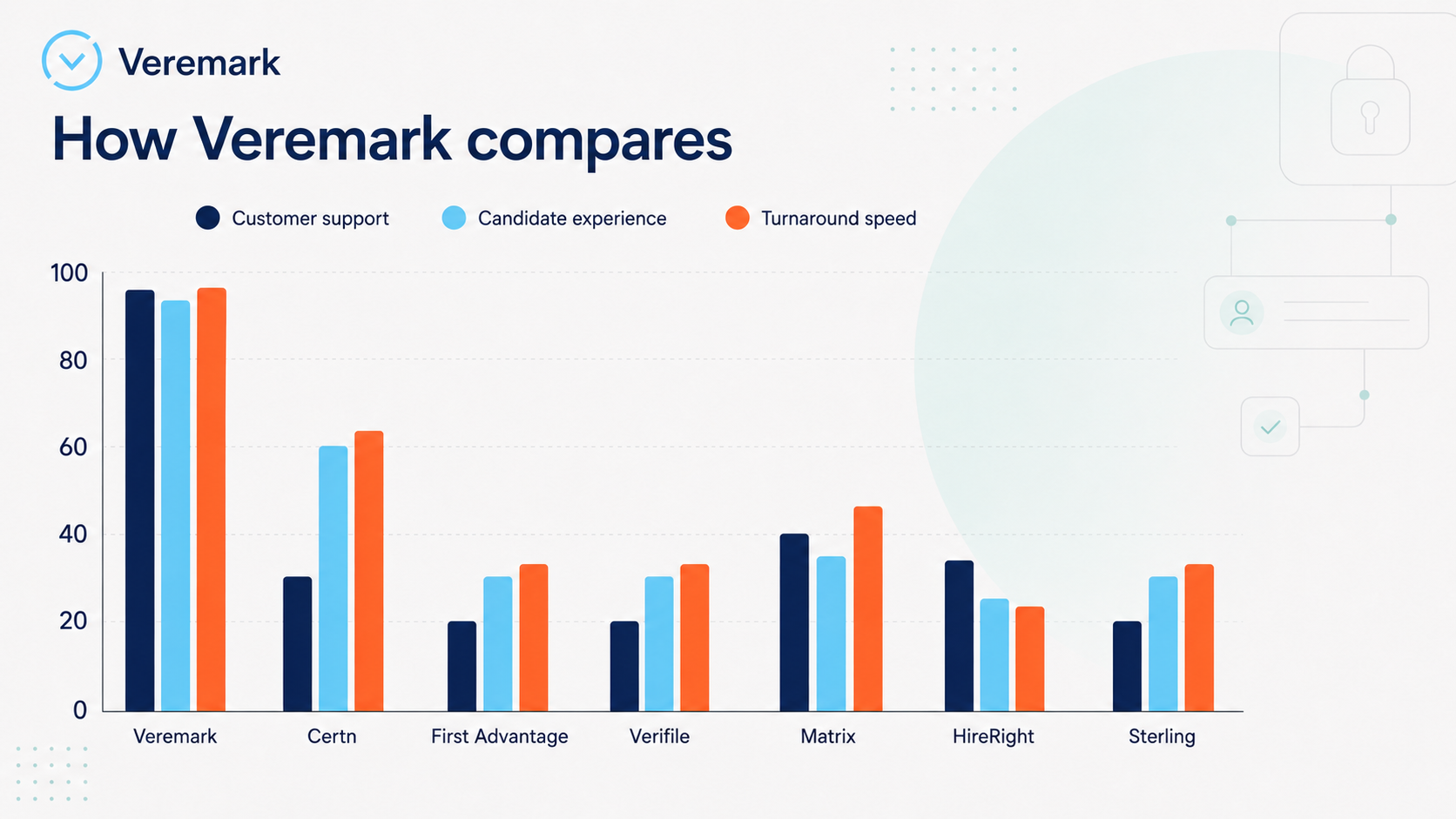
Veremark is trusted by more than 11,000 companies, including Wise, PepsiCo, Canva, Kuehne+Nagel, AXA, McDonald’s, Schneider Electric and Worley. We consistently outperform across all major buying considerations, including support, candidate experience, turnaround speed, integration flexibility, pricing transparency and product direction - making our solution the most balanced and reliable choice across global markets.
GDPR and PDPA-compliance is built in to our workflow
A modern screening provider needs to do more than return a report. It needs to help employers show that the process was proportionate, consent-led and secure.
Veremark is designed to support GDPR and PDPA-compliant screening, with digital handling of candidate data and governance built into the workflow. Our platform also integrates with ATS and HRIS platforms, including Rippling, HiBob, Ashby, SmartRecruiters, Workable, Greenhouse, Lever, Bullhorn, JobAdder, Teamtailor, iCIMS and LinkedIn TalentHub, as well as API functionality. (help.veremark.com)
That matters because compliance is weakest when teams move data between systems manually. Integrated workflows reduce duplication, cut down on chasing, and make it easier to see what has been requested, what is outstanding and what has been completed.
Enterprise security
Bank-grade encryption and military-level data protection. Your candidate information is safeguarded with industry-leading security standards, ensuring zero data breaches and complete peace of mind.
Speed & effeciency
Reduce time-to-hire by up to 80% with real-time verification updates and seamless integrations. Get candidates onboarded faster without compromising on thoroughness or compliance.
Expert support
Dedicated account managers and 24/7 expert support ensure your team succeeds. Get personalized guidance, proactive compliance updates, and priority assistance whenever you need it.
Reduce risk, hire faster, scale up.
Veremark leads in customer satisfaction, candidate experience, and turnaround speed
Based on reviews of responsiveness, satisfaction, and service quality, Veremark leads with consistently high ratings across Trustpilot, G2, and Capterra.
See more details on our comparison page
Read More



%20(1)%20(2)%20(2)%20(1).jpg)


FAQs

Partnering with specialised providers like Veremark allows financial institutions to access expert and up-to-date screening services, ensuring accuracy, compliance with global regulations, and streamlined processes that enhance the speed and efficiency of background checks.
Pre-employment screening is crucial for verifying the accuracy of an applicant's credentials and ensuring they meet the company's standards for integrity and reliability.
Yes, many employee onboarding software solutions include features that help ensure compliance with labour laws and industry regulations. This can include automated document collection, e-signature capabilities, and tracking of required background checks, training and certifications.
Trusted by the world's best workplaces




APPROVED BY INDUSTRY EXPERTS
.png)
.png)


and Loved by reviewers


Transform your hiring process
Request a discovery session with one of our background screening experts today.