
What is an adverse financial history check, and why do employers run one?


An adverse financial history check helps employers identify formal signs of financial distress that could create additional risk in roles involving money, client funds, financial decisions or regulated responsibilities.
In Veremark's 2025 data, the adverse financial history check flagged a discrepancy 7.4% of the time, the highest rate of any traditional background check. Employment verification flagged 1.8%, while criminal and sanctions checks came in close to zero.
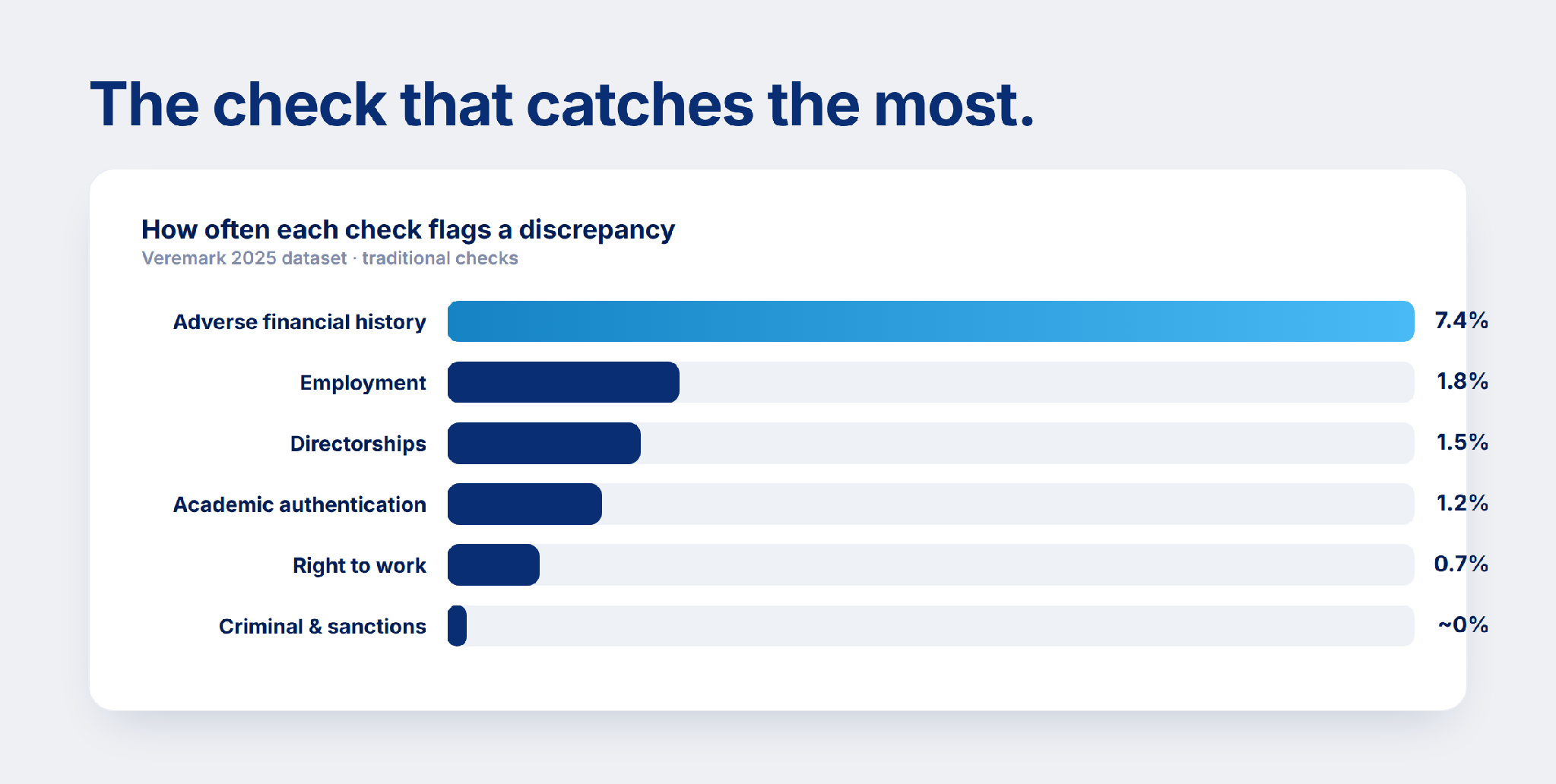
That makes adverse financial history screening particularly valuable for employers hiring into financially sensitive positions. Yet it is still frequently treated as an optional background screening add-on rather than a core part of a risk-based screening programme.
The check looks at how a candidate has managed financial obligations. It is not designed to assess whether someone would qualify for a loan or to rank candidates by their credit score.
For roles involving payments, client funds, procurement or significant financial authority, it can provide an important additional layer of pre-employment risk assessment.
What does an adverse financial history check include?
An adverse financial history check can identify formal markers of financial difficulty recorded against a candidate, including:
- County court judgments (CCJs)
- Individual voluntary arrangements (IVAs)
- Bankruptcies
- Defaults or missed payments
In the UK, certain adverse financial information can remain on a credit file for up to six years. The screening process uses regulated credit-reference data to report relevant financial events rather than providing employers with a consumer lending score.
The purpose is not to judge a candidate based on their wealth or personal circumstances. Employers are looking for information such as undisclosed insolvency, significant judgments or patterns of unmanaged financial difficulty that may be relevant to the responsibilities of the role.
For organisations looking to build a more comprehensive employee background screening process, financial history checks can therefore complement employment verification, identity checks, criminal record checks and sanctions screening.
Why does financial history matter when assessing hiring risk?
Financial pressure is one of the most common warning signs associated with workplace fraud.
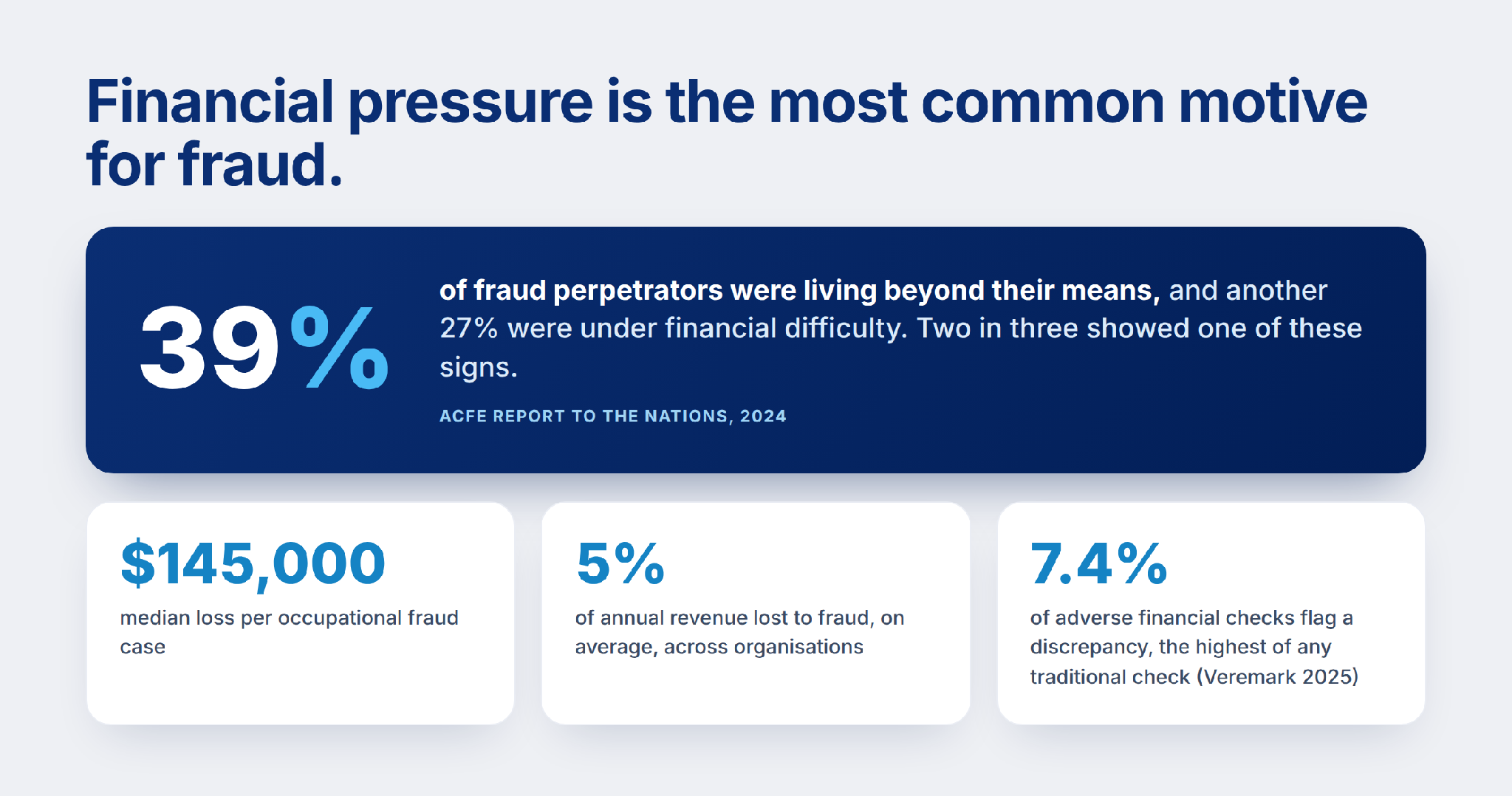
According to the ACFE's 2024 Report to the Nations, 39% of fraud perpetrators were living beyond their means and 27% were experiencing financial difficulties, making these the two most common behavioural warning signs identified in fraud cases.
The median loss per fraud case was $145,000, while organisations are estimated to lose around 5% of annual revenue to occupational fraud.
That does not mean that someone experiencing debt or financial difficulty is likely to commit fraud.
However, where an employee will have access to company money, customer accounts, payment systems or commercially sensitive financial decisions, unexplained financial distress can be a legitimate risk factor for an employer to understand.
An effective background screening provider should therefore help organisations apply financial checks selectively, based on the actual risk associated with each position.
When should employers run an adverse financial history check?
An adverse financial history check is not appropriate for every employee.
It is most valuable when the responsibilities of the role create genuine financial, regulatory or fraud exposure.
Typical examples include:
Financial services and fintech: FCA-regulated employees under SM&CR, financial advisers and employees handling client money.
Accountancy, audit and legal services: Roles involving client funds, trust accounts or significant financial responsibility.
Insurance: Underwriters, claims handlers, brokers and employees with payment authority.
Retail, hospitality and gambling: Certain cash-handling, payment-authorisation and financially sensitive positions.
Procurement and finance: Accounts payable teams, payment administrators, budget holders, procurement professionals and senior finance employees.
Senior leadership: Directors and executives with significant authority over company finances.
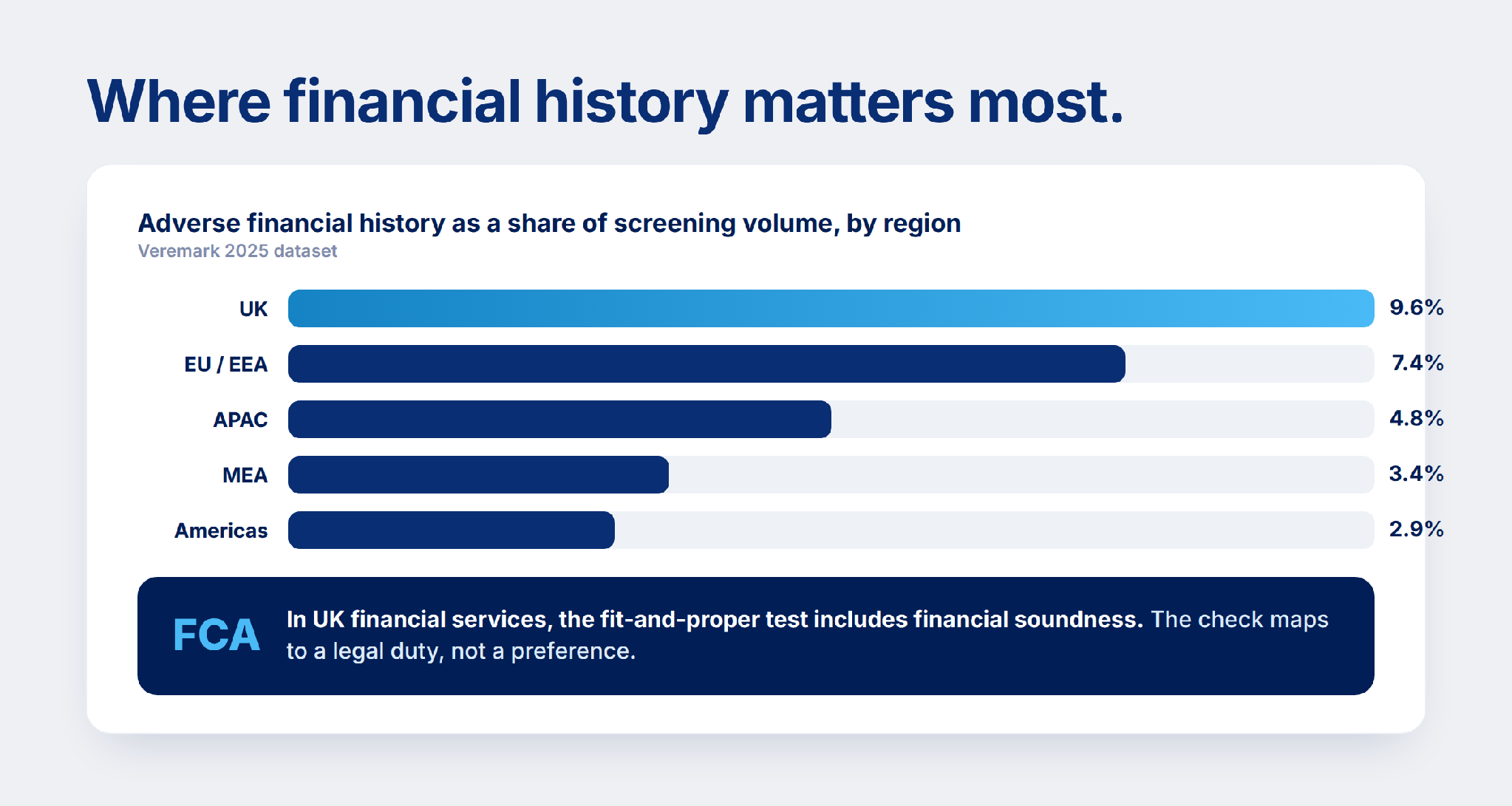
In UK financial services, financial soundness can also form part of regulatory obligations. The FCA's fit-and-proper assessment includes financial soundness as one of its three core criteria.
For relevant regulated positions, employers therefore need more than an informal assessment. They need a consistent process and clear evidence that appropriate checks were completed.
For roles with no meaningful financial access or regulatory responsibility, however, an adverse financial history check may be unnecessarily intrusive without delivering proportionate risk insight.
Choosing the right adverse financial history screening provider
Employers should look beyond whether a screening company can simply retrieve financial information.
A reliable background screening provider should help determine when the check is appropriate, what information can legally be collected in each jurisdiction and how results should be interpreted.
Important considerations include:
- Geographic coverage
- Compliance with local privacy and employment laws
- Candidate consent processes
- Turnaround times
- Clear and easy-to-understand reports
- Integration with wider background screening workflows
- Support when a potentially adverse result is identified
This becomes particularly important for organisations hiring internationally, where employment credit screening rules can vary significantly between countries.
Using adverse financial history checks responsibly
A financial judgment from four years ago is not a character verdict.
Used properly, an adverse financial history check should be one part of a broader hiring decision, assessed in the context of the responsibilities of the position and the candidate's explanation.
Employers should capture appropriate consent, manage candidate information in accordance with GDPR or equivalent local privacy legislation, and provide candidates with an opportunity to explain relevant findings before making an adverse hiring decision.
Different markets also impose different restrictions.
In the US, employment credit checks can fall under the Fair Credit Reporting Act (FCRA), while a number of states and cities restrict when employers can use credit information during recruitment.
A blanket financial screening policy can therefore create unnecessary compliance risk.
A risk-based approach is generally more appropriate: screen employees where financial history is genuinely relevant to the position.
Adverse financial history checks in different countries
The information available through an adverse financial history check, and the rules governing its use, vary depending on where the candidate is based.
United Kingdom: Checks can draw on regulated credit-reference information and may support financial-services compliance requirements. Candidate data must be handled in line with UK GDPR.
United States: Employment credit screening is regulated by the FCRA alongside additional state and local restrictions.
Singapore and APAC: Financial history screening is commonly used for certain financial-services and regulated positions, subject to local privacy requirements such as Singapore's PDPA and expectations from regulators including MAS.
For multinational employers, managing these differences internally can quickly become complicated.
Working with a global background screening provider allows employers to apply consistent screening standards while adapting the checks, consent process and reporting requirements to the regulations of each market.
How Veremark runs an adverse financial history check
Veremark makes adverse financial history screening straightforward for employers.
The process consists of three main steps.
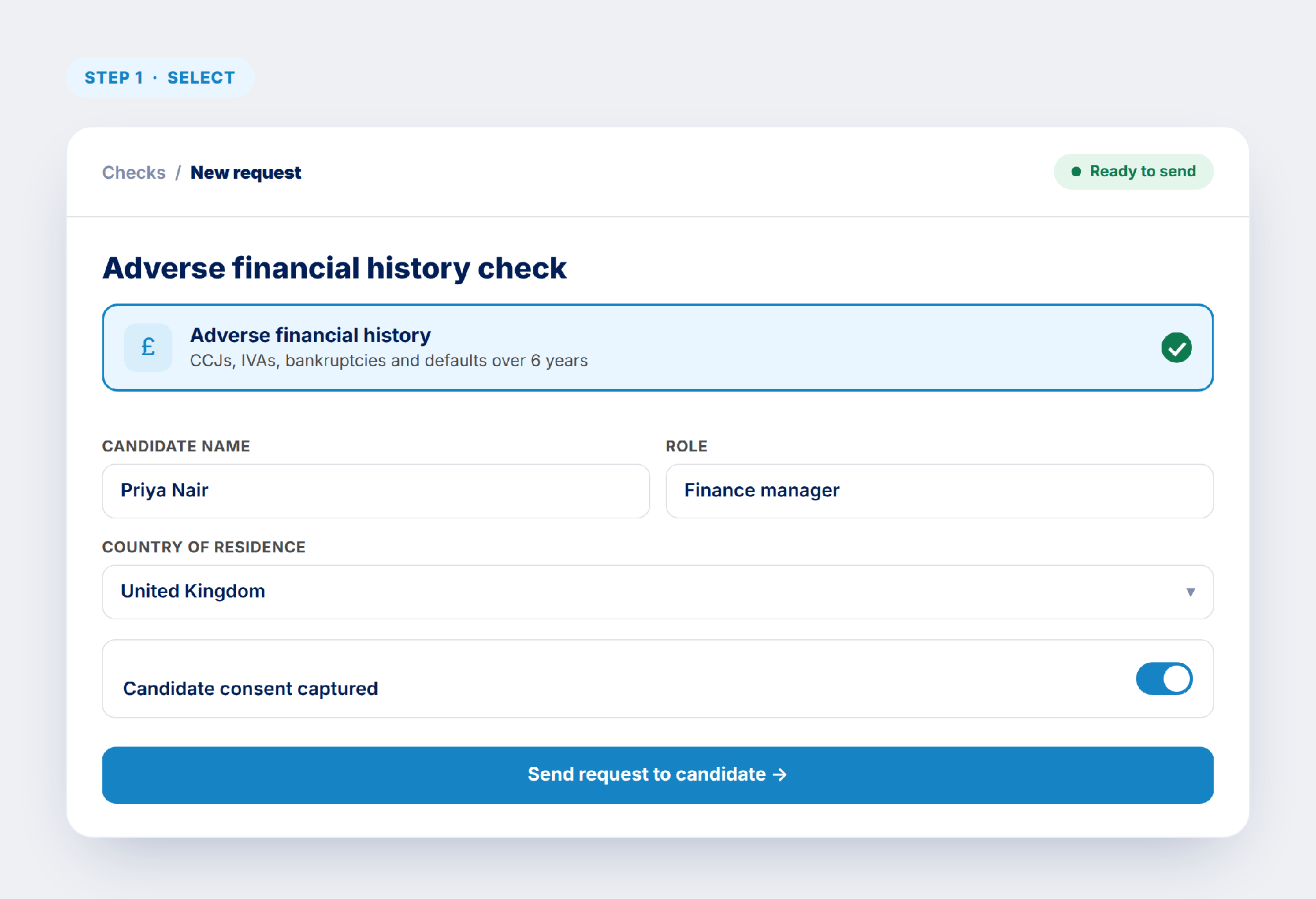
1. Request the check
Select the adverse financial history check as part of your screening package. The candidate provides the required information and appropriate consent is captured.
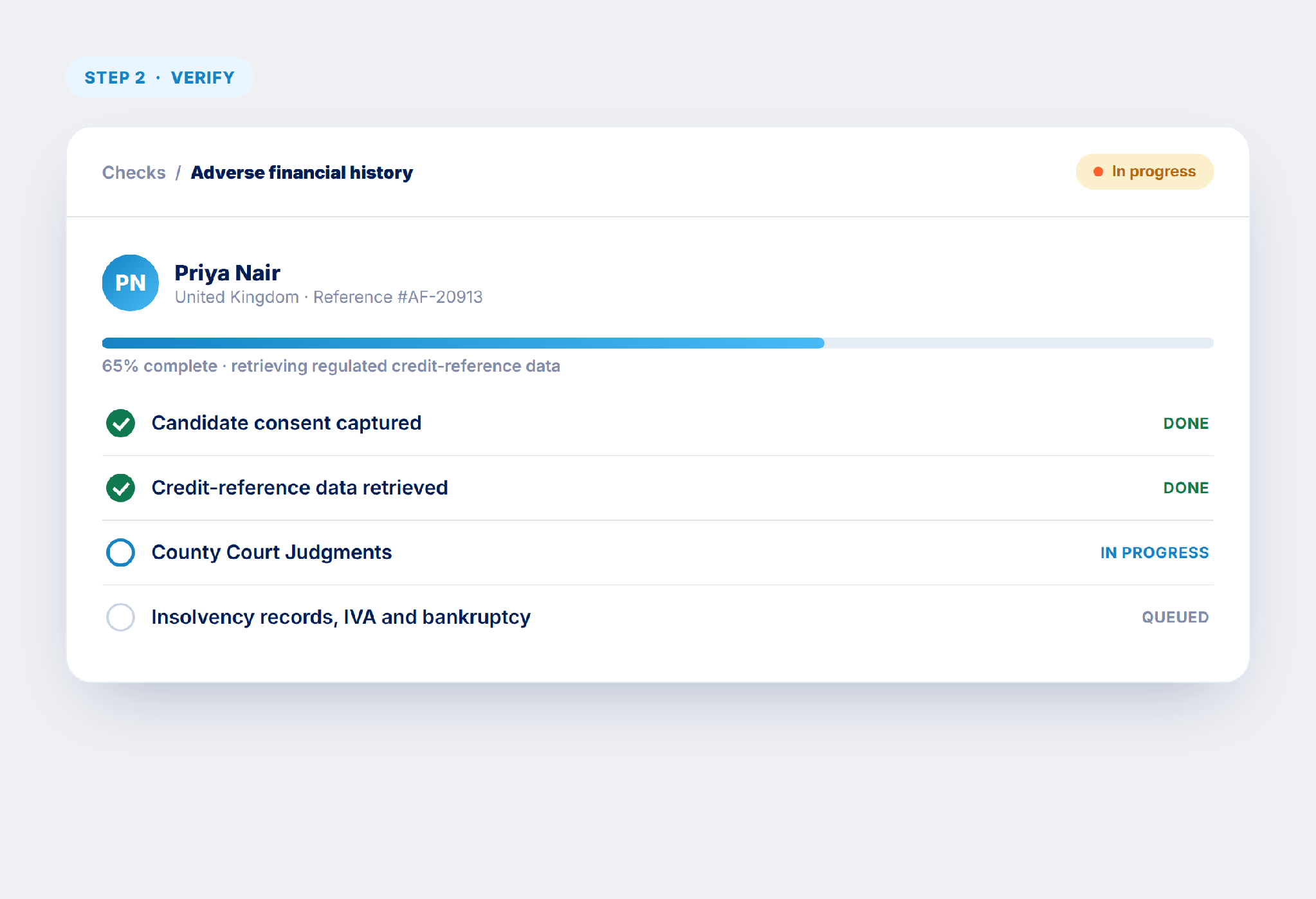
2. Veremark conducts the search
Veremark retrieves relevant regulated credit-reference information and compiles applicable judgments, insolvencies and other reportable financial records.
3. Review the report
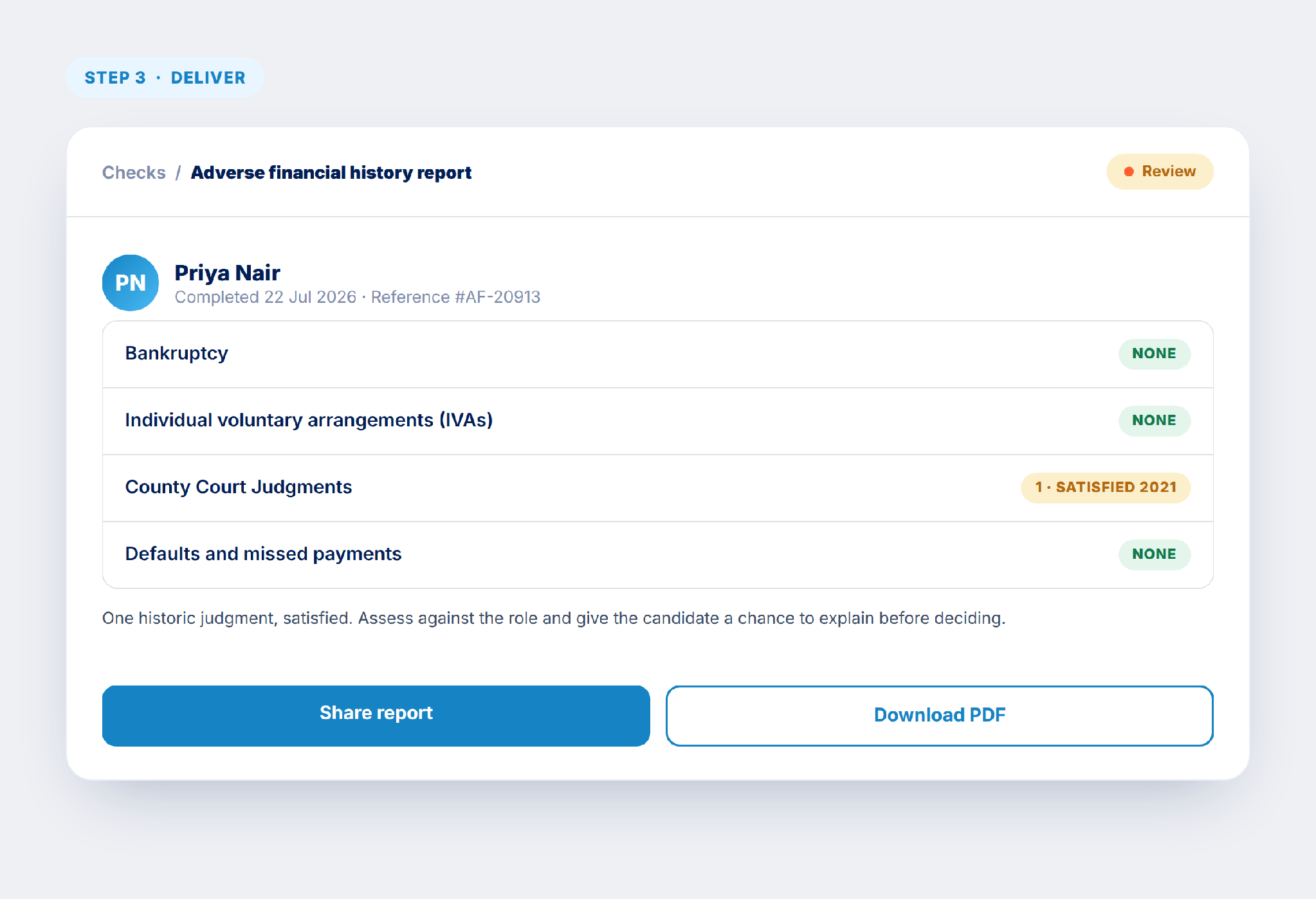
Your team receives a clear, shareable screening report showing what was identified, giving you the information needed to assess the findings against the responsibilities and risk profile of the role.
Veremark's background screening service is available on a flexible pay-as-you-go basis with no long-term lock-in. Employers can run checks in individual markets or build international screening programmes while supporting compliance with requirements including GDPR and PDPA.
Fast turnaround times also help employers complete appropriate due diligence without unnecessarily delaying the hiring process.
Why include adverse financial history checks in your background screening programme?
Veremark's screening data shows that adverse financial history checks identify discrepancies more frequently than other traditional screening checks.
At the same time, financial pressure remains one of the most commonly identified warning signs in occupational fraud cases.
For positions involving money, payments, procurement, client funds or major financial decisions, an adverse financial history check can therefore be one of the highest-value checks in an employer's screening programme.
The key is to use it proportionately.
Rather than screening every candidate in the same way, organisations should build a risk-based background screening programme in which the checks performed reflect the access, responsibilities and regulatory obligations associated with each role.
For employers hiring across multiple countries, working with an experienced global screening provider can also make that process significantly easier, helping teams manage candidate consent, local compliance requirements and screening results through one consistent process.

Read More





.jpg)
FAQs

This depends on the industry and type of role you are recruiting for. To determine whether you need reference checks, identity checks, bankruptcy checks, civil background checks, credit checks for employment or any of the other background checks we offer, chat to our team of dedicated account managers.
Many industries have compliance-related employment check requirements. And even if your industry doesn’t, remember that your staff have access to assets and data that must be protected. When you employ a new staff member you need to be certain that they have the best interests of your business at heart. Carrying out comprehensive background checking helps mitigate risk and ensures a safer hiring decision.
Again, this depends on the type of checks you need. Simple identity checks can be carried out in as little as a few hours but a worldwide criminal background check for instance might take several weeks. A simple pre-employment check package takes around a week. Our account managers are specialists and can provide detailed information into which checks you need and how long they will take.
All Veremark checks are carried out online and digitally. This eliminates the need to collect, store and manage paper documents and information making the process faster, more efficient and ensures complete safety of candidate data and documents.
In a competitive marketplace, making the right hiring decisions is key to the success of your company. Employment background checks enables you to understand more about your candidates before making crucial decisions which can have either beneficial or catastrophic effects on your business.
Background checks not only provide useful insights into a candidate’s work history, skills and education, but they can also offer richer detail into someone’s personality and character traits. This gives you a huge advantage when considering who to hire. Background checking also ensures that candidates are legally allowed to carry out certain roles, failed criminal and credit checks could prevent them from working with vulnerable people or in a financial function.
Trusted by the world's best workplaces




APPROVED BY INDUSTRY EXPERTS
.png)
.png)



and Loved by reviewers


Transform your hiring process
Request a discovery session with one of our background screening experts today.