
Check an employees address as part of your background screening: here's why


Address verification is the check that answers the one question every remote hire raises: is this person actually where they say they are? It used to be an administrative box. It now sits where identity, right to work and fraud meet.
Remote and cross-border hiring have turned "where does this candidate live" into a live question about identity, eligibility and fraud. An address check confirms a real, verifiable location, underpins right-to-work compliance, and sets the scope for every location-based check that follows. It’s cheap and quick, and skipping it means trusting a claim you can’t see.
57% of HR leaders plan to hire in another country within the year, and 58% already employ tech talent working remotely abroad. A lot of those offers go to people the employer never meets in person, in countries they’re not standing in.
The fraud that runs on a fake address
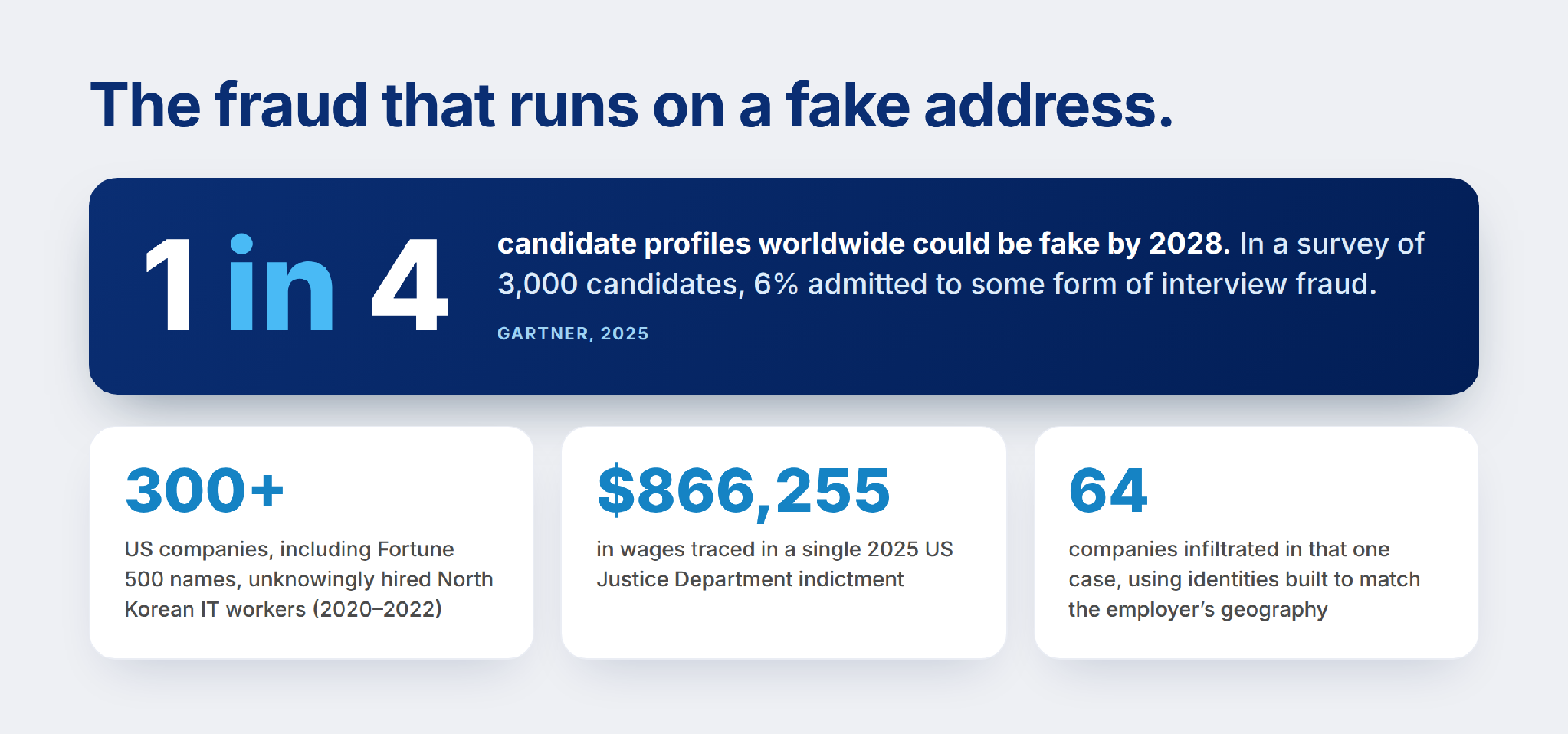
By 2028, one in four candidate profiles worldwide could be fake, according to Gartner. In a survey of 3,000 candidates, 6% admitted to some form of interview fraud, either impersonating someone or having a stand-in pose as them.
The clearest example is the North Korean IT worker scheme. Operatives apply for remote roles at Western companies using stolen or borrowed identities built to match the employer’s geography. Between 2020 and 2022, more than 300 US companies, including several Fortune 500 names, hired these workers without knowing it. A single 2025 Justice Department indictment traced $866,255 in wages from just ten of at least 64 infiltrated companies.
The whole scheme depends on faking a location. Company laptops get shipped to an accomplice’s home, the "laptop farm", which supplies a residential address and a local internet connection so the login looks domestic. What breaks the illusion is a genuine residential address that can be verified against independent records, rather than a forwarding address, a VoIP number or a VPN endpoint. That’s the job an address check does.
Failing to correctly verify your employee address is expensive
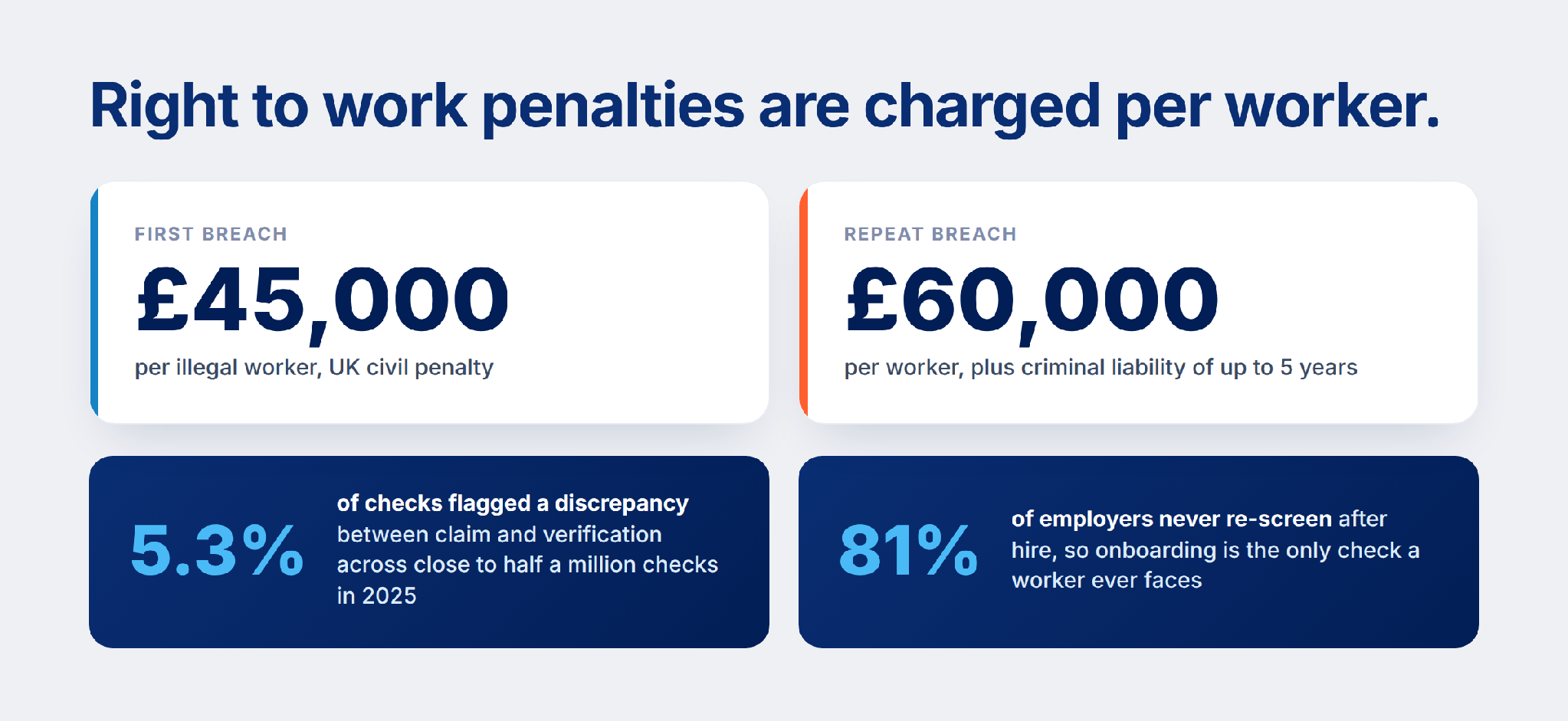
Confirming where a candidate lives is also how you establish whether you can legally employ them. In the UK, hiring someone without the right to work carries civil penalties of up to £45,000 per worker for a first breach and £60,000 for repeat offences, with criminal liability of up to five years. The system is going digital as well: eVisa holders are now checked in real time through the Home Office online service rather than by inspecting a passport, so an auditable record of who someone is and where they are matters more, not less.
Veremark’s 2025 data shows the exposure isn’t rare. Across close to half a million checks, more than one in twenty (5.3%) flagged a discrepancy between what the candidate claimed and what verification confirmed. Yet 81% of employers run no screening at all once someone is hired. For four in five organisations, the check at onboarding is the only one a worker will ever face.
An address you don’t know is a jurisdiction you don’t search
This is what makes address history load-bearing rather than routine. Most background checks are scoped by location, and criminal records are the sharpest case. In the United States they’re held at county level, so a screener has to know every county a candidate has lived in to search the right courts. Miss an address and you miss the county, which means a clean result might only mean you looked in the wrong place.
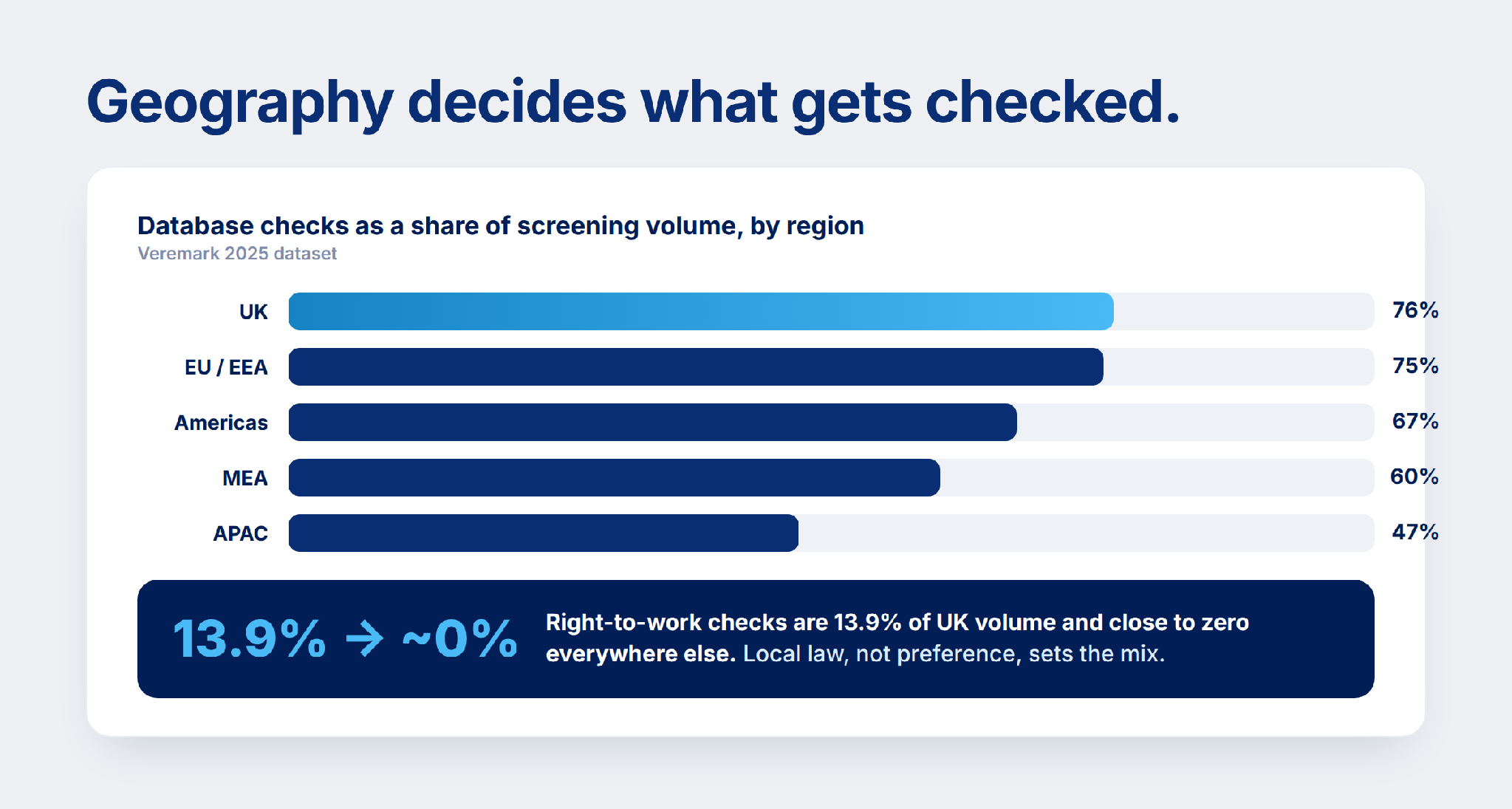
The check mix itself shows how much geography drives screening. In Veremark’s data, right-to-work checks are 13.9% of UK volume and close to zero elsewhere. Database checks make up 76% of UK volume but 47% across APAC, where reference and employment checks take over. Local law, not preference, decides what gets checked, and all of it hangs off knowing where the candidate actually is.
What an address check confirms
An address check verifies a candidate’s current residential address against independent records rather than taking their word for it. Veremark cross-references two supporting documents, usually utility bills or bank statements, against electoral, credit-header and other data sources.
Most checks also rebuild an address history covering around six years: rented homes, time with family, temporary stays, and any other names linked to those addresses. For fraud teams the linked-names element often matters as much as the addresses, because it surfaces aliases a single name search would miss. What comes back is a verified trail, not a single data point.
The same fact, different rules by market
The check exists everywhere. What it’s used for, and what the law allows, shifts by country.
In the UK it supports right-to-work checks and feeds DBS applications, which ask for a five-year address history, all under UK GDPR. In the US it’s the backbone of criminal screening, since records are local: screeners run a social security number trace to surface past addresses, then search each county, under the FCRA. In Singapore and the Philippines, address checks are routine in financial services and outsourcing hiring, governed by the PDPA and the Data Privacy Act, with consent front and centre. A partner that runs across those markets saves you rebuilding the process one country at a time.
Industries and roles that need an address check
Address verification underpins right-to-work and scopes your other checks, so it's near-universal. It matters most for:
- Financial services & fintech: Regulated hires and anyone handling client funds or data
- Healthcare & social care: Roles needing a DBS check, where address history sets the search
- Remote & distributed teams: Cross-border and work-from-anywhere hires you never meet
- Logistics, delivery & gig: High-volume, fast-turnover hiring that needs identity confirmed
- Technology: Staff with access to systems, IP and customer data
- Any right-to-work-sensitive hire: Visa holders and roles with legal eligibility requirements
Address check software from Veremark: get an answer within 72 hours
Three steps.
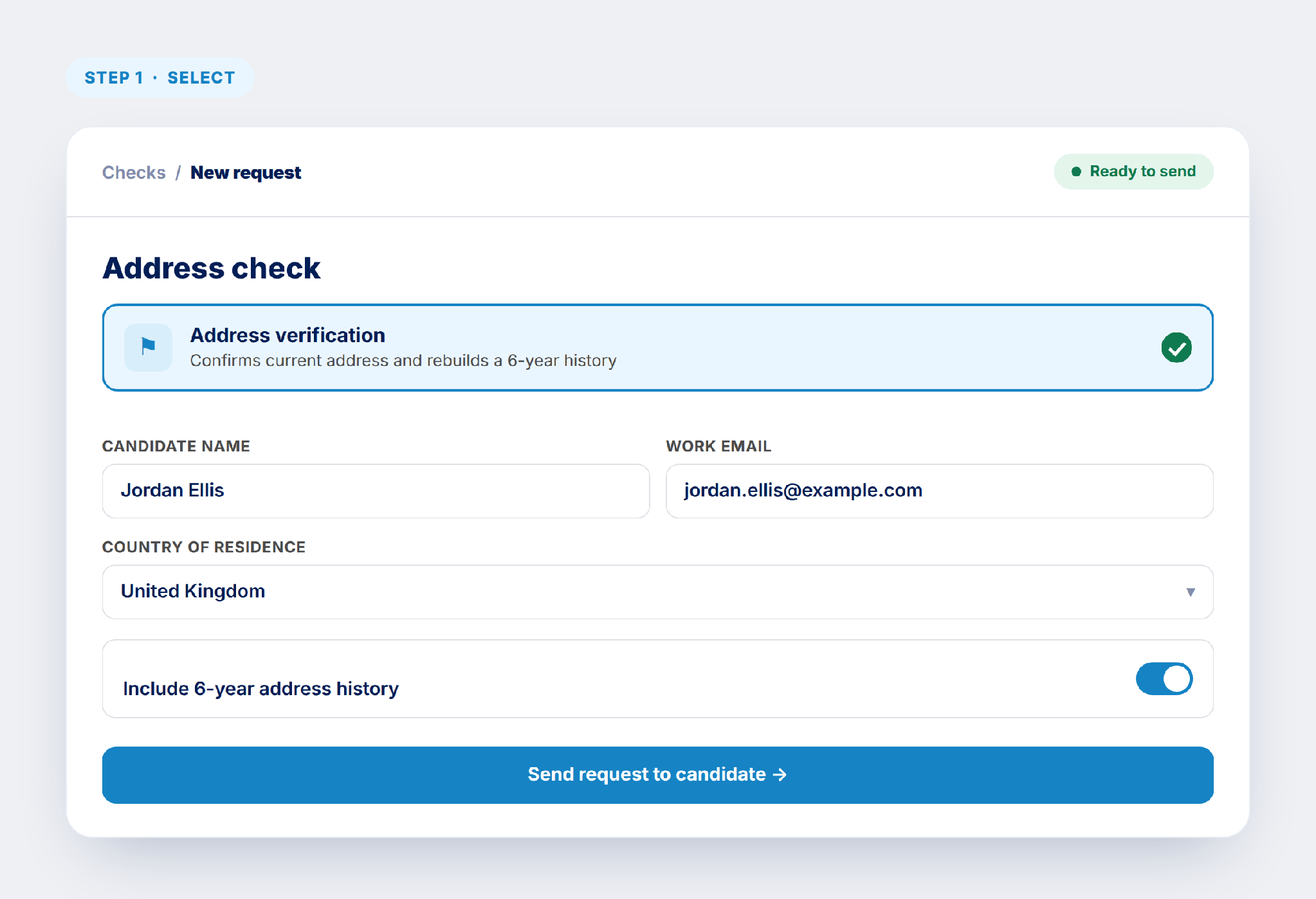
You select the address check and enter the candidate’s details.
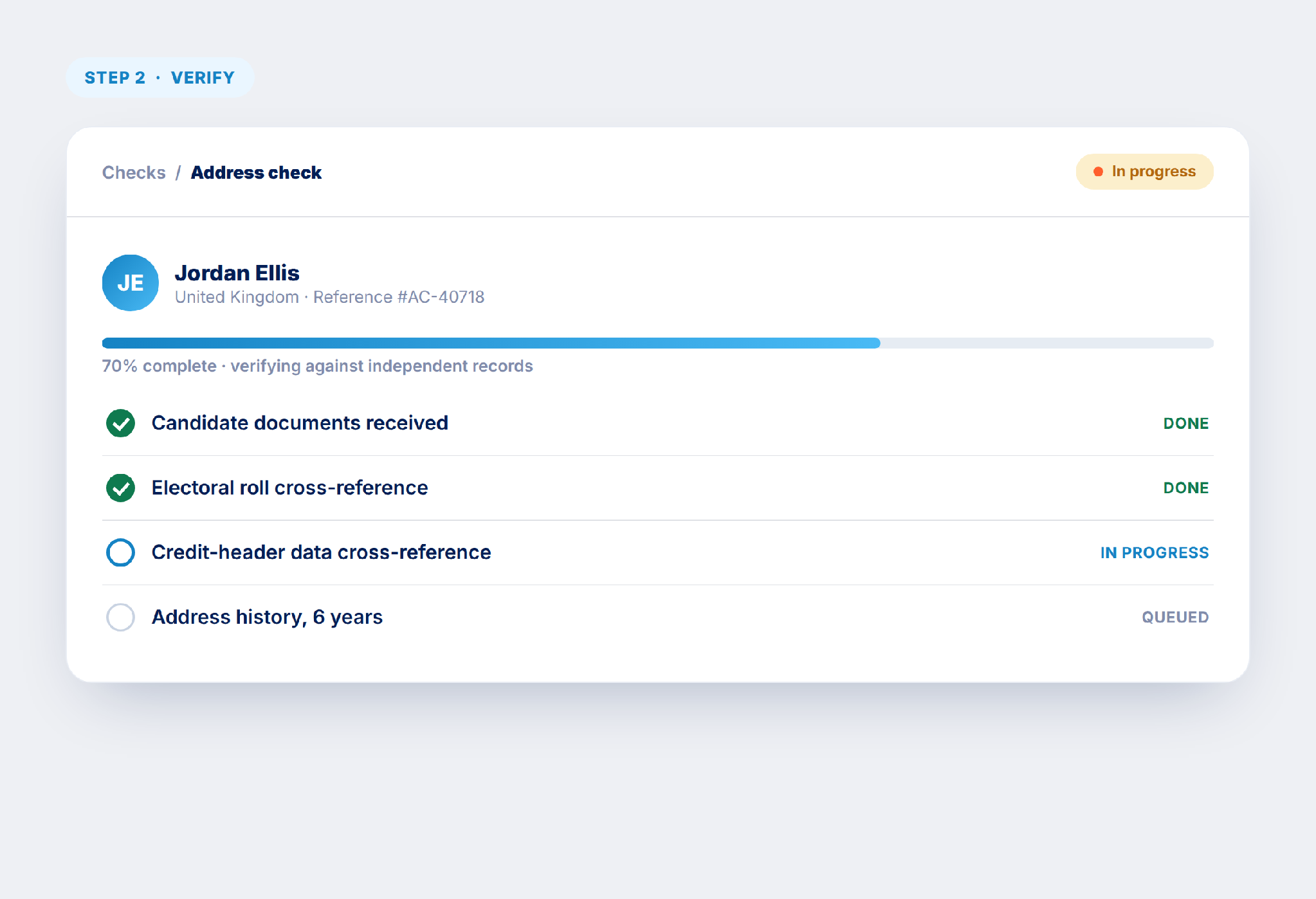
Veremark verifies through global data providers and, where needed, the candidate’s own documents.
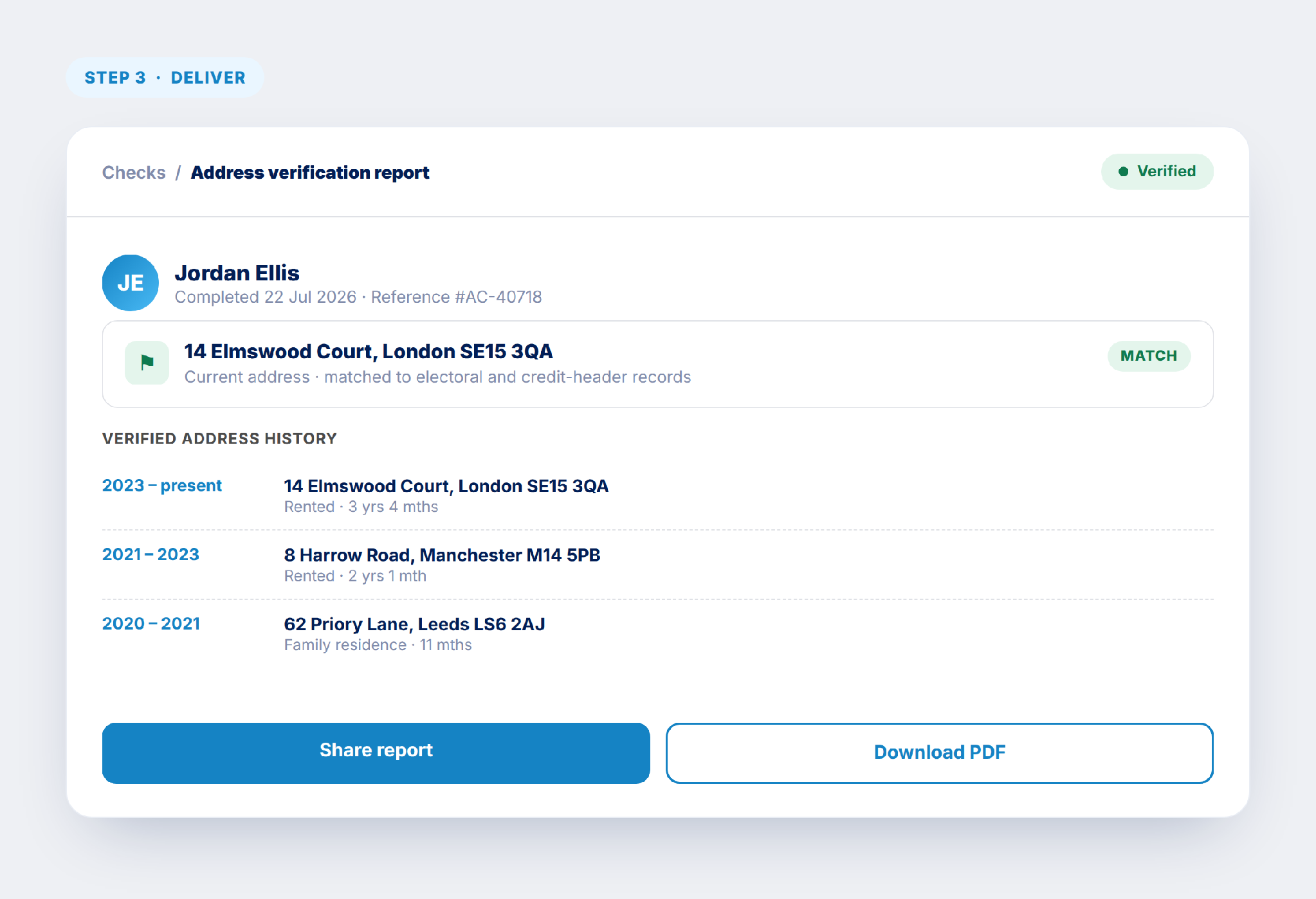
You get a shareable report with the result and the supporting history.
It runs pay-as-you-go with no long-term contract, stays compliant with GDPR and PDPA, and comes with 24/7 support for teams hiring across time zones. Turnaround is quick enough that it rarely holds up an offer.

Read More




.png)

FAQs

This depends on the industry and type of role you are recruiting for. To determine whether you need reference checks, identity checks, bankruptcy checks, civil background checks, credit checks for employment or any of the other background checks we offer, chat to our team of dedicated account managers.
Many industries have compliance-related employment check requirements. And even if your industry doesn’t, remember that your staff have access to assets and data that must be protected. When you employ a new staff member you need to be certain that they have the best interests of your business at heart. Carrying out comprehensive background checking helps mitigate risk and ensures a safer hiring decision.
Again, this depends on the type of checks you need. Simple identity checks can be carried out in as little as a few hours but a worldwide criminal background check for instance might take several weeks. A simple pre-employment check package takes around a week. Our account managers are specialists and can provide detailed information into which checks you need and how long they will take.
All Veremark checks are carried out online and digitally. This eliminates the need to collect, store and manage paper documents and information making the process faster, more efficient and ensures complete safety of candidate data and documents.
In a competitive marketplace, making the right hiring decisions is key to the success of your company. Employment background checks enables you to understand more about your candidates before making crucial decisions which can have either beneficial or catastrophic effects on your business.
Background checks not only provide useful insights into a candidate’s work history, skills and education, but they can also offer richer detail into someone’s personality and character traits. This gives you a huge advantage when considering who to hire. Background checking also ensures that candidates are legally allowed to carry out certain roles, failed criminal and credit checks could prevent them from working with vulnerable people or in a financial function.
Trusted by the world's best workplaces




APPROVED BY INDUSTRY EXPERTS
.png)
.png)


and Loved by reviewers


Transform your hiring process
Request a discovery session with one of our background screening experts today.