
The post-hire trust gap: what happens after onboarding, and why it matters


.png)
Most employers screen people before they join. Far fewer ask whether that same level of trust still fits the role six months, two years or three promotions later.
That is the post-hire trust gap. It appears when an employee’s role changes, their access grows, the business expands or working patterns shift, while the checks and controls around that person stay frozen at the point of hire. For compliance teams, that gap can become a real source of risk.
This is why ongoing employee background screening should be seen as part of workforce risk management, rather than a one-off hiring task.
We're not advocating for screening every employee constantly - that could potentially damage the culture in your organisation. What we're outlining here is the value of linking checks to clear risk triggers: promotion into sensitive roles, transfer into regulated teams, new access to financial systems, or responsibility for vulnerable people, customer data or critical infrastructure.
Building a long-term culture of workplace trust
Background checks are usually treated as a gateway into the organisation. A candidate is screened, the report is reviewed and onboarding begins. That model works well for confirming identity, qualifications, employment history and role-specific risk before someone starts.
Background checks help employers verify key candidate information before employment begins, but what do you have in place when the employee’s position inside the business changes?
A junior finance hire may start with limited system access. Two years later, they may approve supplier payments. A customer support agent may begin with access to basic account records. After moving into operations, they may see sensitive customer data, billing information or internal controls. A regional manager may be promoted into a role with authority over hiring, budgets and vendor selection.
The person may be the same. The risk profile is not.
Compliance teams often inherit this problem because access rights, reporting lines and approval authority tend to grow faster than control frameworks. HR updates the job title. IT updates the permissions. Finance updates the approval limits. The screening record often stays untouched.

Promotions create new exposure
Promotion is usually treated as a reward, but it should also trigger a risk review. When someone moves into a role with greater authority, the organisation is making a new trust decision. That decision may involve financial control, regulatory responsibility, access to confidential data or influence over other employees.
Consider these three examples:
1. An employee promoted into procurement may gain power over supplier selection and contract approval. That creates exposure to bribery, conflicts of interest and invoice fraud.
2. A finance employee moving into a senior role may gain authority to approve payments, change bank details or access payroll data.
3. A manager moving into a regulated business unit may become responsible for processes where misconduct could create legal or licence-related consequences.
It does not mean screening every employee constantly. It means linking checks to clear risk triggers: promotion into sensitive roles, transfer into regulated teams, new access to financial systems, or responsibility for vulnerable people, customer data or critical infrastructure.
Remote work changed the control environment
The move from office-based work to remote and hybrid work changed how trust operates.
Employees may access systems from different locations, use shared home networks, handle sensitive calls outside secure offices and work with less direct oversight. A role that once carried moderate risk in an office may carry higher risk when performed remotely.
The answer is not to treat remote employees with suspicion. A culture of trust requires fairness. It also requires clarity. Employees should know why certain roles require extra checks, what data will be reviewed and how decisions will be made.
Business growth changes employee risk
Risk does not stay fixed as a company grows.
A 40-person business may rely on close working relationships and founder oversight. A 400-person business needs stronger controls because personal familiarity no longer scales. A business operating in one country may know the rules well. A business hiring across five countries faces different laws, data practices and employment expectations.
Growth changes the stakes in several ways:
- First, access becomes more complex. More systems, more users and more permission levels create more opportunities for mistakes or misuse.
- Second, roles become more specialised. Employees may handle narrower but more sensitive responsibilities, such as sanctions review, payroll, client onboarding or security administration.
- Third, regulation becomes more demanding. A company that wins enterprise customers may need to prove stronger controls. A company entering financial services, healthcare, education or government supply chains may face stricter expectations.
- Fourth, hiring becomes more distributed. International hiring can introduce different standards for education, employment references, criminal record availability and right to work evidence. Veremark’s guide to international background checks explains why local context matters when verifying candidates across borders.
The result is simple: the screening framework that worked at one stage may become too light for the next.
Compliance needs a live view of workforce risk
Compliance teams are expected to reduce risk, evidence controls and respond quickly when something goes wrong. That is hard when employee trust decisions are based only on information collected years earlier.
A stronger model connects screening to the employee lifecycle.
Pre-employment checks remain essential. They help confirm who the person is and whether their background fits the role. Checks such as employment history verification, criminal record checks where lawful and relevant, and right to work checks all have a clear place at hiring stage.
After onboarding, the focus should shift to risk-based review. That can include re-screening for regulated roles, periodic checks for positions with high financial authority, and screening when an employee changes role, location or access level.
The policy should be clear, lawful and proportionate. Employees should understand that checks are tied to role risk rather than personal mistrust. Consent, privacy and local legal requirements must be built into the process from the start.
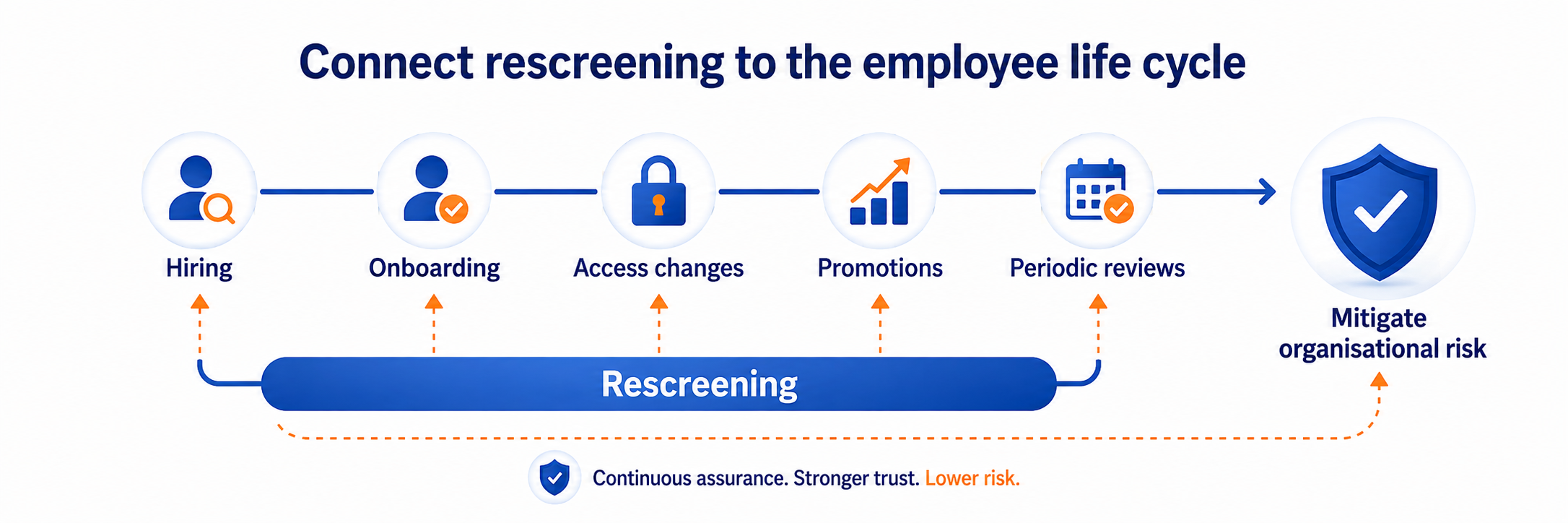
Closing the workplace trust gap
The post-hire trust gap grows when companies treat onboarding as the final trust decision. In reality, trust changes as people move through the business.
Promotions, remote work, new markets, larger teams and stricter client requirements all change the level of risk an organisation carries. Employees grow with the business. Their access, authority and responsibilities grow too.
Ongoing employee background screening helps close that gap. Used properly, it gives compliance teams a practical way to match checks to real risk, support fair decision-making and build a workplace where trust is active rather than assumed.
.png)
Read More






FAQs

This depends on the industry and type of role you are recruiting for. To determine whether you need reference checks, identity checks, bankruptcy checks, civil background checks, credit checks for employment or any of the other background checks we offer, chat to our team of dedicated account managers.
Many industries have compliance-related employment check requirements. And even if your industry doesn’t, remember that your staff have access to assets and data that must be protected. When you employ a new staff member you need to be certain that they have the best interests of your business at heart. Carrying out comprehensive background checking helps mitigate risk and ensures a safer hiring decision.
Again, this depends on the type of checks you need. Simple identity checks can be carried out in as little as a few hours but a worldwide criminal background check for instance might take several weeks. A simple pre-employment check package takes around a week. Our account managers are specialists and can provide detailed information into which checks you need and how long they will take.
All Veremark checks are carried out online and digitally. This eliminates the need to collect, store and manage paper documents and information making the process faster, more efficient and ensures complete safety of candidate data and documents.
In a competitive marketplace, making the right hiring decisions is key to the success of your company. Employment background checks enables you to understand more about your candidates before making crucial decisions which can have either beneficial or catastrophic effects on your business.
Background checks not only provide useful insights into a candidate’s work history, skills and education, but they can also offer richer detail into someone’s personality and character traits. This gives you a huge advantage when considering who to hire. Background checking also ensures that candidates are legally allowed to carry out certain roles, failed criminal and credit checks could prevent them from working with vulnerable people or in a financial function.
Trusted by the world's best workplaces


APPROVED BY INDUSTRY EXPERTS
.png)
.png)


and Loved by reviewers


Transform your hiring process
Request a discovery session with one of our background screening experts today.