Easy-to-follow guide for UK employers using the DBS update service



The DBS update service allows you to check whether an employee’s existing criminal record certificate is still current, without requesting a new DBS check each time. It is free for employers, provides an immediate online result and can make ongoing safeguarding checks easier to manage. However, you must have the employee’s consent and confirm that their certificate meets the legal requirements of the role.
Here’s how to use the service correctly, including who is eligible, how to check a certificatcose and what to do when the results change.
A brief overview of the DBS update service
The Disclosure and Barring Service (DBS) provides an online subscription service that allows individuals to keep their Standard or Enhanced DBS certificates up to date.
When someone joins, you can check whether new information has been identified since their certificate was issued. This can help you avoid unnecessary repeat applications when recruiting someone who already holds an appropriate certificate.
The service is particularly useful for employers in education, healthcare, social care and other sectors where criminal record checks form part of safeguarding requirements.
According to the DBS annual quality account for 2025–26, the organisation processed more than 7.4 million checks during the financial year. A reliable system for checking existing certificates can therefore save employers considerable administrative effort.
The service covers Standard and Enhanced DBS certificates, including eligible Enhanced checks with barred-list information. Basic DBS checks are excluded.
How much does it cost?
Employers can carry out status checks completely free of charge. There is no need to register for an employer account.
For individuals to keep their profile and status live on the DBS update service, they will need to pay subscription cost of £15 per year. Eligible volunteers can subscribe for free.
You can pay an employee’s subscription fee with their permission, although they must retain control of their account.
How to use the DBS update service as an employer
Using the service is straightforward, provided you complete the necessary checks before accessing an employee’s information.
Step 1: Confirm the employee is registered
Ask your employee or candidate whether they have an active subscription.
Individuals can join while their DBS application is being processed, using their application reference number, or within 30 calendar days of their certificate's issue date.
If they miss the registration deadline, they will normally need a new Standard or Enhanced DBS application before joining.
You should encourage new starters to subscribe early if their role will require ongoing checks.
Step 2: Check that the certificate is suitable
Before checking the certificate's status, confirm that you are legally entitled to the information it contains.
You must establish that:
- The role qualifies for the relevant level of DBS check.
- You have verified the employee’s identity.
- You have seen the original paper DBS certificate in person, or your recruiting organisation has verified the genuine original where direct viewing is not possible.
- You have the employee’s consent to perform a status check.
- The Enhanced certificate covers the appropriate workforce and only the barred-list information you are entitled to request.
For example, an Enhanced certificate covering work with adults cannot automatically be reused for a teaching role requiring checks against the children’s workforce and barred list.
Standard certificates have different workforce rules, but you must still be legally entitled to request that level of check.
If you are unsure about eligibility, read Veremark’s guide to what criminal record checks UK employers can legally request.
Step 3: Complete the online status check
Once you have confirmed eligibility and obtained consent, visit the GOV.UK DBS Update Service.
Select the option to check a certificate's status and enter:
- Your organisation’s name.
- Your first name and surname.
- The employee’s DBS certificate number.
- Their surname, as shown on the certificate.
- Their date of birth, as shown on the certificate.
You must then accept the legal declaration confirming your entitlement to access the information.
The result appears immediately. You can record the date and outcome in your screening records, applying your organisation’s data protection and retention policies.
How to understand the results
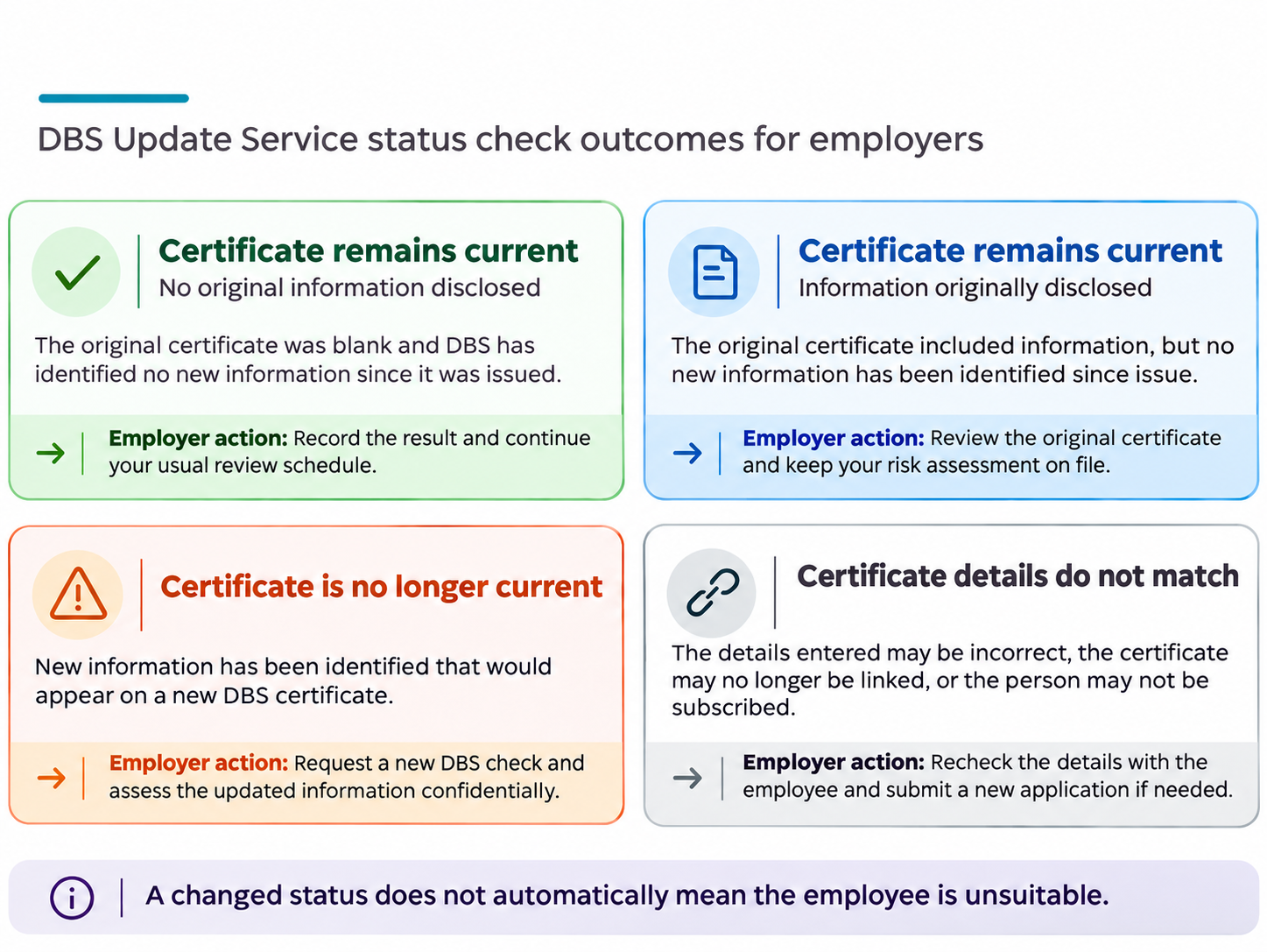
The status check can return four outcomes.
1. Certificate remains current, with no original information disclosed.
The certificate was originally blank, and DBS has identified no further information requiring disclosure.
2. Certificate remains current, with information originally disclosed.
The existing certificate contained information, but DBS has confirmed no further information requiring disclosure since it was issued.
You should still consider the information shown on the original certificate when assessing suitability.
3. Certificate is no longer current.
DBS has identified new information that would appear on a new certificate.
You must request a new DBS check to understand what has changed. A changed status does not automatically mean the employee is unsuitable.
4. Certificate details do not match.
The details may have been entered incorrectly, the certificate may have been removed from the subscription, or the individual may not be registered.
Check the information with the employee before deciding whether a fresh application is required.
For more guidance on making fair decisions, see Veremark’s article on handling criminal record check results.
What should you do if an employee's DBS status changes?
If the result shows that a certificate is no longer current, arrange a confidential discussion with the employee and request a new DBS certificate.
Once the updated information is available, assess its relevance to the employee’s responsibilities and any associated safeguarding risks.
If the original certificate included a barred-list check, and you are legally entitled to that information, you may also be able to request an early confirmation check to establish whether the change concerns barred status.
You must not knowingly allow a barred individual to undertake regulated activity with the group from which they are barred.
Keep a clear record of your decision and follow your organisation’s safeguarding procedures.
How often should employers carry out status checks?
There is no prescribed frequency for carrying out repeat status checks.
The DBS employer guidance, updated in October 2026, recommends a risk-based approach that reflects the nature of the role and your safeguarding obligations.
For example, a care provider might choose six-monthly checks for eligible staff working directly with vulnerable adults. Your organisation should document its chosen schedule and apply it consistently.
DBS does not automatically notify employers when a certificate’s status changes. Each check provides information available at that point in time, so you must carry out repeat checks yourself.
Consent also remains essential. If an employee withdraws permission, leaves your organisation or moves into a role where you no longer have legal entitlement, you must stop checking their certificate.
Keep your screening process compliant
A current DBS certificate is one part of assessing an employee’s suitability. You should continue to complete relevant identity, employment history, reference and right to work checks.
Treat DBS information as sensitive personal data. Limit access, document your lawful basis for processing it and avoid keeping certificate information longer than necessary.
Veremark’s guide to criminal record checks and GDPR explains the information handling requirements in more detail.
For employers managing multiple roles, Veremark provides DBS checks alongside wider employment screening services.
The most effective approach is to establish eligibility before the first check, record consent, set a review schedule and act promptly when a certificate's status changes. That gives you a repeatable process for maintaining safeguarding standards throughout employment.

Read More






FAQs

This depends on the industry and type of role you are recruiting for. To determine whether you need reference checks, identity checks, bankruptcy checks, civil background checks, credit checks for employment or any of the other background checks we offer, chat to our team of dedicated account managers.
Many industries have compliance-related employment check requirements. And even if your industry doesn’t, remember that your staff have access to assets and data that must be protected. When you employ a new staff member you need to be certain that they have the best interests of your business at heart. Carrying out comprehensive background checking helps mitigate risk and ensures a safer hiring decision.
Again, this depends on the type of checks you need. Simple identity checks can be carried out in as little as a few hours but a worldwide criminal background check for instance might take several weeks. A simple pre-employment check package takes around a week. Our account managers are specialists and can provide detailed information into which checks you need and how long they will take.
All Veremark checks are carried out online and digitally. This eliminates the need to collect, store and manage paper documents and information making the process faster, more efficient and ensures complete safety of candidate data and documents.
In a competitive marketplace, making the right hiring decisions is key to the success of your company. Employment background checks enables you to understand more about your candidates before making crucial decisions which can have either beneficial or catastrophic effects on your business.
Background checks not only provide useful insights into a candidate’s work history, skills and education, but they can also offer richer detail into someone’s personality and character traits. This gives you a huge advantage when considering who to hire. Background checking also ensures that candidates are legally allowed to carry out certain roles, failed criminal and credit checks could prevent them from working with vulnerable people or in a financial function.
Trusted by the world's best workplaces




APPROVED BY INDUSTRY EXPERTS


and Loved by reviewers


Transform your hiring process
Request a discovery session with one of our background screening experts today.