
What Counts, What Proof You Will Need, What to Check Before You Submit Professional Qualifications for COMPASS C2 in 2026



From 1 January 2026, MOM's updated COMPASS C2 list of degree-equivalent professional qualifications applies to new and renewal Employment Pass applications. For many teams, this is the part of C2 that gets overlooked. The reason is that professional qualifications often sit in a grey zone between "this looks credible" versus "this will earn points under COMPASS, and we can prove it in a way MOM accepts".
This article focuses on three things:
- What changed for 2026, and what "degree-equivalent" means in MOM's terms
- What verification proof implies in practice, so you do not discover gaps late
- How to update your workflow so professional qualifications are handled consistently
What You Need to Know
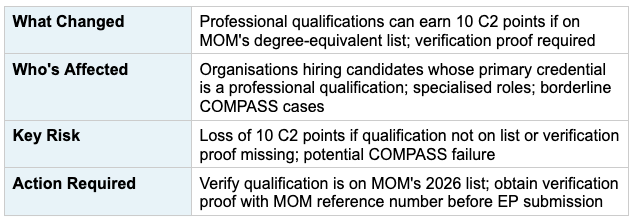
What Changed in 2026: Degree-Equivalent Professional Qualifications Can Earn C2 Points
MOM's updated list spells out the rule clearly:
- Employment Pass candidates can earn 10 points on COMPASS C2 (Qualifications) if they have professional qualifications recognised as degree-equivalent, from the institutions listed in MOM's document
- When applying for the EP, you will need to submit verification proof confirming the qualifications are authentic
Example: An accountant with a professional ACCA qualification can still earn points under COMPASS C2, even if they had never gone to university nor completed a degree.
Critical distinction: The "degree-equivalent" label is a specific classification tied to a published list.
MOM's Employment Pass eligibility page makes a clear point: qualifications that are not considered as a degree-equivalent by Singapore will not earn points under COMPASS, and employers should not submit them for C2 scoring.
That single line can change how your team handles "extra documents", especially when someone wants to submit everything without checking the list first.
Why This Matters Beyond "10 Points"
In many organisations, professional qualifications show up in hiring in predictable patterns:
- A candidate's strongest credential is a professional qualification, not a bachelor's degree
- A hiring manager cares more about the professional credential than the academic degree
- A role is specialised, and the professional credential is the hiring signal that matters
- A team is trying to reach COMPASS thresholds and is looking for levers
The key question: Can your organisation reliably answer these two questions when it counts?
- Does this professional qualification qualify as "degree-equivalent" under MOM's 2026 list?
- If yes, can we produce verification proof that will be accepted as part of an EP submission?
What "Verification Proof" Means in Practice for EP Submissions
MOM's "Documents required for Employment Pass" page sets expectations on what happens when you submit verification proof via background screening companies:
- If you choose to submit verification proof from background screening companies, it must be from selected background screening companies only, and it must contain a MOM verification reference number
- Follow MOM’s step-by-step guide on how to submit these verification proof(s) for your work pass application
The submission process: You fill up the MOM EP application form and include the MOM verification reference number together with an upload of the verification proof.
Timing expectation: MOM's FAQ states most verification checks can be completed within 14 working days. If there is no update, you need to approach the background screening company directly to obtain an interim report that can be submitted to MOM in the meantime for your urgent or time-sensitive applications.
Important note: "Submit verification proof" does not refer to a generic upload of your candidate’s certificate, but refers to a specific workflow with MOM-approved providers like Veremark.
The 5 Details That Decide Whether a Professional Qualification Is Submission-Ready
When teams run into delays with professional qualifications, it is usually because one of these details is missing or inconsistent:
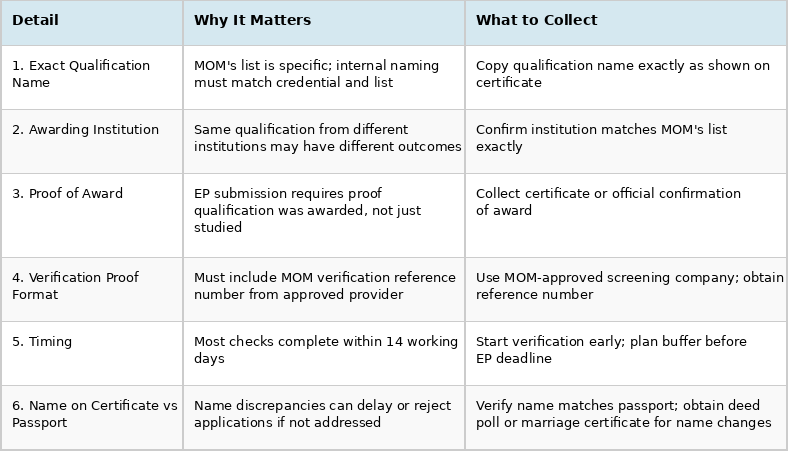
Detail 1: The Exact Qualification Name
MOM's degree-equivalent list is specific. Your form needs to match what is on the candidate's credential and what is on MOM's list. Small variations in naming can create confusion during submission and result in rejections or lost points.
Detail 2: The Awarding Institution
MOM's list ties professional qualifications to institutions. A qualification with the same name from different awarding bodies can have different outcomes. Verify that the awarding institution matches the list exactly.
Detail 3: Proof of Award
Teams often collect "proof of study" early, but later realise the EP submission needs proof that the qualification was actually awarded. Be clear internally about what you accept at each stage: transcripts versus certificates versus official confirmation of award.
Detail 4: Verification Proof Format and Reference Number
If using a background screening company, the verification proof needs the MOM verification reference number. Without this reference number, the proof is not submission-ready.
Detail 5: Timing Against EP Submission Milestones
If your EP submission is scheduled tightly, a "most checks complete within 14 working days" expectation can still be uncomfortable if verification only starts after offer acceptance. Plan verification timing with a bigger buffer before your submission deadlines.
Detail 6: Name on Certificate Differs from Passport Name
If the name on the education certificate does not match the passport name submitted to the Singapore authorities, a legal document or supporting evidence needs to be provided to prove that the different names refer to the same applicant.
Note: None of these are complicated on their own. The complexity comes from inconsistency, especially when different recruiters handle professional qualifications differently. Issues that are not identified upfront and only discovered later can also cause timeline adjustments, impacting your hiring outcomes.
When "Degree-Equivalent" Is a Minimum Requirement
There is a second reason to treat degree-equivalent qualifications carefully. In some contexts, "degree-equivalent" can function as a minimum bar.
Example: Skills Bonus (Shortage Occupation List, SOL)
MOM's Skills Bonus (SOL) page includes an additional requirement that candidates must have at least a degree-equivalent qualification, described as scoring 10 points on C2. Not every organisation will touch SOL roles. However, it illustrates how "degree-equivalent" can appear in more than one place in the EP ecosystem.
Question to Consider
If your organisation is hiring for specialised roles where SOL might be relevant, do you want professional qualifications handled as a standardised pathway rather than an exception?
What Employers Typically Update for 2026
Here are three workflow adjustments that tend to make the biggest difference. These are presented as options. Different teams optimise for different trade-offs.
Update 1: Create a "Degree-Equivalent Check" Step Before Verification Starts
Instead of sending every professional qualification for verification, some teams add a quick gate:
- Is the qualification on MOM's 2026 degree-equivalent list?
- Is the awarding institution aligned with the list?
Benefit: Saves time and cost by filtering out non-qualifying credentials early.
Update 2: Standardise What You Ask Candidates For, Early
A lightweight intake pack can include:
- Certificate or proof of award
- Exact qualification name
- Awarding institution
- Year awarded
- Any membership or licence details that may be relevant for verification, depending on the credential
- Any supporting documents for name discrepancies
Benefit: Reduces back-and-forth chasing for missing documents later.
Update 3: Make Ownership Clear for Follow-Up and Escalation
MOM's FAQ says the follow-up is directly with the background screening company if there is no update.
That prompts an internal question: who owns follow-up? Recruiter, HR ops, mobility, or a central admin?
Why this matters: Verification is time-bound. If ownership is unclear, the candidate experience tends to suffer.
A Simple Checklist You Can Paste into Your EP Workflow
If you want a practical section to copy into a process document, this is a clean baseline:
- Confirm the professional qualification appears on MOM's degree-equivalent list for 2026
- Confirm the awarding institution matches the list
- Collect proof of award and store the qualification name exactly as shown on the credential
- If using a background screening company, ensure the verification proof includes the MOM verification reference number, and follow the submission guide steps
- Plan verification timing against EP submission needs, noting MOM's guidance that most checks can be completed within 14 working days.
- If yours take longer, consider obtaining an interim report from your provider to submit to MOM for more urgent applications first.
Key Takeaways
- Professional qualifications can earn 10 C2 points if they appear on MOM's 2026 degree-equivalent list
- Verification proof must come from MOM-approved screening companies and include a MOM reference number
- Qualifications not on the list will not earn points and should not be submitted for C2 scoring
- Five critical details determine submission-readiness: qualification name, awarding institution, proof of award, verification format, and timing
- "Degree-equivalent" can function as a minimum requirement for certain pathways like SOL, not just a points opportunity
- Most verification checks complete within 14 working days; plan accordingly
{{mom="/components"}}
Related Resources
- MOM COMPASS C2 List of Degree-Equivalent Professional Qualifications
- MOM Employment Pass Eligibility
- MOM Skills Bonus (SOL)
Read More


.png)


FAQs

This depends on the industry and type of role you are recruiting for. To determine whether you need reference checks, identity checks, bankruptcy checks, civil background checks, credit checks for employment or any of the other background checks we offer, chat to our team of dedicated account managers.
Many industries have compliance-related employment check requirements. And even if your industry doesn’t, remember that your staff have access to assets and data that must be protected. When you employ a new staff member you need to be certain that they have the best interests of your business at heart. Carrying out comprehensive background checking helps mitigate risk and ensures a safer hiring decision.
Again, this depends on the type of checks you need. Simple identity checks can be carried out in as little as a few hours but a worldwide criminal background check for instance might take several weeks. A simple pre-employment check package takes around a week. Our account managers are specialists and can provide detailed information into which checks you need and how long they will take.
All Veremark checks are carried out online and digitally. This eliminates the need to collect, store and manage paper documents and information making the process faster, more efficient and ensures complete safety of candidate data and documents.
In a competitive marketplace, making the right hiring decisions is key to the success of your company. Employment background checks enables you to understand more about your candidates before making crucial decisions which can have either beneficial or catastrophic effects on your business.
Background checks not only provide useful insights into a candidate’s work history, skills and education, but they can also offer richer detail into someone’s personality and character traits. This gives you a huge advantage when considering who to hire. Background checking also ensures that candidates are legally allowed to carry out certain roles, failed criminal and credit checks could prevent them from working with vulnerable people or in a financial function.
Trusted by the world's best workplaces


APPROVED BY INDUSTRY EXPERTS
.png)
.png)


and Loved by reviewers


Transform your hiring process
Request a discovery session with one of our background screening experts today.