
Before Your Next EP Submission in 2026: The Often Overlooked Detail That Can Change Your COMPASS Points



From 1 January 2026, MOM's updated COMPASS C2 list of institutions that earn 20 points applies to both new and renewal Employment Pass applications.
The key shift is that the list now makes a sharper distinction between Group A and Group B institutions, where the faculty can determine whether the full 20 points will be awarded to your EP application.
This article explains what changed, why it matters, and how organisations should adjust accordingly for anyone looking to hire foreign talent in Singapore from here.
What You Need to Know
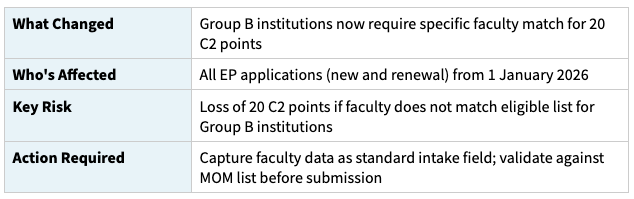
What Changed in 2026
MOM's updated list states:
- Group A institutions: 20 points are awarded for degrees from all faculties
- Group B institutions: 20 points are awarded only for degrees from specific faculties
Employers must select the institution and the faculty from the Employment Pass application form dropdown. Two candidates from the same university can be awarded different points - faculty is no longer background detail, it is now a field that directly determines how many points get awarded.
Why This Matters, Even When the Candidate Is Clearly Qualified
Many HR teams have a working mental model: "Candidate has a degree from University X, so we should get 20 points." In 2026, that model only holds for Group A institutions. For Group B, graduating from a named university alone is no longer enough to predict the outcome. The faculty has to match what is listed as eligible.
This can show up in everyday situations:
- The candidate's CV lists the school clearly, but the faculty name is missing or abbreviated
- The degree certificate uses a faculty name that does not match how internal forms capture it
- Someone selects an institution correctly in the EP form, but the faculty selection is off, because the organisation never standardised how to collect it
How the List Works
Think of the 20-point list as having two categories:
Group A: Straightforward
If the institution is Group A, degrees from all faculties qualify for 20 points.
Group B: Faculty-Specific
If the institution is Group B, only degrees from the specific faculties listed for that institution qualify for 20 points.
A practical implication is that the "same school" can lead to different outcomes when two candidates studied different faculties at the same institution. If your organisation has roles where COMPASS margins are tight, this is the kind of detail that you’d want to handle earlier than later.
Putting it into Context
Consider two candidates with bachelor's degrees from the same Group B institution:
- Candidate A: Studied in a faculty that is listed as eligible for that institution = 20 points
- Candidate B: Studied in a faculty not listed = 0 points
In 2026, these can be treated differently for C2 scoring, even though both degrees are legitimate and both candidates may be strong.
What to Update in Your Workflow: Three Workable Approaches
Different organisations will approach this differently. Here are three approaches you can choose from, depending on your hiring volume and how much you rely on C2 points.
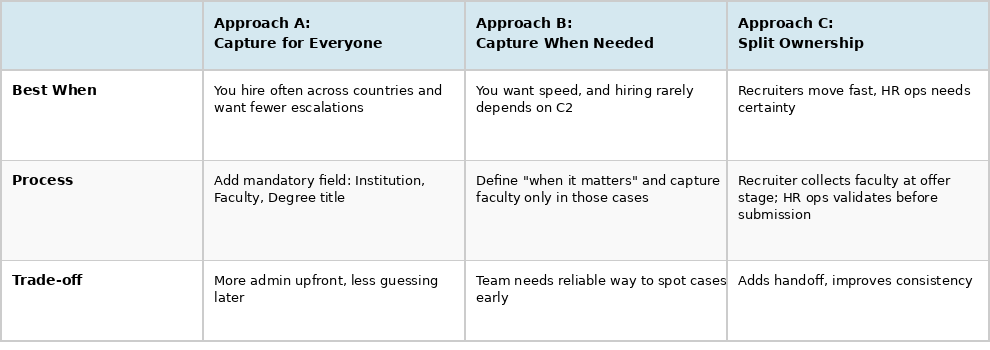
Approach A: Capture Faculty for Every EP Candidate (Default Standard)
Best when: You hire often across countries and want fewer one-off escalations.
How it works:
- Add a mandatory field to your candidate intake: Institution, Faculty, Exact degree title
- Ask candidates to copy the faculty wording exactly as it appears on the certificate
- Store it in one place that recruiters and HR ops both use
Trade-off: More time-consuming for your candidate and yourself upfront, but less guessing later.
Approach B: Capture Faculty Only When C2 Points Are Likely to Matter
Best when: You want speed, and your hiring outcomes rarely depend on C2.
How it works:
- Define "when it matters", such as borderline COMPASS cases, specific job families, or specific geographies
- Capture faculty only in those cases
Trade-off: Your team needs a reliable way to spot these cases early. If not, this becomes inconsistent.
Approach C: Split Ownership (Recruiter Collects, HR Ops Validates)
Best when: Recruiters move fast, and HR ops needs submission certainty.
How it works:
- Recruiter collects faculty details during offer stage
- HR ops validates faculty against the list before submission
Trade-off: Adds a handoff, but improves consistency if HR ops is well-equipped.
A Simple "Faculty-Ready" Intake Checklist
If you want something operational but light, this is a good baseline:
- Institution name as shown on certificate
- Faculty or school name as shown on certificate
- Qualification title exactly as shown on certificate
- Awarding year
- Link or attachment to certificate or official transcript
Then, before submission, ask one question:
- Is this institution Group A or Group B, and if Group B, does the faculty match the eligible list?
Common Friction Points and How Teams Handle Them
1. Faculty Is Not Obvious on the CV
The Problem: Many candidates list the university and degree, but not the faculty. For candidates who graduated a long time ago, they may no longer remember which faculty they studied in.
How teams handle it: Request one extra detail early, rather than chasing it after paperwork begins. Get the candidate to check and find out their faculty details because it is a mandatory requirement.
2. Faculty Naming Is Inconsistent
The Problem: Certificates can use naming conventions that differ from internal intake forms.
How teams handle it: Store the faculty as two fields:
- Faculty name as written on certificate
- Faculty name as selected in the EP dropdown
This reduces confusion when someone revisits the record months later.
3. Multiple Stakeholders Touching the Same Data
The Problem: When recruiters, HR ops, and mobility teams each store education details in different places, mismatches become more likely.
How teams handle it: Fix this with one shared checklist and one owner.
Diagnostic Question
If you are curious which friction point you have, ask internally: "Where do we go to find faculty information today?" If the answer is unclear or varies by person, you have a data ownership gap.
{{mom="/components"}}
Related Resources
Read More
.png)
.png)




FAQs

This depends on the industry and type of role you are recruiting for. To determine whether you need reference checks, identity checks, bankruptcy checks, civil background checks, credit checks for employment or any of the other background checks we offer, chat to our team of dedicated account managers.
Many industries have compliance-related employment check requirements. And even if your industry doesn’t, remember that your staff have access to assets and data that must be protected. When you employ a new staff member you need to be certain that they have the best interests of your business at heart. Carrying out comprehensive background checking helps mitigate risk and ensures a safer hiring decision.
Again, this depends on the type of checks you need. Simple identity checks can be carried out in as little as a few hours but a worldwide criminal background check for instance might take several weeks. A simple pre-employment check package takes around a week. Our account managers are specialists and can provide detailed information into which checks you need and how long they will take.
All Veremark checks are carried out online and digitally. This eliminates the need to collect, store and manage paper documents and information making the process faster, more efficient and ensures complete safety of candidate data and documents.
In a competitive marketplace, making the right hiring decisions is key to the success of your company. Employment background checks enables you to understand more about your candidates before making crucial decisions which can have either beneficial or catastrophic effects on your business.
Background checks not only provide useful insights into a candidate’s work history, skills and education, but they can also offer richer detail into someone’s personality and character traits. This gives you a huge advantage when considering who to hire. Background checking also ensures that candidates are legally allowed to carry out certain roles, failed criminal and credit checks could prevent them from working with vulnerable people or in a financial function.
Trusted by the world's best workplaces


APPROVED BY INDUSTRY EXPERTS
.png)
.png)


and Loved by reviewers


Transform your hiring process
Request a discovery session with one of our background screening experts today.