
Employment Pass Education Verification in 2026: The 3 Key Changes HR Teams Must Know for EP Submissions



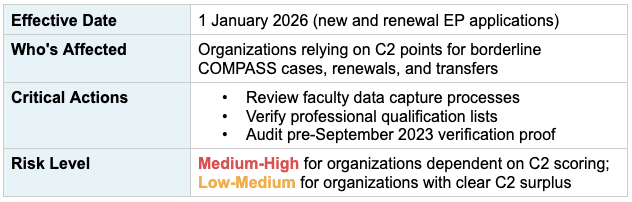
From 1 January 2026, three changes to MOM's education verification requirements will affect how HR teams score COMPASS C2 points and whether borderline EP applications succeed or fail. With the November 2025 list updates, the stakes are particularly high for organisations that rely on C2 points to meet COMPASS thresholds, or where faculty-specific qualifications can determine approval or rejection.
The changes are operational rather than conceptual. They introduce new data requirements, tighter verification rules, and faculty-level distinctions that many teams do not capture today. This guide walks you through what has changed, what stays the same, and the practical adjustments HR teams are implementing to stay compliant.
Quick Reference
Context: Where Education Verification Sits in the EP Process
Employment Pass candidates generally need to meet the EP qualifying salary and, unless exempted, pass the points-based COMPASS framework. COMPASS includes C2 (Qualifications) as one of four individual attributes. Declaring qualifications is not always compulsory. It becomes essential when you need those points to meet COMPASS requirements, or when a specific pathway requires it.
The key question: When are we relying on qualifications to carry part of the eligibility outcome? This distinction matters because the 2026 changes make qualification details more consequential.
The 2026 Changes: What You Need to Know
MOM released updated COMPASS C2 lists in November 2025, applicable from 1 January 2026. Two lists directly affect C2 scoring outcomes and verification requirements.
Change 1: Faculty Now Determines C2 Points for Group B Institutions
What MOM Changed
The updated list of institutions awarded 20 points under C2 now distinguishes between two groups:
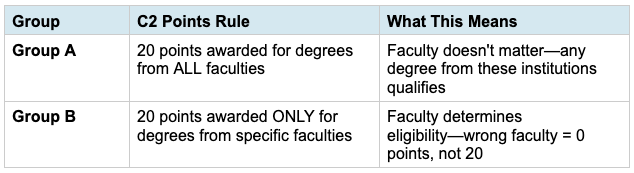
Critical requirement: MOM now requires employers to select both institution name and faculty in the EP application form dropdowns. This is part of the eligibility logic, not optional context.
Why This Matters
In most organisations, candidate intake captures institution, qualification title, and graduation year. Faculty is often missing or treated as optional context. The 2026 list makes faculty determinative, not contextual.
Putting it into context
Two candidates both studied at Institution X (Group B):
- Candidate A: Faculty of Engineering (listed as eligible) = 20 C2 points
- Candidate B: Faculty of Arts (not listed) = 0 C2 points
Same institution, different C2 outcome. If your COMPASS calculation depends on those 20 points, Candidate B's application may fail.
💡 Question Worth Asking Internally
If your team had to find faculty information tomorrow for ten active candidates, where would it come from? CV text, certificates, candidate emails, HRIS fields, or "someone remembers"?
If the answer is not "HRIS field" or "standard intake form", you have a process gap.
{{the-often-overlooked-detail-that-can-change-your-compass-points="/components"}}
Change 2: Professional Qualifications Now Have Explicit Proof Requirements
What MOM Changed
MOM's updated list of degree-equivalent professional qualifications (released November 2025) states that EP candidates will earn 10 points on COMPASS C2 if they hold listed qualifications. Employers must submit verification proof confirming authenticity when applying.
Why This Matters
Professional qualifications show up in hiring in three ways:
- Primary credential for specialised roles (e.g. regulated professions like accounting, law, engineering)
- Supplemental credential in addition to a degree
- Fallback credential when a degree route is unclear or unavailable
The explicit proof requirement means you cannot claim the 10 C2 points without submitting verification proof upfront.
Connection to Other COMPASS Criteria
Some EP pathways reference "degree-equivalent qualification" as a minimum requirement. For example, the Shortage Occupation List (SOL) Skills Bonus specifies at least a degree-equivalent qualification, which ties back to scoring 10 points on C2. This shows how qualifications matter beyond generic C2 points. They can be threshold requirements for specific bonuses or pathways.
💡 Question Worth Asking Internally
When a candidate's strongest credential is a professional qualification, do you have a consistent process to:
- Confirm it appears on the 2026 list?
- Verify the awarding institution matches the list exactly?
- Determine what you will accept as verification proof for EP submission?
{{mom-what-counts-what-proof-you-will-need-what-to-check-before-you-submit-professional-qualifications-for-compass-c2="/components"}}
Change 3: "Verify Once" Has a Critical Exception for Pre-September 2023 Proof
What Stays the Same
MOM's June 2023 policy established that employers verify each candidate's qualifications once when submitting the EP application. Once verified, there is no need to reverify for renewals or employer changes. The EP application form prompts you if verification is needed.
The Exception: Proof Issued Before 1 September 2023
For verification proof issued before 1 September 2023, you need to ask the background screening company to reissue the proof with a MOM verification reference number. MOM's FAQ confirms: approach the screening company to reissue with a reference number, which you will key into the EP application form. Old proof without the reference number is not submission-ready under current requirements.
Why This Matters
Many employers have verified folders or HRIS attachments storing older documents. The document may be legitimate but not submission-ready. This tends to surface during:
- EP renewals
- Employer transfers
- Situations where the original verification was done years ago and different people now own the process
💡 Practical Thought Experiment
If a new HR ops team member joined and had to renew 20 EPs next month, how would they identify which verification proofs are pre-1 September 2023 and need reissue?
If the answer is "manually check each file", you need a system.
{{mom-audit-this-before-your-next-ep-renewal="/components"}}
What Did Not Change (But Is Easy to Overlook)
Sometimes the risk is the existing policy people stop paying attention to because everything feels routine.
Education Verification Has Been Mandatory Since September 2023
MOM's June 2023 announcement positioned verification as a trust mechanism to reduce fraud. This context matters because it signals how seriously MOM treats verification proof.
COMPASS Still Depends on How You Declare Qualifications
MOM's COMPASS guide notes you can choose to provide qualifications if the application needs points from C2. This becomes more consequential in 2026 because the lists are more detailed.
Two approaches to consider:
- Declare everything: Creates more documentation work, may not provide benefit
- Declare only what you need: Risk of missing points you intended to rely on
Neither is universally right. The key is knowing which approach your organisation is taking and ensuring your team executes it consistently.
Your 2026 Implementation Checklist
Based on what HR teams are implementing in practice, here are three high-impact adjustments for 2026 compliance:
1. Capture "Institution + Faculty" as Standard Intake Data
The Problem: Faculty is not captured early, so teams chase it late when candidates are unavailable and start dates are already communicated.
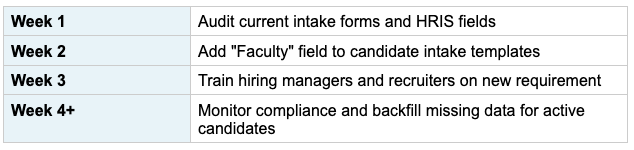
The Solution: Add one field to your intake template asking candidates to copy the faculty name exactly as it appears on their certificate.
Implementation Timeline:
2. Treat Professional Qualifications Like Primary Credentials
The Problem: Professional qualifications are treated as side notes rather than verifiable inputs with point consequences.
The Solution: Treat professional qualifications exactly like degrees in your verification checklist:
- Confirm the credential aligns to the 2026 list
- Confirm the awarding institution matches the list exactly
- Confirm you can produce verification proof at submission time
Who this affects most: Organisations hiring for roles that rely on professional credentials (accounting, finance, engineering, legal) or hiring from regions where degree comparability is complex.
3. Implement a Simple Rule for Pre-September 2023 Proof
The Problem: Teams assume "verified once" means the proof in their files is submission-ready, when it may need reissue.
The Solution: Adopt a two-part rule:
- Pre-1 Sept 2023 proof: Flag it and plan for reissue early (do not wait until submission deadline)
- Post-1 Sept 2023 proof: Store the MOM reference number in a consistent HRIS field or folder naming convention
Practical step: Run a one-time audit of your verification proof folder. Tag or move pre-Sept 2023 files to a "Needs Reissue" subfolder. Contact your screening company proactively for batch reissue before renewal dates hit.
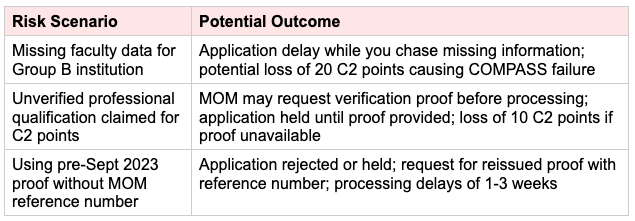
Consequences of Non-Compliance
Understanding the risk profile helps prioritise implementation:
Key Resources and Links
- MOM Employment Pass Eligibility
- COMPASS Framework Overview
- List of Institutions (20 points): Available under COMPASS C2 documentation on MOM website
- Professional Qualifications List (10 points): Available under COMPASS C2 documentation on MOM website
- MOM-Approved Background Screening Companies
- Documents Required for EP
- SOL Skills Bonus Details
Final Thoughts
The 2026 education verification changes are operational refinements that make existing rules more precise. Precision matters when C2 points determine whether an application succeeds or fails.
Organisations handling this well treat these changes as data capture upgrades. They ask: What do we need to capture earlier in the hiring process so we are not scrambling at submission time?
The implementation checklist above gives you the three highest-impact adjustments. Start with faculty data capture. It affects the most applications and has the clearest operational fix.
If you want support implementing these changes, Veremark's background screening team works with employers on MOM-compliant education verification processes. Reach out if you would like to discuss your specific situation.
{{mom="/components"}}
Frequently Asked Questions
What if my candidate's institution is not on either list?
If the institution does not appear on the 20-point list, the candidate will not score C2 points for that qualification. However, they may still be eligible for an EP if they meet other COMPASS criteria or salary thresholds. Consider whether the candidate has a professional qualification that appears on the 10-point list, or whether their salary and other attributes provide sufficient COMPASS points.
Can I use verification from a non-MOM approved provider?
No. MOM requires verification through their approved background screening companies. Verification from other providers will not be accepted for EP applications. Check MOM's website for the current list of approved providers.
What is the cost and turnaround time for verification versus reissue?
Costs and turnaround times vary by screening company and qualification type. Generally, reissue is faster (1-3 business days) and cheaper than initial verification (which can take 2-6 weeks depending on the institution and country). Contact your preferred MOM-approved screening company for current pricing.
If a candidate has both a degree and a professional qualification, which should I declare?
Declare whichever credential gives you the most C2 points (or both, if both contribute meaningfully). If the degree is from a Group A institution (20 points), that is typically your primary credential. If the degree is from an institution not on the list but the candidate has a listed professional qualification (10 points), declare the professional qualification. However, declaring both creates more verification work without additional benefit if you have already maxed out C2 points.
What happens if I select the wrong faculty for a Group B institution?
If you select a faculty that is not listed as eligible for that Group B institution, the candidate will not receive the 20 C2 points. This could cause the application to fail if you were relying on those points to meet COMPASS thresholds. MOM may also request clarification or reject the application if the faculty-qualification mismatch is apparent. Always verify faculty eligibility before submission.
How do I access the actual 2026 C2 lists?
The lists are available on MOM's website under the Employment Pass eligibility section, specifically in the COMPASS C2 (Qualifications) documentation. Look for the "List of institutions awarded 20 points" and "List of degree-equivalent professional qualifications awarded 10 points" published in November 2025.
Read More





FAQs

This depends on the industry and type of role you are recruiting for. To determine whether you need reference checks, identity checks, bankruptcy checks, civil background checks, credit checks for employment or any of the other background checks we offer, chat to our team of dedicated account managers.
Many industries have compliance-related employment check requirements. And even if your industry doesn’t, remember that your staff have access to assets and data that must be protected. When you employ a new staff member you need to be certain that they have the best interests of your business at heart. Carrying out comprehensive background checking helps mitigate risk and ensures a safer hiring decision.
Again, this depends on the type of checks you need. Simple identity checks can be carried out in as little as a few hours but a worldwide criminal background check for instance might take several weeks. A simple pre-employment check package takes around a week. Our account managers are specialists and can provide detailed information into which checks you need and how long they will take.
All Veremark checks are carried out online and digitally. This eliminates the need to collect, store and manage paper documents and information making the process faster, more efficient and ensures complete safety of candidate data and documents.
In a competitive marketplace, making the right hiring decisions is key to the success of your company. Employment background checks enables you to understand more about your candidates before making crucial decisions which can have either beneficial or catastrophic effects on your business.
Background checks not only provide useful insights into a candidate’s work history, skills and education, but they can also offer richer detail into someone’s personality and character traits. This gives you a huge advantage when considering who to hire. Background checking also ensures that candidates are legally allowed to carry out certain roles, failed criminal and credit checks could prevent them from working with vulnerable people or in a financial function.
Trusted by the world's best workplaces


APPROVED BY INDUSTRY EXPERTS
.png)
.png)


and Loved by reviewers


Transform your hiring process
Request a discovery session with one of our background screening experts today.