
Should HR introduce a “trust threshold” for background screening different roles?


Treating every hire the same sounds fair, but in background screening, it often makes very little sense.
A junior employee with limited access can end up waiting on checks that add almost no value to the role. At the same time, someone else may be joining a team where they can move money, view sensitive customer data, change critical systems or make decisions with little oversight.
Those are different levels of risk. Your screening process should recognise that.
We think HR teams should introduce a trust threshold for different roles. The more access, authority or potential for harm a role carries, the stronger the screening should be. Lower-risk roles can move through onboarding with fewer checks. Higher-risk roles should face greater scrutiny before access is granted.
And this should not stop on someone's first day.
If an employee is promoted into a role with more authority, more sensitive access or greater control over money, systems or people, you should reassess whether the screening they completed when they joined is still enough.
That is a more sensible way to think about trust at work.
Screen for the role in front of you
Many screening programmes are built around standard packages.
Every employee in a country might receive the same checks. Everyone above a certain seniority gets another package. Some organisations apply the same process to almost every hire because it is simpler to administer.
Simple is not always useful.
Take two software developers. One works on a public website with limited production access. The other has administrator rights across infrastructure containing customer data.
Giving both candidates the same screening package ignores the part that actually matters: what they will be trusted to do.
The same problem appears across organisations.
A payroll administrator may be able to amend employee bank details. A finance hire may approve large payments. Someone in customer support could have access to extensive personal data. A relatively junior engineer might hold credentials that can change live systems.
Job titles tell you surprisingly little about actual exposure.
A trust threshold starts somewhere else. You look at the access attached to the role, then decide what evidence you need before giving someone that access.
More checks are not always better
There is an understandable temptation to treat more screening as safer screening.
That can quickly become wasteful.
If a role has no responsibility for money, a financial history check may add little. If qualifications have no bearing on someone's ability to do the job, spending days verifying them may achieve very little. Running unnecessary checks also creates more work for HR teams and more friction for candidates.
That matters when you are trying to get people started.
Screening can hold up onboarding when employers wait for checks that are only loosely connected to the role. A more proportionate approach gives you room to move lower-risk employees through the process faster.
That does not mean lowering standards. It means being clearer about what you are trying to establish.
Our experience across global screening programmes is that different roles and sectors already produce very different risk profiles.
In Veremark's analysis of close to half a million employment checks, education checks recorded discrepancies in 21.1% of cases and employment checks in 15.3%. Screening patterns also varied substantially by industry. Financial services placed more emphasis on areas such as financial history and sanctions, while healthcare relied more heavily on employment and academic verification.
That variation is exactly what you would expect.
The risks are different, so the checks should be different too.
Our guidance on screening in regulated industries follows the same principle. Start with the role, understand the risk, then select checks that have a clear reason to be there.
Identity should come first
There is one part of screening that sits underneath almost every trust decision: are you dealing with the person they claim to be?
As Elaine Ooi, VP of People & Culture at Veremark, puts it:
"The level of screening should reflect the role and the access that person will have in your organisation. You could spend days confirming someone's employment history and qualifications, only to discover later that there is a discrepancy with the identity attached to the application. Starting with identity reduces that risk."
That point has become more important as recruitment fraud has become easier to scale.
According to The Times, in June 2026, more than 700 suspected North Korean bots applied for remote-working roles at a large UK bank. The applicants reached initial virtual interviews before being identified as suspicious.
That should make any employer think carefully about what sits behind a polished application.
A credible CV is no longer especially difficult to produce. Neither is a convincing cover letter. Deepfake technology and AI-generated identities make it harder to assume that a strong remote interview tells you very much about who is actually on the other side of the screen.
Daniel Callaghan, CEO and Co-founder of Veremark, has warned about exactly this shift:
“AI-generated CVs, deepfake identities, falsified credentials, and increasingly complex global regulations have made background screening far more challenging. Background screening is really about minimizing risk. It’s about ensuring that the people handling your data or money are trustworthy.”
That is the logic behind role-based screening.
The more sensitive the access, the more confidence you should have in the person receiving it.
Our guide to identity verification explains why identity should come early in the process. If you are working from a false identity, every check that follows can give you confidence in the wrong person.
Promotions should trigger another look
One of the biggest weaknesses in many screening policies is that they focus almost entirely on the point of hire.
People do not stay in the same roles forever.
Someone can join in a position with limited access, then be promoted into a job where they approve payments, manage sensitive information, control systems or make decisions that carry much greater risk.
.png)
Their trust threshold has changed, even if their employer has not thought about it that way.
If the role changes materially, it is reasonable to ask whether the original screening still matches the new level of responsibility.
That could mean additional checks when somebody moves into finance, gains privileged system access, starts working with vulnerable people or steps into a regulated position.
It does not mean rescreening everybody whenever their title changes. The trigger should be a meaningful increase in access or authority.
This is also where external and internal hiring policies can become oddly inconsistent.
An external candidate for a senior role may face extensive screening before they join. An existing employee can sometimes be promoted into an almost identical role without anyone checking whether their original screening covered the same risks.
Familiarity is not a control.
If the role now carries greater exposure, you should review the screening against the role as it exists today.
Seniority is only part of the picture
It would be easy to turn a trust threshold into another hierarchy.
That would miss the point.
Some senior roles clearly carry considerable risk because of their authority. Others may have less operational access than relatively junior technical or financial positions.
What matters is what someone can actually do.
Can they move money?
Can they access confidential customer records?
Can they alter critical infrastructure?
Can they work unsupervised with vulnerable people?
Can they make decisions with significant legal, financial or reputational consequences?
Those questions tell you far more than a job grade.
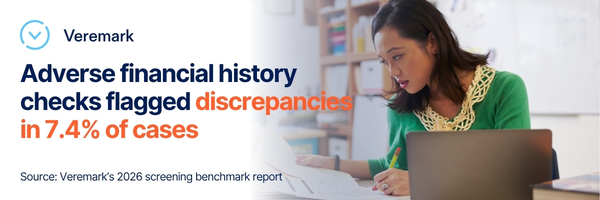
Veremark's screening data, for example, found that adverse financial history checks flagged discrepancies in 7.4% of cases. That may be highly relevant for someone handling client funds or financial approvals. It is far harder to justify for an employee whose role has no financial responsibility.
A good screening policy should be able to explain why every check exists.
If you cannot connect the check to a meaningful risk in the role, it is worth asking whether it belongs there.
Treat trust as something that changes
Cybersecurity teams have long understood that access should reflect responsibility.
You would not give every employee administrator rights because it is easier than setting permissions properly. Screening deserves the same discipline.
Set a sensible baseline. Then increase screening where the role creates more exposure. Revisit it when someone's access changes.
Our guide to background checks for AI job application scams takes the same position. A remote engineer, a finance hire and a junior marketing employee do not automatically need the same screening process.
That is the real benefit of a trust threshold.
You spend less time on checks that add little. Lower-risk hires can get through onboarding more quickly. Higher-risk positions receive the attention they deserve. And when somebody moves into a role with more authority, you have a clear reason to review whether the trust you are placing in them still matches the checks you have completed.
Background screening works better when it reflects the job people are actually being asked to do.

Read More



.png)
FAQs

This depends on the industry and type of role you are recruiting for. To determine whether you need reference checks, identity checks, bankruptcy checks, civil background checks, credit checks for employment or any of the other background checks we offer, chat to our team of dedicated account managers.
Many industries have compliance-related employment check requirements. And even if your industry doesn’t, remember that your staff have access to assets and data that must be protected. When you employ a new staff member you need to be certain that they have the best interests of your business at heart. Carrying out comprehensive background checking helps mitigate risk and ensures a safer hiring decision.
Again, this depends on the type of checks you need. Simple identity checks can be carried out in as little as a few hours but a worldwide criminal background check for instance might take several weeks. A simple pre-employment check package takes around a week. Our account managers are specialists and can provide detailed information into which checks you need and how long they will take.
All Veremark checks are carried out online and digitally. This eliminates the need to collect, store and manage paper documents and information making the process faster, more efficient and ensures complete safety of candidate data and documents.
In a competitive marketplace, making the right hiring decisions is key to the success of your company. Employment background checks enables you to understand more about your candidates before making crucial decisions which can have either beneficial or catastrophic effects on your business.
Background checks not only provide useful insights into a candidate’s work history, skills and education, but they can also offer richer detail into someone’s personality and character traits. This gives you a huge advantage when considering who to hire. Background checking also ensures that candidates are legally allowed to carry out certain roles, failed criminal and credit checks could prevent them from working with vulnerable people or in a financial function.
Trusted by the world's best workplaces


APPROVED BY INDUSTRY EXPERTS
.png)
.png)


and Loved by reviewers


Transform your hiring process
Request a discovery session with one of our background screening experts today.