Managing the hidden access risk of third-party contractors: 6 key takeaways from our webinar


How confident are you that everyone with access to your organisation's systems, data and workplaces has undergone appropriate background screening?
For permanent employees, the answer is usually fairly straightforward. Most organisations have established processes for verifying identities, checking credentials and assessing potential risks before someone joins the business.
But what about the contractors, consultants, agency workers and supplier personnel who might have exactly the same access?
As businesses become increasingly reliant on external workers, maintaining consistent oversight of everyone operating within the organisation is becoming more challenging.
In our recent webinar, Third-Party Workforce Risk: Managing the Hidden Access Risk, Adam Cooney from Veremark explored where these risks arise and how HR, Procurement and Compliance leaders can close the gaps in their existing screening processes.
For anyone who missed the discussion, here are six important takeaways.
1. The workforce you can't see could be your biggest blind spot
One of Adam's opening observations was that many organisations have a much larger workforce than their employee records might suggest.
Alongside permanent employees, businesses increasingly rely on contractors, agency workers, consultants and individuals supplied through third-party companies.
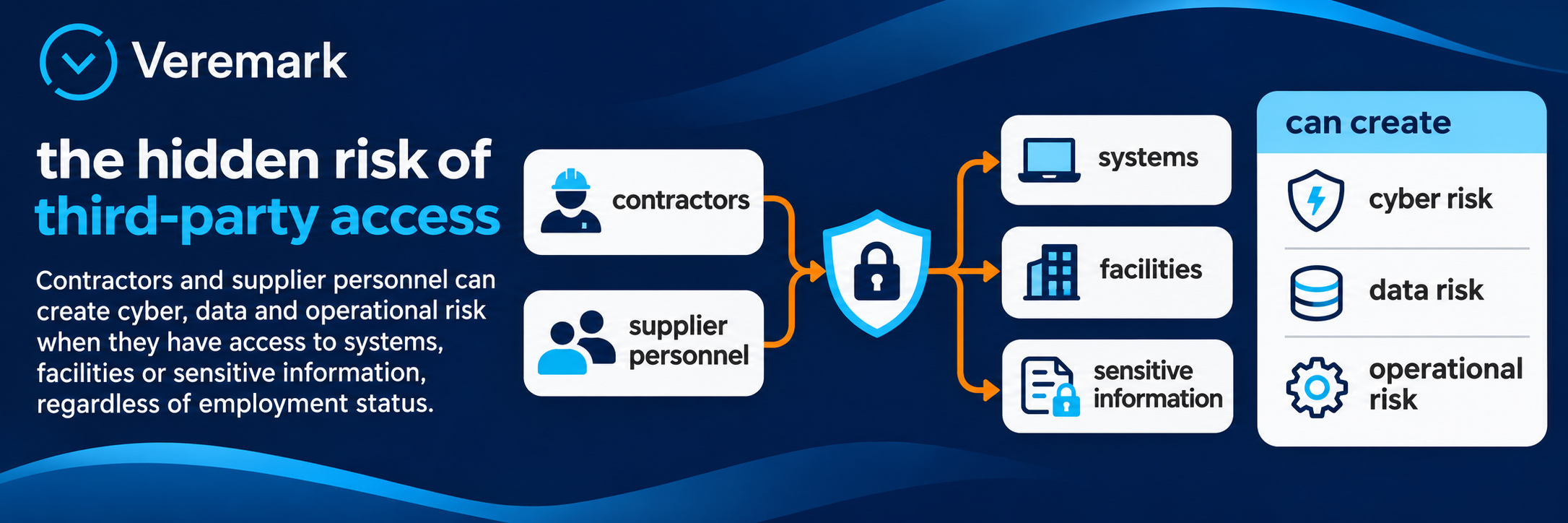
These people may have access to sensitive systems, customer information, financial records or physical premises. However, their onboarding and screening processes can look very different from those used for permanent employees.
Consider an external IT consultant brought in to support a major project. They might receive privileged access to internal systems within days of starting, yet the organisation may have limited visibility of the background checks they've undergone.
This creates a hidden workforce risk that can easily be overlooked.
Someone doesn't need to appear on your payroll to have access to your organisation's most valuable assets.
For HR and Compliance leaders, understanding the full extent of your workforce is the starting point for managing that risk.
2. The level of access matters more than employment status
An important message from the webinar was that employment status alone is a poor indicator of risk.
A permanent employee, contractor and supplier representative could all have access to the same confidential information. Yet the level of screening applied to each person might be completely different.
Often, it's simply because they entered the organisation through different processes.
Adam encouraged organisations to consider the relationship between an individual's responsibilities, their access permissions and the potential consequences if something goes wrong.
For example, a contractor with administrative access to sensitive financial systems is likely to require a different level of verification from someone carrying out occasional work in a low-risk environment.
The solution isn't necessarily to make every worker complete the same background checks.
Instead, organisations should establish consistent, risk-based screening standards, ensuring that people with comparable levels of access and responsibility undergo appropriately equivalent checks.
This can help businesses strengthen security without introducing unnecessary complexity or delays into contractor onboarding.
For further guidance, read our article on the background checks UK employers should consider for contract workers.
3. Knowing your supplier doesn't mean you know their employees
Most organisations have supplier due diligence procedures in place.
Procurement teams may assess a company's financial stability, regulatory compliance, security certifications and ability to deliver a particular service.
But Adam highlighted a significant gap in this approach: supplier assurance doesn't always translate into assurance about the individuals carrying out the work.
A supplier could meet every contractual requirement while the people they provide have undergone screening that falls short of your organisation's own standards.
The distinction is important.
Knowing that a supplier is compliant tells you something about the business. It doesn't necessarily tell you who has access to your systems, what checks those individuals have completed or whether those checks are still relevant.
The situation becomes even more complicated when suppliers subcontract work to other organisations.
This is where businesses need to look beyond contractual assurances and establish a reliable process for verifying the individuals working on their behalf.
The risk often sits in the gaps between different processes, particularly where Procurement, suppliers, HR and IT operate independently.
4. Outsourcing a service doesn't remove the potential consequences
The webinar also examined the wider consequences of security failures involving third-party service providers.
Adam referenced the 2023 cyberattack on Capita, one of the UK's largest outsourcing providers, to illustrate how an incident within a supplier organisation can affect its customers.
The attack resulted in the theft of personal information belonging to approximately 6.6 million people, including individuals whose data was held on behalf of other organisations.
In October 2025, the Information Commissioner's Office fined two Capita entities a combined £14 million for failures to protect personal information.
Although the breach wasn't attributed to inadequate contractor background screening, the case demonstrates how risks within external business relationships can have far-reaching consequences.
For organisations that depend on suppliers to manage sensitive information or deliver essential services, understanding the associated risks is crucial.
Outsourcing responsibility for a service doesn't mean the commercial and reputational consequences will remain with the supplier.
This makes effective supplier due diligence, individual screening and ongoing oversight important parts of an organisation's wider risk management strategy.
5. Background screening shouldn't end when a contractor starts work
Another key takeaway was the importance of managing third-party workforce risk throughout the engagement lifecycle.
Many organisations focus their attention on onboarding. Background checks are completed, access is granted and the individual begins working.
But what happens six months later?
A contractor might take on additional responsibilities, gain access to more sensitive information or remain with the organisation considerably longer than originally expected.
Meanwhile, the circumstances that informed their original risk assessment may have changed.
Adam explained why organisations should build regular reviews into their third-party workforce management processes, particularly when an individual's role, access permissions or responsibilities change.
Depending on the role and applicable requirements, this could involve additional verification, periodic rescreening or reassessing the level of access someone needs.
The same principle applies when an engagement ends. Organisations need reliable processes to ensure that access permissions are removed promptly and records are updated.
An individual's level of risk can change throughout their engagement. Your screening and oversight processes should be able to respond accordingly.
You can learn more about when and how to repeat background checks in our guide to rescreening for compliance and risk management.
6. Everyone owns a piece of third-party risk, but who owns the whole process?
One of the most practical discussions in the webinar focused on accountability.
In many organisations, different departments are responsible for different stages of the third-party workforce journey.
HR manages screening. Procurement assesses suppliers. IT grants system permissions. Compliance oversees governance. Hiring managers determine who they need and what those individuals will be doing.
Each team has an important role, but problems can arise when there's no clear ownership of the overall process.
For example, Procurement might approve a supplier without confirming individual screening requirements, while IT could grant system access without knowing whether the necessary checks have been completed.
Adam encouraged organisations to consider five questions:
- Who has access? Can you identify every employee, contractor and supplier representative accessing your organisation?
- What was checked? Do you know which background checks each individual has completed?
- Did those checks meet your standards? Can you demonstrate that screening was appropriate for their role and level of risk?
- Who owns the risk? Is there clear accountability for approving access and maintaining oversight?
- Could you evidence it? If challenged by an auditor or regulator, could you demonstrate that appropriate processes were followed?
If these questions are difficult to answer, there may be gaps worth investigating.
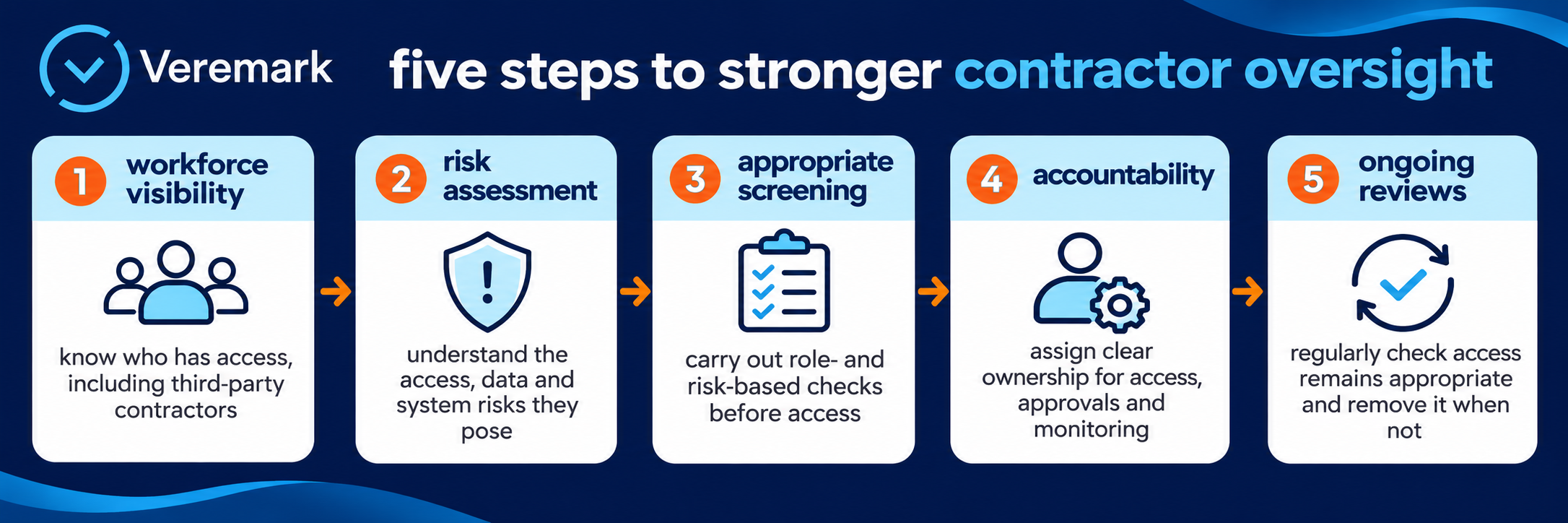
Adam concluded with five practical steps for improving third-party workforce oversight: map your workforce, understand access and risk, standardise screening requirements, define ownership and continue reviewing risk throughout the engagement lifecycle.
For additional insight into building a more consistent screening strategy, read our article on five outdated hiring assumptions HR teams should leave behind.
Strengthening your approach to third-party background screening
As organisations increasingly rely on external workers, ensuring consistent screening standards across the wider workforce is becoming an important part of protecting sensitive information, maintaining compliance and reducing business risk.
The key message from Veremark's webinar was that organisations need greater visibility of who has access to their business and confidence that appropriate checks have been completed.
Veremark's global background screening solutions help businesses establish consistent, risk-based verification processes for employees, contractors and other third-party personnel.
With access to background checks across more than 180 countries, including identity verification, employment history, criminal record checks and professional qualifications, Veremark can help you strengthen screening standards while keeping onboarding efficient.
Speak to our team to discover how Veremark can help your organisation reduce third-party workforce risk.
Missed the webinar? Watch Third-Party Workforce Risk: Managing the Hidden Access Risk on demand for more practical insights from Adam Cooney.




FAQs

This depends on the industry and type of role you are recruiting for. To determine whether you need reference checks, identity checks, bankruptcy checks, civil background checks, credit checks for employment or any of the other background checks we offer, chat to our team of dedicated account managers.
Many industries have compliance-related employment check requirements. And even if your industry doesn’t, remember that your staff have access to assets and data that must be protected. When you employ a new staff member you need to be certain that they have the best interests of your business at heart. Carrying out comprehensive background checking helps mitigate risk and ensures a safer hiring decision.
Again, this depends on the type of checks you need. Simple identity checks can be carried out in as little as a few hours but a worldwide criminal background check for instance might take several weeks. A simple pre-employment check package takes around a week. Our account managers are specialists and can provide detailed information into which checks you need and how long they will take.
All Veremark checks are carried out online and digitally. This eliminates the need to collect, store and manage paper documents and information making the process faster, more efficient and ensures complete safety of candidate data and documents.
In a competitive marketplace, making the right hiring decisions is key to the success of your company. Employment background checks enables you to understand more about your candidates before making crucial decisions which can have either beneficial or catastrophic effects on your business.
Background checks not only provide useful insights into a candidate’s work history, skills and education, but they can also offer richer detail into someone’s personality and character traits. This gives you a huge advantage when considering who to hire. Background checking also ensures that candidates are legally allowed to carry out certain roles, failed criminal and credit checks could prevent them from working with vulnerable people or in a financial function.
Trusted by the world's best workplaces




APPROVED BY INDUSTRY EXPERTS



and Loved by reviewers


Transform your hiring process
Request a discovery session with one of our background screening experts today.