
Why the first 48 hours after a speak-up report decide trust


Early handling shapes confidence in your reporting process
Most organisations put a lot of effort into the front door of reporting. They launch a channel, publish a policy, run training, and feel relieved that the system now exists. That work matters, but it often distracts from the part employees pay attention to most.
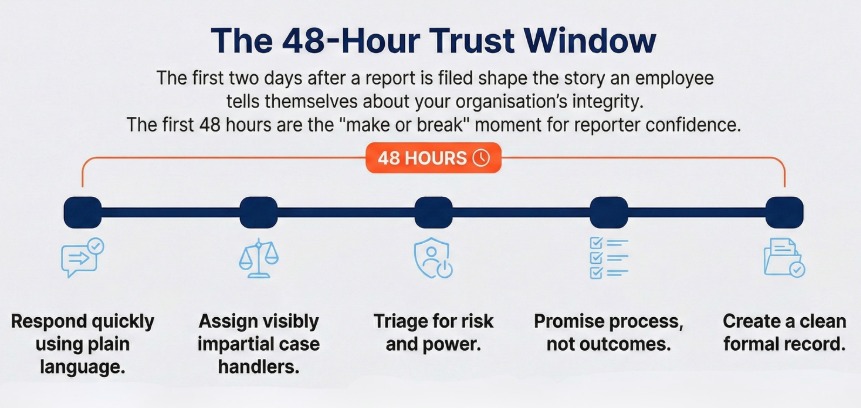
When someone speaks up, they don’t judge your programme by the channel. They judge it by what happens next. The first two days do not determine the outcome of a case, but they do shape the story the reporter tells themselves about your organisation. They decide if you take concerns seriously, if you can act with discipline, and if you can keep a process fair when pressure starts to build.
This is why the first 48 hours matter more than many teams admit. You can run a compliant programme and still lose trust early, simply through slow response, unclear ownership, or handling that looks “too close” to the people involved.
The questions people ask, even when they don’t say them
In the first 48 hours, a reporter often runs through a small set of questions.
- Will anyone take this seriously, or will they label it drama?
- Will this get back to the person I’m reporting?
- Will I face blowback?
- Will the organisation treat the facts fairly, or protect a reputation?
You do not need to answer all of these with detail. You do need to respond in a way that shows you recognise the risk the person took by coming forward, and you run a process you can stand behind.
A scenario worth pressure-testing
Picture a report that doesn’t come packaged neatly. A respected employee reports a senior leader for a pattern. Intimidation in meetings, boundary-crossing comments, pressure to keep problems “in the team.” It isn’t headline material. It is also the kind of issue that can shape culture for years if people feel they can’t challenge it.
Now look at your system through that lens. Who receives the report. Who decides who handles it. How quickly does the reporter hear back. How do you prevent the subject’s influence from shaping scope before you gather facts.
If your honest answer is “it depends,” that might be true, but it also tells you something. A lot of employees assume “it depends” means “it depends on who the report names.”
What strong early handling looks like
Teams sometimes treat the first response as admin. That’s a mistake. Early handling is the first proof that your programme is real.
Respond quickly, in plain language.
You don’t need a long note, you need a clear one. Confirm you received the report. Share what happens next. Give a time marker for the next touchpoint. If you ask for more detail, explain how and why. If your acknowledgement reads like a legal disclaimer, many employees will read it as self-protection, even if you meant it as precision.
Triage for risk, not convenience.
In the early stage, triage should focus on harm risk, retaliation risk, and evidence risk. It should also account for power. If the subject can influence people or processes, you may need separation and escalation earlier than you would for other cases. This is also where organisations often misread “messy” reports. They downgrade them because they can’t prove them fast. In practice, messy reports often point to patterns that only surface when you handle them with care over time.
Assign handlers who look impartial, not only capable.
Employees judge independence through structure, not intention. Reporting lines, relationships, and proximity to leadership matter. If your process routes sensitive reports to people who feel close to the subject, trust drops, even if those handlers act professionally. This is why “independent investigation” needs design behind it, not a line in a policy.
Set expectations you can keep.
Don’t promise outcomes. Promise process. Tell the reporter what you will do next, what you might need from them, and what you can and cannot share. Name retaliation early and give a clear route to raise it. People often wait too long to flag blowback because they assume it’s pointless. Your early language can either reinforce that fear or reduce it.
Create a clean record from day one.
Informal handling kills credibility. Side chats, vague verbal updates, and “let’s keep it quiet” signals all tell the reporter the organisation wants control, not clarity. Keep one consistent record of receipt, triage decisions, ownership, and communications. It supports the reporter, it supports fairness, and it protects your organisation if the case later faces scrutiny.
Common internal pushback, and what it misses
You might hear objections like these.
- “We can’t respond quickly, we might inflame things.”
- A quick acknowledgement doesn’t inflame anything. It shows control and respect.
- “We can’t say much because of confidentiality.”
- You can still share process, timing, and boundaries. Silence reads like avoidance.
- “We don’t have capacity to handle every report this way.”
- That may be true. Then your programme promise does not match your operating model. That’s not a comms issue. That’s a design issue. You either adjust service levels, add capacity, or narrow scope.
A simple review you can run this week
Take two recent cases and look only at the first 48 hours.
How long did acknowledgement take. Who chose the case owner and why. What did you tell the reporter to expect. When did the next touchpoint happen. Where could influence have shaped the path before facts were gathered.
This is a good reality check because it shows you what your programme communicates when it matters, not what your policy says it should communicate.
Watch the on-demand session
In Trust at work, the speak-up series, Episode 2, we go deeper on how trust rises or falls inside reporting systems, especially when power dynamics and reputation start to shape decisions.
{{wb-webinar-trusted-reporting-starts-with-trusted-process="/components"}}



FAQs

This depends on the industry and type of role you are recruiting for. To determine whether you need reference checks, identity checks, bankruptcy checks, civil background checks, credit checks for employment or any of the other background checks we offer, chat to our team of dedicated account managers.
Many industries have compliance-related employment check requirements. And even if your industry doesn’t, remember that your staff have access to assets and data that must be protected. When you employ a new staff member you need to be certain that they have the best interests of your business at heart. Carrying out comprehensive background checking helps mitigate risk and ensures a safer hiring decision.
Again, this depends on the type of checks you need. Simple identity checks can be carried out in as little as a few hours but a worldwide criminal background check for instance might take several weeks. A simple pre-employment check package takes around a week. Our account managers are specialists and can provide detailed information into which checks you need and how long they will take.
All Veremark checks are carried out online and digitally. This eliminates the need to collect, store and manage paper documents and information making the process faster, more efficient and ensures complete safety of candidate data and documents.
In a competitive marketplace, making the right hiring decisions is key to the success of your company. Employment background checks enables you to understand more about your candidates before making crucial decisions which can have either beneficial or catastrophic effects on your business.
Background checks not only provide useful insights into a candidate’s work history, skills and education, but they can also offer richer detail into someone’s personality and character traits. This gives you a huge advantage when considering who to hire. Background checking also ensures that candidates are legally allowed to carry out certain roles, failed criminal and credit checks could prevent them from working with vulnerable people or in a financial function.
Trusted by the world's best workplaces




APPROVED BY INDUSTRY EXPERTS
.png)
.png)



and Loved by reviewers


Transform your hiring process
Request a discovery session with one of our background screening experts today.