
What independence in speak-up investigations really means


Most organisations say they run fair investigations. Many also say they investigate independently. If you work in HR, Legal, Compliance, or People, that probably sounds reasonable because you know the intent behind the process and you know the people doing the work.
Your employees don’t experience intent. They experience structure. They look at who receives the report, who controls scope, who decides outcomes, and who has relationships with the people involved. If that structure looks too close, trust drops, even if the investigation team acts professionally.
That’s the part some organisations avoid. Independence is not a statement you add to a policy. It’s a design choice you make in how the process runs day to day.
This article is part of Trust at work, the speak-up series. It builds on a point we discuss often, independence fails most often in ordinary ways, not dramatic ones.
The quiet ways independence breaks
When people hear “conflict of interest,” they picture corruption. In reality, independence often breaks without bad actors. It breaks through proximity, incentives, and ambiguity.
Consider what employees see. A report names a senior leader. The case gets handled by someone in the same leadership chain, or by a function seen as “part of management.” The subject has a strong internal network. The reporter knows that the people involved attend the same offsites, share the same peers, and sit in the same approval meetings.
Even if every person involved tries to be fair, the structure creates doubt. And doubt is enough to stop someone from reporting, or to delay them until the problem grows.
A skeptic inside your company might say, “We trust our leaders to act responsibly.” That belief may be genuine. It’s also not a control. It doesn’t remove the pressure people feel when a case threatens a respected leader, a strong performer, or a key relationship.
Independence has two jobs, fairness and credibility
A lot of programmes focus on being fair in practice, then get surprised when employees still don’t trust them. That usually happens because independence has two jobs, not one.
First, it has to support impartial decision-making. Second, it has to look impartial to the people who might use the system. That second part is not PR. It’s part of how trust works. If employees assume the process is stitched up, they either won’t use it, or they’ll use it only when they feel forced to.
This is also why “independent investigation” as a phrase doesn’t do much. People don’t judge you by words. They judge you by the structure they can infer from what they see and hear.
Where trust tends to collapse
In our experience, independence tends to fail in a few predictable places.
One is reporting lines. If the investigator or decision-maker sits in the subject’s chain, employees assume influence, even if the subject never makes a call. Another is social closeness. Senior teams often know each other well. People notice who has history, who protects who, and who gets the benefit of the doubt.
The intake stage also matters more than most teams think. If one person or one function can quietly downgrade, re-label, or close a report early, you create a single point where influence can shape the path before facts are gathered. Add “informal resolution” into the mix and trust can erode fast, because informal handling often works best when power doesn’t matter, and fails most when it does.
This isn’t about assuming bad intent. It’s about recognising that people act differently when stakes rise. A complaint about a peer is one kind of situation. A complaint about a senior leader is another.
A practical way to pressure-test your design
You don’t need a complex model to test independence. You need to see your process from the reporter’s side.
Ask yourself, if you reported a senior leader tomorrow, would you trust the assigned handler to act without pressure. If you knew the handler had a relationship with the subject, would you still believe the outcome. If you worried your identity could leak through internal chatter, would you report at all.
If your answer is “it depends,” your programme relies on discretion. Discretion can be useful, but it’s also the thing many employees least trust, because discretion often follows power.
What stronger independence looks like without outsourcing everything
Independence doesn’t mean you outsource every case. It means you remove avoidable influence points and you build credibility into how decisions get made.
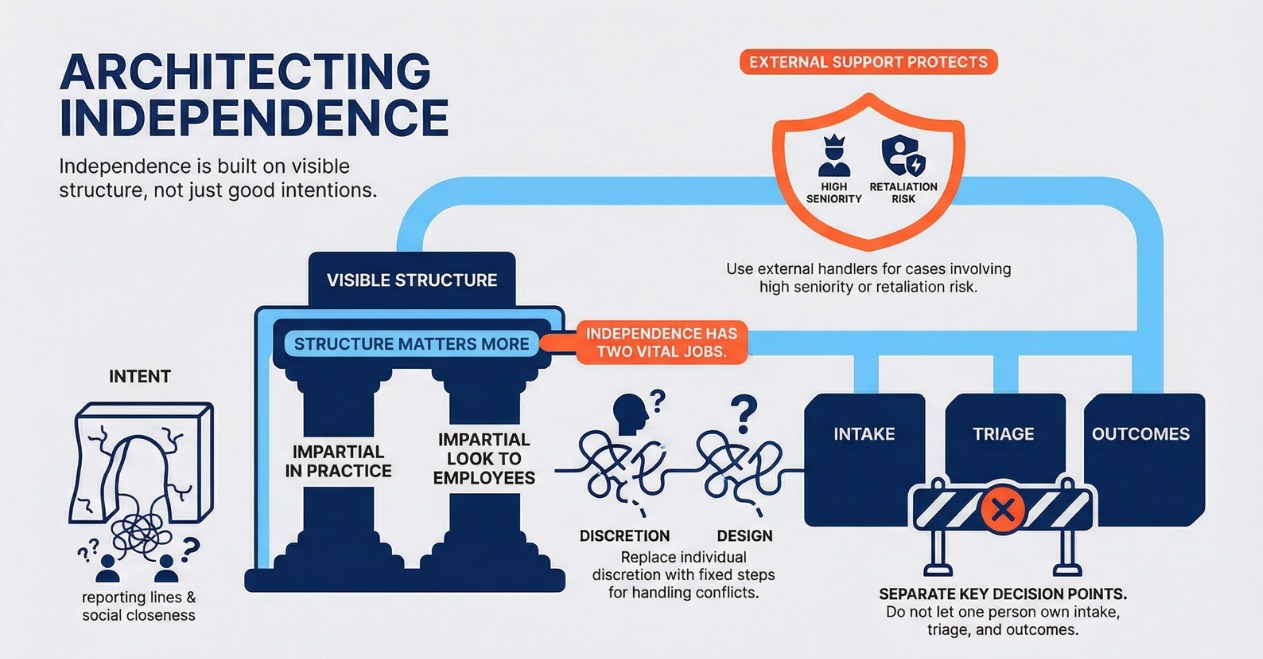
Start by separating decision points.
Don’t let one person own intake, triage, scope, and outcome. Splitting those steps makes it harder for influence to hide and easier to show you followed a disciplined process.
Next, treat conflicts of interest as a design input, not an afterthought.
Define what counts as a conflict in your context, reporting lines, business incentives, close working relationships, prior involvement. Then define what you do when a conflict exists, not in theory, but in how you assign handlers and approvers.
External support also has a place, but it shouldn’t be framed as a last resort. High-risk cases often don’t look sensational. They look like seniority, influence, repeat allegations, retaliation risk, or issues that could become legal matters. In those situations, external involvement can protect fairness and protect the organisation from later claims of bias.
Finally, communicate process, not conclusions.
You often can’t share details, and you shouldn’t try. You can still share what steps you ran, what standards you applied, and how you managed conflicts. That’s how you show discipline without breaching confidentiality.
The trade-off leaders need to face
Many leaders want to “handle it quietly” and “build trust” at the same time. Those goals fight each other more often than people admit.
If you optimise for quiet, you train employees to treat the channel as theatre. If you design for credibility, you accept more documentation, clearer governance, and sometimes more escalation. That can feel uncomfortable. It also keeps problems from sitting in the dark until someone forces them into the light.
Watch the on-demand session
In Trust at work, the speak-up series, Episode 2, we go deeper on how independence, fairness, and follow-through shape trust, including why perceived conflicts of interest can sink a programme even when policies look strong.
{{wb-webinar-trusted-reporting-starts-with-trusted-process="/components"}}
.jpg)


FAQs

This depends on the industry and type of role you are recruiting for. To determine whether you need reference checks, identity checks, bankruptcy checks, civil background checks, credit checks for employment or any of the other background checks we offer, chat to our team of dedicated account managers.
Many industries have compliance-related employment check requirements. And even if your industry doesn’t, remember that your staff have access to assets and data that must be protected. When you employ a new staff member you need to be certain that they have the best interests of your business at heart. Carrying out comprehensive background checking helps mitigate risk and ensures a safer hiring decision.
Again, this depends on the type of checks you need. Simple identity checks can be carried out in as little as a few hours but a worldwide criminal background check for instance might take several weeks. A simple pre-employment check package takes around a week. Our account managers are specialists and can provide detailed information into which checks you need and how long they will take.
All Veremark checks are carried out online and digitally. This eliminates the need to collect, store and manage paper documents and information making the process faster, more efficient and ensures complete safety of candidate data and documents.
In a competitive marketplace, making the right hiring decisions is key to the success of your company. Employment background checks enables you to understand more about your candidates before making crucial decisions which can have either beneficial or catastrophic effects on your business.
Background checks not only provide useful insights into a candidate’s work history, skills and education, but they can also offer richer detail into someone’s personality and character traits. This gives you a huge advantage when considering who to hire. Background checking also ensures that candidates are legally allowed to carry out certain roles, failed criminal and credit checks could prevent them from working with vulnerable people or in a financial function.
Trusted by the world's best workplaces




APPROVED BY INDUSTRY EXPERTS
.png)
.png)


and Loved by reviewers


Transform your hiring process
Request a discovery session with one of our background screening experts today.