
The trust problem nobody wants to talk about: workplace misconduct


Trust in the workplace has traditionally been treated as a binary decision made at the point of hire. Once background checks cleared and the offer accepted, organisations operated on the assumption that trust would hold indefinitely. This “hire once, trust forever” model worked for an era of stable tenure and co-located teams but in 2026 is structurally obsolete.
According to recent research, serious misconduct incidents (whether intentional or not) now cost organisations an average of $17.4 million annually - an increase of 123% since 2018. The critical question for organisations has moved from “who can we trust?” to “how do we keep trust visible and defensible throughout the employment lifecycle?”
The "Great Disconnect"
Sexual harassment is the clearest example of what happens when screening and whistleblowing don't connect, exposing the gap more clearly than any other workplace risk. Currently, nearly half of employees who experience workplace sexual harassment never report it, primarily due to a lack of trust in leadership - or fear of retaliation.
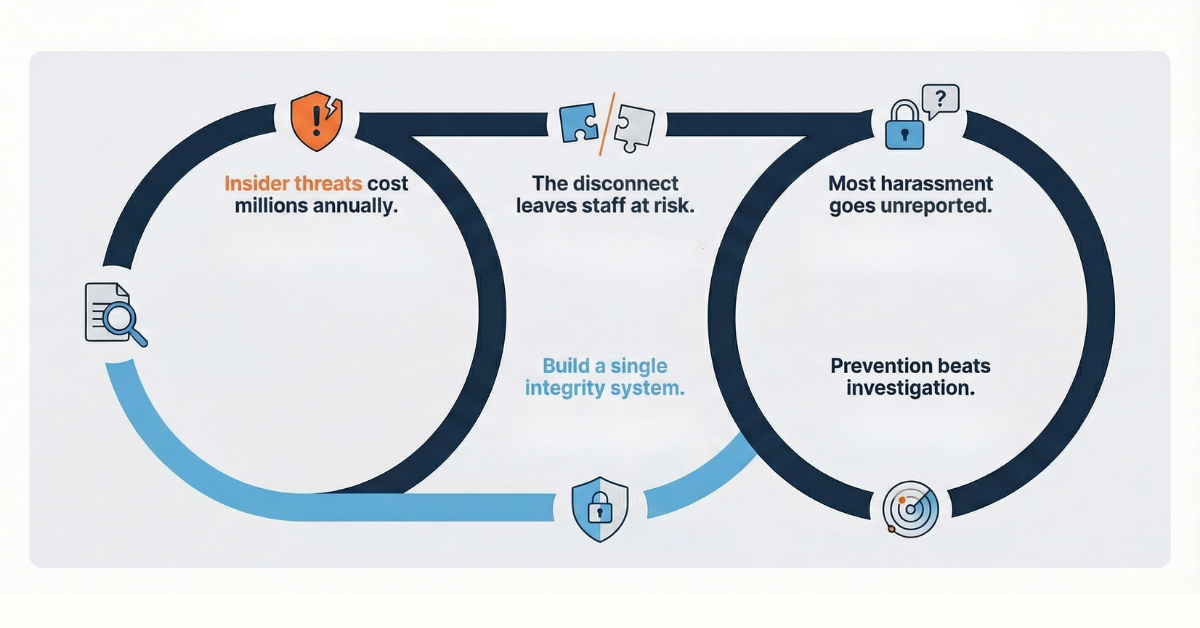
But while leaders often mistake a lack of formal complaints for a healthy culture, it’s rarely proof of a safe workplace - rather, evidence that your reporting infrastructure doesn't work. This "Great Disconnect" occurs when pre-hire screening and post-hire whistleblowing operate in silos. While businesses invest heavily in criminal checks and references at the door, the rigour of verification often drops to zero the moment an employee is onboarded.
Why prevention beats investigation
The “Me Too” movement was the cultural watershed that moved sexual harassment from an HR “compliance” issue to a boardroom priority. It connected workplace safety to the broader arc of women’s rights and equality reform, making it clear that organisations are now judged on their proactive behaviour, not just their written policies.
By the time a formal complaint is made, the system has already failed. The perpetrator has had access to victims and trust in leadership has eroded to the point where someone is willing to risk their career to speak up. True prevention systems capture early signals - a comment to a colleague or office “banter” that goes too far - before they escalate into harm.
High-consequence sectors have already recognised this gap and built integrated systems to close it. The United Nations operates ClearCheck, a system-wide screening database to prevent the re-hiring of individuals with records of serious misconduct, and over 380 organisations participate in the Misconduct Disclosure Scheme to share data on sexual misconduct. These aren't experimental programmes but operational systems proving that when screening and disclosure infrastructure integrate, perpetrator movement becomes visible and preventable.
'Is there anything we should know right now?' A workplace trust system answers: 'How do we keep risk visible as roles, access and behaviour change over time?'
The institutional cost of inaction
Beyond the human toll, the financial and institutional costs are staggering. UK tribunal costs average £27,000 to £45,000 per claim, not including legal fees and management time. But the deepest cost is institutional. Because when harassment goes unreported, perpetrators move between roles unchallenged, and the organisation loses the ability to demonstrate a duty of care.
The organisations best positioned for 2026 won't be those with the most policies but those who have built screening and whistleblowing as a single integrity system. Veremark's workplace trust platform closes this loop by integrating pre-hire screening with anonymous reporting channels and auditable trail management to prove duty of care across the entire employment lifecycle.
Talk to us about building prevention architecture that works.
Read More





%20(1)%20(1)%20(1).jpg)
FAQs

This depends on the industry and type of role you are recruiting for. To determine whether you need reference checks, identity checks, bankruptcy checks, civil background checks, credit checks for employment or any of the other background checks we offer, chat to our team of dedicated account managers.
Many industries have compliance-related employment check requirements. And even if your industry doesn’t, remember that your staff have access to assets and data that must be protected. When you employ a new staff member you need to be certain that they have the best interests of your business at heart. Carrying out comprehensive background checking helps mitigate risk and ensures a safer hiring decision.
Again, this depends on the type of checks you need. Simple identity checks can be carried out in as little as a few hours but a worldwide criminal background check for instance might take several weeks. A simple pre-employment check package takes around a week. Our account managers are specialists and can provide detailed information into which checks you need and how long they will take.
All Veremark checks are carried out online and digitally. This eliminates the need to collect, store and manage paper documents and information making the process faster, more efficient and ensures complete safety of candidate data and documents.
In a competitive marketplace, making the right hiring decisions is key to the success of your company. Employment background checks enables you to understand more about your candidates before making crucial decisions which can have either beneficial or catastrophic effects on your business.
Background checks not only provide useful insights into a candidate’s work history, skills and education, but they can also offer richer detail into someone’s personality and character traits. This gives you a huge advantage when considering who to hire. Background checking also ensures that candidates are legally allowed to carry out certain roles, failed criminal and credit checks could prevent them from working with vulnerable people or in a financial function.
Trusted by the world's best workplaces


APPROVED BY INDUSTRY EXPERTS
.png)
.png)


and Loved by reviewers


Transform your hiring process
Request a discovery session with one of our background screening experts today.



.png)