
The questions leaders should ask about speak-up reporting


Boards and senior leaders often treat speak-up reporting like a dashboard problem. How many reports came in. How many got closed. How fast teams handled them. It feels sensible because the numbers look objective.
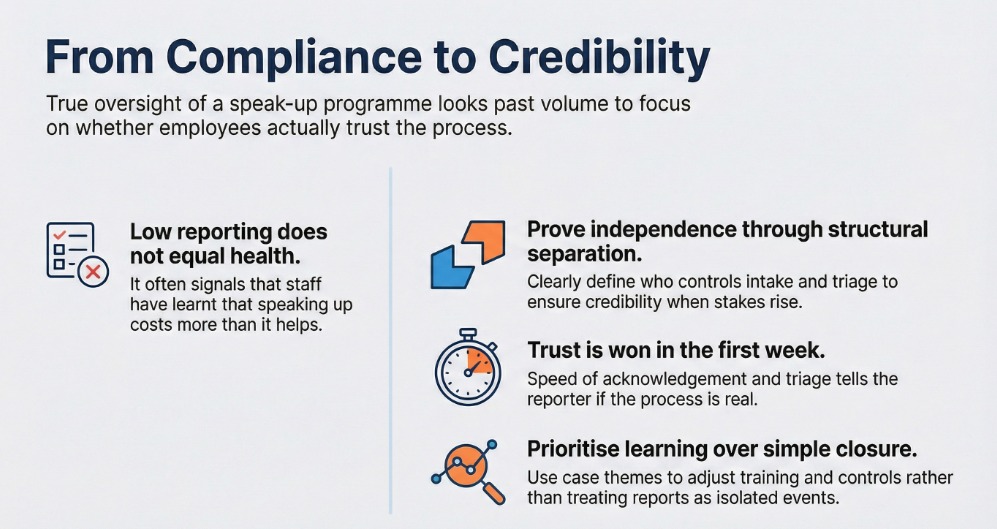
But speak-up programmes don’t succeed on activity. They succeed on belief. People either believe your organisation will handle a concern fairly, or they don’t. When they don’t, the programme can still look “healthy” on paper while issues keep moving through other routes, private chats, resignations, transfers, lawyers, the media.
So if you want oversight that actually reduces risk, a useful shift is this. Don’t start by asking what the numbers are. Start by asking what the programme teaches employees about speaking up here.
Because every programme teaches something, even when you do nothing.
The uncomfortable truth about low reporting
Low reporting can mean a healthy culture. It can also mean people have learnt that speaking up is a personal risk with little upside. Many leaders accept the first interpretation because it feels reassuring, and because the second interpretation is harder to deal with.
There’s a simple way to challenge your own assumption. Ask, where do you see the “first signals” of issues in your organisation.
If concerns mainly appear in exit interviews, or as sudden resignations, or as “performance problems” that seem to follow a complaint, your reporting volume stops looking like good news. It starts looking like a lagging indicator of silence.
What your reporting system signals in the first week
Most trust isn’t built at the end of an investigation. It’s built in the first week, when the reporter tries to work out if they made a mistake by speaking up.
This is why “time to acknowledge” and “time to first meaningful update” matter more than most boards think. A slow or vague response teaches people that the channel is administrative, not real. A fast, clear response teaches them someone is in control and the process has a spine.
You can’t solve every case quickly. You can show you take the report seriously quickly. Those are different.
Independence isn’t a value. It’s a structure.
Leaders love to say “we investigate independently.” Employees don’t accept that phrase on faith. They look at who handles the case and who can influence the path.
Here’s the question that tends to surface reality. If a report named a senior leader, would you run the same process, with the same discipline, and the same distance. Or would it suddenly become “sensitive,” “complex,” and “best handled quietly.”
That’s not a church problem or a government problem. It’s an organisation problem. Power changes how people behave around the process, even when they mean well.
So a practical board question is not “do we investigate independently.” It’s “where can influence enter the process without leaving a trace.”
If the answer is unclear, you’re probably relying on discretion. Discretion works best when the stakes are low. It works worst when the stakes are high.
Fairness is what stops the system from becoming politics
Some leaders worry speak-up programmes create drama. They worry about false complaints, internal conflict, reputational damage. Those concerns aren’t imaginary. A weak process can create all of that.
But a fair process reduces those risks rather than increases them. Fairness means you don’t pick a side at intake. You create a disciplined route to facts. You protect the reporter from blowback while you protect due process for the respondent. You keep records. You make decisions that you can explain.
When you don’t do this, people assume politics. Reporters assume cover-up. Respondents assume stitch-up. Managers assume it’s about alliances. That’s when the programme becomes something people use as a weapon, or avoid entirely.
The question that tells you if the programme works
If you want one board-level test, it’s this.
What change did the organisation make because people spoke up.
Not “what cases did we close.” Not “what training did we roll out.” Actual change tied to themes, hotspots, or repeated issues. A shift in manager expectations. A tightened control. A clearer separation of roles. A redesign of how cases get assigned. A new way of checking retaliation.
Employees don’t need you to share case outcomes to believe the programme works. They do need to see that speaking up has consequences for the organisation, not only for the person who spoke up.
Getting oversight right without stepping into case files
You don’t need to read case details to oversee this well. You need to watch for signals that the programme has credibility.
A simple rhythm helps.
Ask for a quarterly view of the first-week experience. Time to acknowledge, time to triage, time to first meaningful update, and reporter drop-off. Ask how the programme manages conflicts of interest, especially when a report involves power. Ask what themes repeat, and what changed because of those themes.
If the answers stay specific, you’re probably looking at a programme that runs consistently. If the answers turn into generalities, or if the same themes show up quarter after quarter with no change, the programme may exist in policy but not in practice.
Watch the on-demand session
In Trust at work, the speak-up series, Episode 2, we talk about what “trusted reporting” looks like when you pressure-test it against real power dynamics, including case examples discussed in the session.
{{wb-webinar-trusted-reporting-starts-with-trusted-process="/components"}}



FAQs

This depends on the industry and type of role you are recruiting for. To determine whether you need reference checks, identity checks, bankruptcy checks, civil background checks, credit checks for employment or any of the other background checks we offer, chat to our team of dedicated account managers.
Many industries have compliance-related employment check requirements. And even if your industry doesn’t, remember that your staff have access to assets and data that must be protected. When you employ a new staff member you need to be certain that they have the best interests of your business at heart. Carrying out comprehensive background checking helps mitigate risk and ensures a safer hiring decision.
Again, this depends on the type of checks you need. Simple identity checks can be carried out in as little as a few hours but a worldwide criminal background check for instance might take several weeks. A simple pre-employment check package takes around a week. Our account managers are specialists and can provide detailed information into which checks you need and how long they will take.
All Veremark checks are carried out online and digitally. This eliminates the need to collect, store and manage paper documents and information making the process faster, more efficient and ensures complete safety of candidate data and documents.
In a competitive marketplace, making the right hiring decisions is key to the success of your company. Employment background checks enables you to understand more about your candidates before making crucial decisions which can have either beneficial or catastrophic effects on your business.
Background checks not only provide useful insights into a candidate’s work history, skills and education, but they can also offer richer detail into someone’s personality and character traits. This gives you a huge advantage when considering who to hire. Background checking also ensures that candidates are legally allowed to carry out certain roles, failed criminal and credit checks could prevent them from working with vulnerable people or in a financial function.
Trusted by the world's best workplaces


APPROVED BY INDUSTRY EXPERTS
.png)
.png)


and Loved by reviewers


Transform your hiring process
Request a discovery session with one of our background screening experts today.