
The KCSIE check most schools leave incomplete


International background checks are the most frequently incomplete area of KCSIE compliance across the schools we work with. The reason isn't negligence. It's that the process is genuinely difficult, and there's very little practical guidance on how to do it well.
KCSIE is clear on the requirement: where a candidate has lived or worked outside the UK, the school must make reasonable efforts to obtain an overseas criminal records check or equivalent. A UK DBS check doesn't cover a candidate's history in other countries. Foreign criminal records are maintained separately, and there's no cross-border mechanism that makes a domestic check sufficient.
Most schools understand this. Where things break down is in the execution.
Every country works differently
Some countries issue criminal record certificates through a national police authority with a straightforward online application. Australia, Canada, and the US fall into this category. The process takes time but it's well documented.
Others require the individual to apply in person at a consulate or embassy. Some certificates arrive in the local language and need certified translation before a school can use them. Some countries have no mechanism at all for issuing certificates to individuals who are no longer resident.
For a school hiring a teacher who spent two years working in the UAE and three in South Korea, the HR team is suddenly navigating two entirely different systems, with different application processes, different turnaround times, different documentary requirements, and potentially different languages. Most HR teams in schools don't have the specialist knowledge or the in-country contacts to manage this reliably. The result is that the check gets started, partially completed, or simply noted as "attempted" without a clear record of what was actually done.
That's the gap Ofsted will find.
What "reasonable steps" actually means
KCSIE doesn't require schools to obtain a certificate in every case. It recognises that some countries make this impossible. What it does require is that schools take reasonable steps and document them properly.
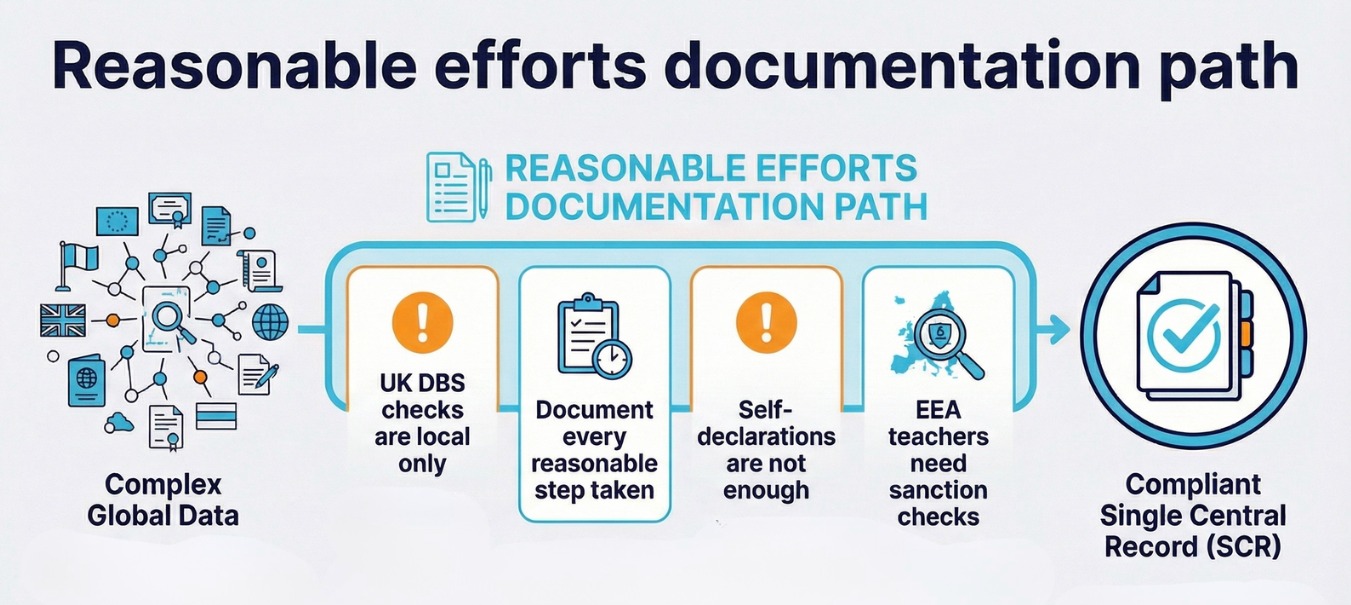
Reasonable steps means actively seeking verification through the appropriate channels in each country. It means recording what was requested, when it was requested, what was received, and what wasn't obtainable (with reasons). A note on file saying "candidate confirmed no overseas criminal record" is not a documented reasonable step. That's a self-declaration, and KCSIE treats it differently.
The documentation matters as much as the check itself. A school that attempted an overseas check, was unable to obtain a certificate because the country doesn't issue them to non-residents, and recorded that process with dates and correspondence is in a defensible position. A school that skipped the check because it seemed too complicated is not.
EEA teachers need a separate check
For candidates who have taught in EEA countries, schools should also check for sanctions or restrictions in the teacher's country of origin. This is separate from the criminal record check. A teacher may have a clean criminal record but be subject to a professional sanction that prevents them from teaching in their home country. The European Commission provides resources to identify the relevant professional bodies in each member state.
This is another check that schools frequently miss, often because they assume the DBS and overseas criminal record check together cover everything. They don't. Professional sanctions are held by teaching regulators, not police authorities.
What the SCR needs to show
For international checks, the Single Central Record must show more detail than for a standard DBS. It needs to record the country the check relates to, what was requested, when it was requested, and what was received. If a certificate wasn't obtainable, the SCR should note what steps were taken and why the check couldn't be completed.
Schools that leave the international column blank, or record only "requested" without a completion date or outcome, are creating an inspection gap. Ofsted inspectors know that international checks are commonly incomplete, which means they're likely to look at them closely.
What we see from running these checks
Veremark conducts international background checks across more than 150 countries. The patterns are consistent: schools know the requirement exists, start the process in good faith, and get stuck when the country-specific mechanics become unclear. The check then sits in a queue, partially complete, until someone either chases it or the candidate starts work without it.
The fix is straightforward. A provider with in-country verification capability and established relationships with the relevant authorities in each country can manage the process from request to completion, including translation where needed. Each check is documented with a full audit trail, which means the school's SCR entry for international verification is evidence-backed rather than self-reported.
.png)
For schools recruiting internationally, or hiring candidates who have lived overseas at any point in their career, this is the single most impactful improvement you can make to your KCSIE compliance. It's also the one that's hardest to do in-house.
For the full KCSIE 2025 checklist, including every pre-employment, international, and ongoing obligation mapped to a screening workflow, download the white paper.
{{https-www-veremark-com-reports-the-kcsie-safeguarding-checklist="/components"}}
.jpg)


FAQs

This depends on the industry and type of role you are recruiting for. To determine whether you need reference checks, identity checks, bankruptcy checks, civil background checks, credit checks for employment or any of the other background checks we offer, chat to our team of dedicated account managers.
Many industries have compliance-related employment check requirements. And even if your industry doesn’t, remember that your staff have access to assets and data that must be protected. When you employ a new staff member you need to be certain that they have the best interests of your business at heart. Carrying out comprehensive background checking helps mitigate risk and ensures a safer hiring decision.
Again, this depends on the type of checks you need. Simple identity checks can be carried out in as little as a few hours but a worldwide criminal background check for instance might take several weeks. A simple pre-employment check package takes around a week. Our account managers are specialists and can provide detailed information into which checks you need and how long they will take.
All Veremark checks are carried out online and digitally. This eliminates the need to collect, store and manage paper documents and information making the process faster, more efficient and ensures complete safety of candidate data and documents.
In a competitive marketplace, making the right hiring decisions is key to the success of your company. Employment background checks enables you to understand more about your candidates before making crucial decisions which can have either beneficial or catastrophic effects on your business.
Background checks not only provide useful insights into a candidate’s work history, skills and education, but they can also offer richer detail into someone’s personality and character traits. This gives you a huge advantage when considering who to hire. Background checking also ensures that candidates are legally allowed to carry out certain roles, failed criminal and credit checks could prevent them from working with vulnerable people or in a financial function.
Trusted by the world's best workplaces




APPROVED BY INDUSTRY EXPERTS
.png)
.png)



and Loved by reviewers


Transform your hiring process
Request a discovery session with one of our background screening experts today.