
The High Price of Systemic Blindness: 3 UK Lessons in Workplace Misconduct


Most UK organisations facing sexual harassment failures thought they had it handled. They had policies in employee handbooks, annual training modules and complaint procedures. What they lacked was the infrastructure to make any of it operational. The gap between what's written and what happens reveals itself through tribunal findings, EHRC enforcement actions and media investigations that expose patterns everyone internally already knew about.
Now, the move toward positive duty is turning workplace culture from a "soft" HR topic into a hard financial and legal risk and, as we approach the October 2026 "All Reasonable Steps" standard, the UK’s framework is setting a high bar for transparency. To meet it, we must look at where current systems have buckled under pressure.
These cases aren’t about a few "bad apples"; they’re about the structural gaps that allow sexual harassment and other misconduct to hide in plain sight - and what organisations must build to prevent the same failures.
1. Financial Services: The 'Sexism in the City' NDA Trap
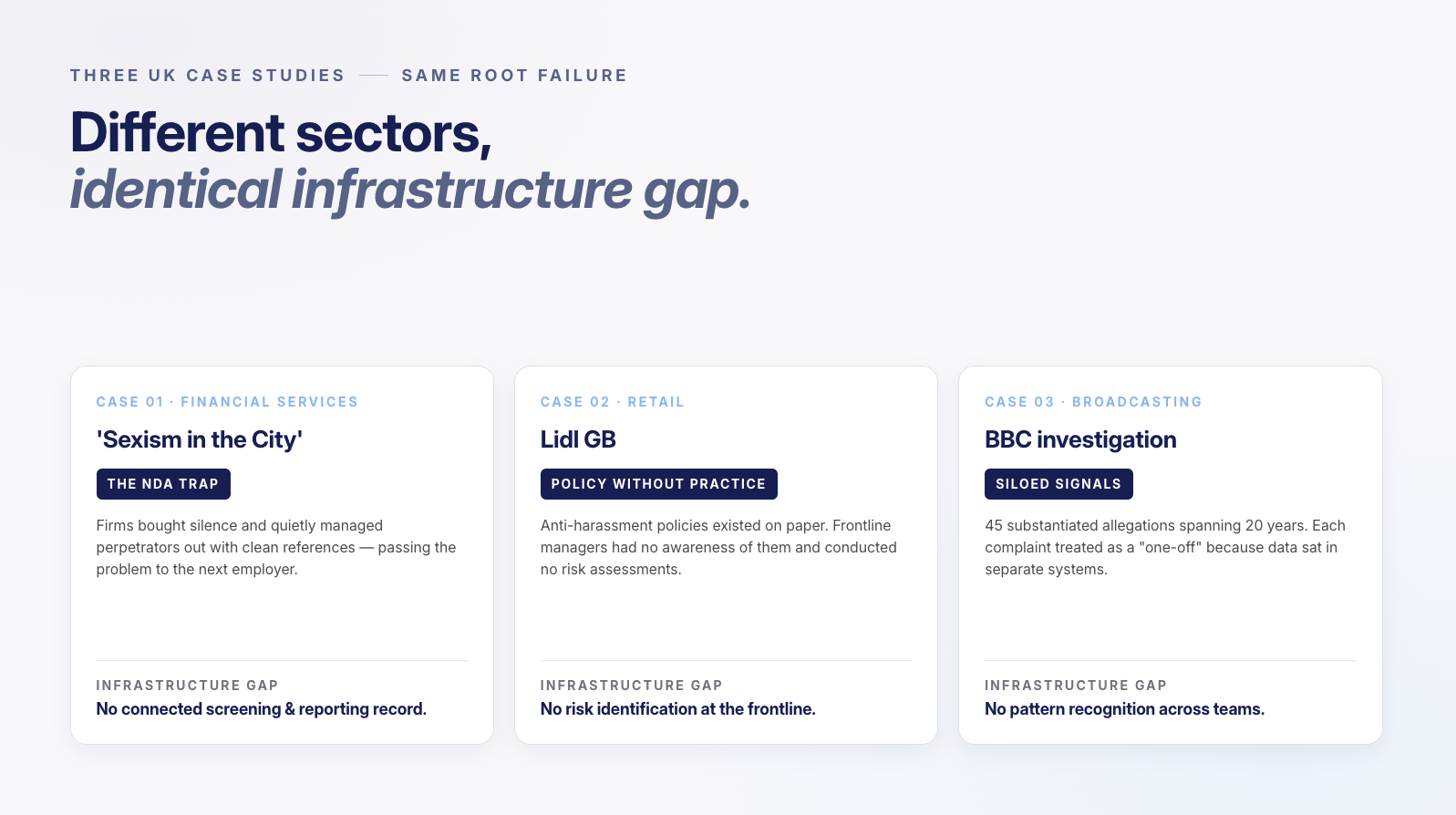
The Treasury Select Committee’s 2024 Sexism in the City report uncovered a culture of sexual harassment within financial services. Ranging from "accidental sexisms" to serious sexual assault, these were frequently met with a wall of silence. Instead of addressing behaviour, firms would "buy victims’ silence" through NDAs, enabling perpetrators to leave through “managed exits” with clean references, effectively passing the problem to their next employer.
The learning: Without a connected integrity system, you are essentially hiring blind to the managed exits of your competitors. When multiple organisations independently choose reputational protection over victim protection, they don't resolve sexual harassment, they create a sector-wide "pass the perpetrator" pattern.
What prevention looks like: From April 2026, NDAs attempting to silence sexual harassment disclosures become void under whistleblowing protections. When concerns are raised through anonymous platforms, investigated through trauma-informed processes and tracked with audit trails, organisations can build records that support appropriate disclosure to protect the next employer.
2. Lidl GB: When policies never reach the frontline
A 2025 tribunal found Lidl managers were completely unaware of anti-harassment policies and had failed to conduct basic risk assessments. A teenager working at a local branch of the supermarket was subjected to repeated sexual advances and physical touching. When she raised it, she was told she should "take it as a compliment."
The learning: A policy is not prevention. The October 2026 "all reasonable steps" standard explicitly requires proof of actual prevention. Real safety requires risk identification - monitoring late-night shifts, lone working, high-risk settings - and giving managers tools to act on signals before they become lawsuits.
What prevention looks like: The EHRC's Section 23 legally binding agreement requires Lidl to conduct staff surveys, track informal complaints and improve training - measures enforced externally, rather than proactively built. Organisations that implement risk assessments, onboarding manager training and anonymous channels for reporting concerns are practicing genuine prevention instead of reacting to enforcement demands.
3. The BBC/Gregg Wallace: The Cost of the Single Missed Signal
The BBC’s independent investigation into Gregg Wallace substantiated 45 allegations of sexual harassment spanning nearly 20 years. The failure wasn't lack of reporting - complaints were raised. The failure was that concerns were scattered across different production companies and departments. Each was treated as a "one-off" incident because no consolidated integrity record existed to show the pattern.
The learning: A single high-profile individual can cause catastrophic brand damage when signals are siloed. Multiple informal complaints about the same person must become visible as a pattern requiring intervention, not isolated incidents that stay invisible because systems don't connect data.
What prevention looks like: Connected systems linking screening data, whistleblowing reports and exit interview patterns across departments and third-party contractors. When three informal complaints surface about the same individual across different teams or production companies, pattern recognition infrastructure reveals what siloed processes hide. This transforms scattered signals into visible patterns that demand action.
The October 2026 Stakes: Changes to UK Law
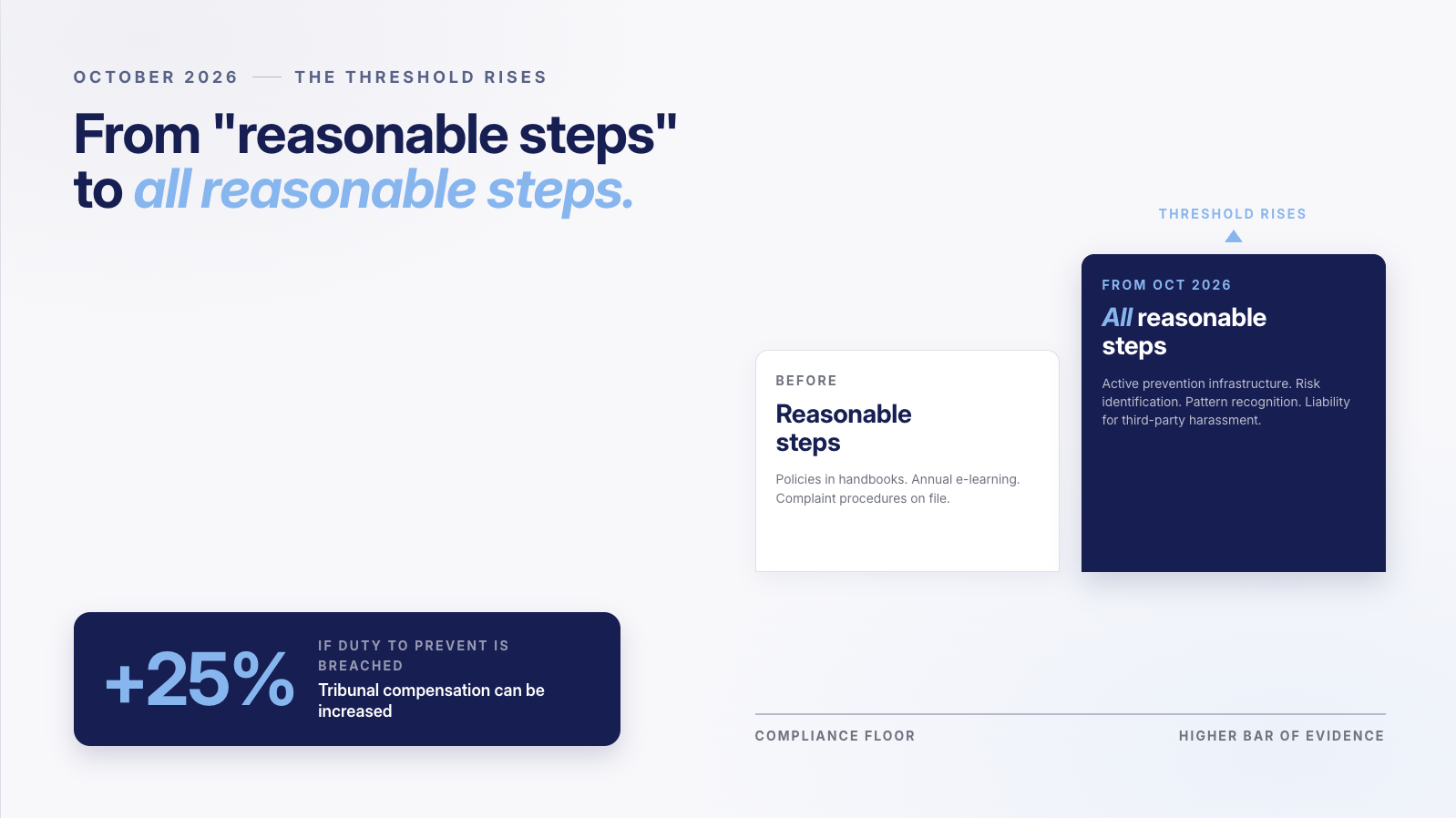
The threshold rises from "reasonable steps" to "all reasonable steps," and you become liable for third-party harassment by customers or clients if you cannot prove you had an active system of prevention.
"Business as usual" compliance infrastructure built around policies in handbooks and annual e-learning won't meet this standard. Tribunals and the EHRC will ask: What infrastructure existed to capture early signals? How did you identify high-risk settings? What evidence demonstrates systematic prevention?
There is financial jeopardy, too: if a sexual harassment claim reaches tribunal and you're found to have breached your duty to prevent, judges can now increase compensation by up to 25%.
What Veremark Provides For UK Organisations
Veremark's internal reporting solution addresses the infrastructure failures these case studies reveal:
- Third-party, anonymous channels that bypass internal hierarchies and solve the fear of reporting that plagued these organisations.
- Live visibility that turns informal signals into auditable data, allowing you to spot patterns across departments or contractors before they escalate into lengthy scenarios.
- A connected integrity model bridging screening and reporting to ensure duty of care is persistent from hire to exit, not episodic compliance at onboarding then silence.
The common thread in every UK failure is not a lack of rules. It's a lack of visibility.
Talk to us about building the infrastructure the October 2026 standard requires.
{{whistleblowing-cta="/components"}}
Read More




.png)
.png)
FAQs

Anonymity is available should the employee wish to withhold their identity. Built with security and experience in mind, our solution is hosted on an end-to-end encrypted platform.
Implementation can be quick for standard software setups, but more complex rollouts with custom workflows, languages, training, and policies may take longer. Veremark can launch an online hotline for your organisation very quickly - but we also offer full consultation prior to roll-out, as well as a white-labeled product for organisations who need this option.
A whistleblower hotline is a reporting channel, such as a phone line, web form, or third-party service, that people can use to raise concerns about wrongdoing.
Trusted by the world's best workplaces


APPROVED BY INDUSTRY EXPERTS
.png)
.png)


and Loved by reviewers


Transform your hiring process
Request a discovery session with one of our background screening experts today.