
Most background screening misses the biggest risk


The 2026 Veremark Screening Benchmark looked at how much screening organisations actually run, what types of check they prioritise, and how often each one flags an issue. The headline finding:
- 58% of all check volume is database checks that flag a discrepancy less than 1% of the time.
- CV gap checks, which flag at 51.7%, sit outside most standard packages.
That gap between where the spend goes and where the risk actually lives is the central problem in background screening today.
This piece walks through what the data shows, why the standard screening model has stopped keeping up, and what a programme designed for current workforce risk looks like.
The check that catches almost nothing dominates the volume

Database checks (criminal record, sanctions, watchlist, financial) make up the bulk of what most screening providers sell. They’re cheap to run, fast to return, and they fit cleanly into a standard pre-employment package. They also flag a discrepancy on fewer than one in 100 candidates.
This isn’t a complaint about database checks themselves. They’re necessary, and the regulated industries that mandate them are right to do so. The issue is volume. When 58% of total screening spend produces a flag rate under 1%, organisations are paying for a lot of confirmation and very little detection.

The Benchmark shows where the detection actually happens. Education checks flag at 15 to 21%. Employment history checks sit in a similar range. CV gap analysis flags at 51.7%.
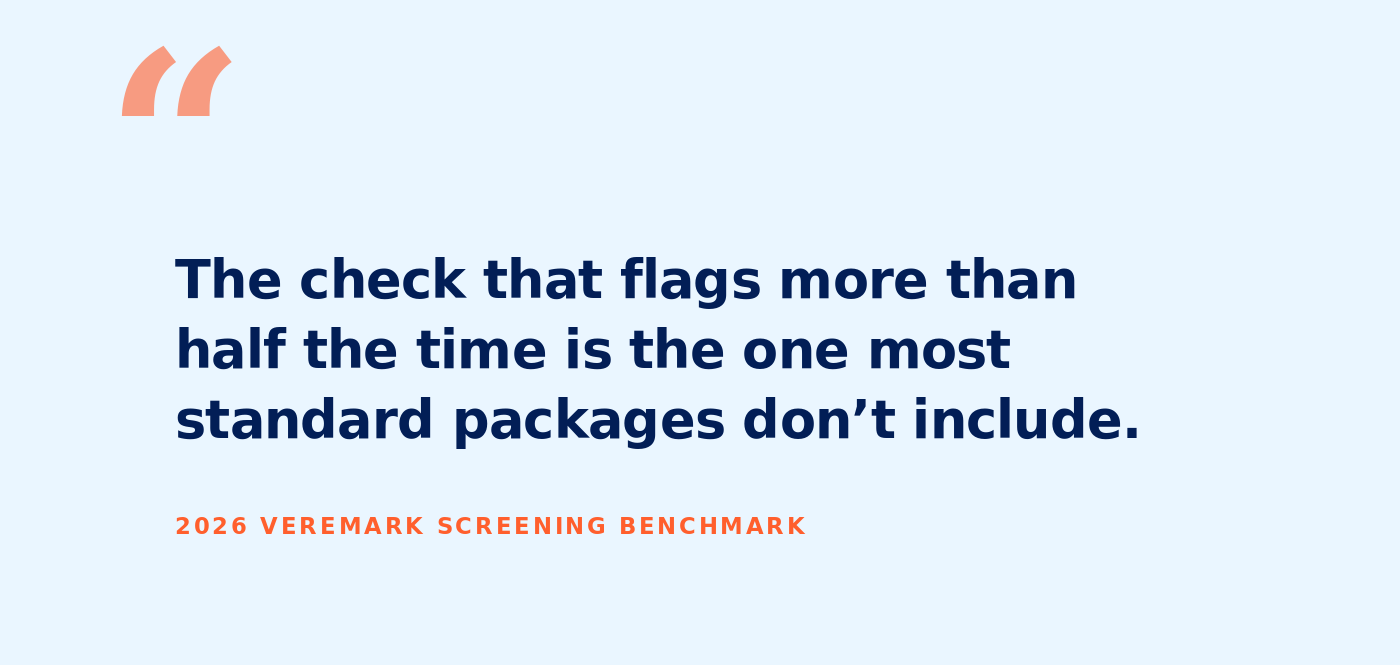
The check that flags more than half the time is the one most standard packages don’t include.
The hire-once-trust-forever model has stopped working
Most screening processes still operate on an assumption from 15 years ago: a candidate is vetted once at the point of hire, the result is recorded, and the file closes. That model worked when work was mostly in person, identity verification meant looking at a passport in a meeting room, and the workforce moved slowly between roles.
It no longer reflects how organisations hire or how risk moves.
Gartner research from 2025 found that 84% of recruiters experienced candidate fraud in the past 12 months. Identity misrepresentation, falsified skills, GenAI-assisted interview fraud, and stolen credentials are now common enough that 54% of recruiting leaders say technology advances have made fraud a larger problem than it was two years ago. By 2028, Gartner expects one in four candidate profiles to be fake.

The same research found that only 7% of recruiting leaders currently use identity verification software during recruitment. The tools that catch the new fraud vectors aren’t yet in the toolkit.
On the post-hire side, the Benchmark found that 81% of employers run no form of post-hire screening at all. Once a candidate is hired, the file closes. Anything that happens after, a change of role, a new access privilege, an undisclosed conviction, a credential that lapses, a sanctions list addition, falls outside the screening programme.
What current screening misses
Three categories of risk consistently sit outside what most programmes cover.
Identity at the point of hire
Gartner’s research on candidate fraud documented organisations unknowingly hiring sanctioned-country IT workers through remote-only roles. The candidates submitted stolen or fabricated identity documents, hid their actual location with VPNs, and used GenAI to alter their appearance in interviews. Background checks aren’t designed to verify identity. They take candidate-supplied information at face value and verify what’s in it. Identity verification confirms the document is real, the document belongs to the person presenting it, and the person is genuinely present during the digital interaction.
Skills and credentials in the GenAI era
Among candidates who used GenAI during the application process, 36% admitted using it to generate text for a writing sample. 29% used it for assessment answers. 7% admitted to participating in interview fraud, which includes standing in for someone else or letting someone stand in for them. For the recruiting team, that changes what an assessment actually measures. Without proctored testing, work samples, or scenario-based questioning, the assessment becomes a test of how well a candidate can prompt an LLM.
Risk after the hire
The Benchmark’s 81% post-hire gap is the largest hole in current screening practice. A clean pre-employment check captures a moment in time. Roles change, access expands, financial circumstances shift, and a small fraction of employees develop concerns that didn’t exist on day one. Without ongoing monitoring, those concerns surface only when something goes wrong, which is usually too late.
What continuous accountability looks like

The fix is straightforward in principle. Keep the pre-employment checks. Extend the programme so the screening file stays open across the full employee lifecycle, with monitoring and verification checkpoints triggered by events: a role change, a system access expansion, a contract renewal, a high-risk life event.
In practice, this means three things working together.
Deeper pre-hire screening that includes the checks where detection actually happens. CV gap analysis. Identity verification with liveness detection and location intelligence. Education and employment history validation against authoritative sources. Adverse media and sanctions screening.
Post-hire monitoring that surfaces relevant changes after the hire. New criminal records, sanctions list additions, regulatory disqualifications, adverse media mentions. Configurable thresholds so the alerts that reach HR are the ones that matter, not noise.
Lifecycle checkpoints triggered by risk events rather than calendar dates. Role changes, system access expansions, contract renewals, suspected misconduct, and high-risk life events all justify a fresh review. Annual blanket re-verification for everyone tends to create more noise than signal.
Underneath all of it: clear lawful basis under UK GDPR (or local equivalent), proportionate checks aligned to role-specific risk, transparent communication with candidates and employees about what’s monitored and why, defined retention rules, and a single audit trail that satisfies regulators.
What to do next
For HR and compliance leaders auditing their own programme, the Benchmark offers a self-assessment frame.
- Look at your screening package composition. What percentage of your check volume sits in the categories that flag under 1%? If it’s most of your spend, you’re paying for confirmation rather than detection.
- Look at what you’re not running. CV gap analysis, identity verification, and adverse media are the most common omissions. Each one closes a specific risk window that a standard pre-employment package leaves open.
- Look at what happens after the hire. If post-hire screening isn’t part of the programme, the 81% gap is yours.
- Look at your provider’s role in this. A provider that only sells pre-employment packages can’t help you build a continuous programme. The capabilities have to be in scope.
Veremark’s continuous accountability platform
Veremark’s screening platform is built for the continuous accountability model. It includes pre-employment background checks (including CV gap analysis and identity verification), post-hire monitoring, adverse media screening, right-to-work checks, speak-up reporting, and global compliance support across more than 180 countries. All of it runs on the same API-driven platform, with a single audit trail.
If you’re auditing your current screening programme against what the Benchmark and the wider analyst research show is now needed, speak to our team.




FAQs

This depends on the industry and type of role you are recruiting for. To determine whether you need reference checks, identity checks, bankruptcy checks, civil background checks, credit checks for employment or any of the other background checks we offer, chat to our team of dedicated account managers.
Many industries have compliance-related employment check requirements. And even if your industry doesn’t, remember that your staff have access to assets and data that must be protected. When you employ a new staff member you need to be certain that they have the best interests of your business at heart. Carrying out comprehensive background checking helps mitigate risk and ensures a safer hiring decision.
Again, this depends on the type of checks you need. Simple identity checks can be carried out in as little as a few hours but a worldwide criminal background check for instance might take several weeks. A simple pre-employment check package takes around a week. Our account managers are specialists and can provide detailed information into which checks you need and how long they will take.
All Veremark checks are carried out online and digitally. This eliminates the need to collect, store and manage paper documents and information making the process faster, more efficient and ensures complete safety of candidate data and documents.
In a competitive marketplace, making the right hiring decisions is key to the success of your company. Employment background checks enables you to understand more about your candidates before making crucial decisions which can have either beneficial or catastrophic effects on your business.
Background checks not only provide useful insights into a candidate’s work history, skills and education, but they can also offer richer detail into someone’s personality and character traits. This gives you a huge advantage when considering who to hire. Background checking also ensures that candidates are legally allowed to carry out certain roles, failed criminal and credit checks could prevent them from working with vulnerable people or in a financial function.
Trusted by the world's best workplaces




APPROVED BY INDUSTRY EXPERTS
.png)
.png)



and Loved by reviewers


Transform your hiring process
Request a discovery session with one of our background screening experts today.