
Financial services rescreens more than anyone, and still misses this


The background check that cleared a candidate at hire was accurate on the day it was run. It described that person, at that moment, against the records available then. It said nothing about who they would be in month four, or month nine, or three years later.
For most of the economy, that's the end of the story. Across the 2025 Veremark dataset, only around 16% of screening checks in non-financial-services industries went to existing staff. The check completed at onboarding is the only verification the other 84% will ever receive, however long they stay and however their role changes.
Financial services is the exception. Around half of all financial services screening activity in the dataset went to existing staff rather than new hires, roughly three times the rate of any other sector. Fit-and-proper attestation cycles drive this, and it's one area where regulation has pulled the industry into the right behaviour.
So if financial services already rescreens, where does the gap come from?
The trigger is the weak point
Most financial services firms have set their rescreening cadence well. Certified staff are recertified annually. Senior managers attest to the fitness of their reports. The calendar-based recheck of sanctions, criminal records, and financial history happens on schedule.
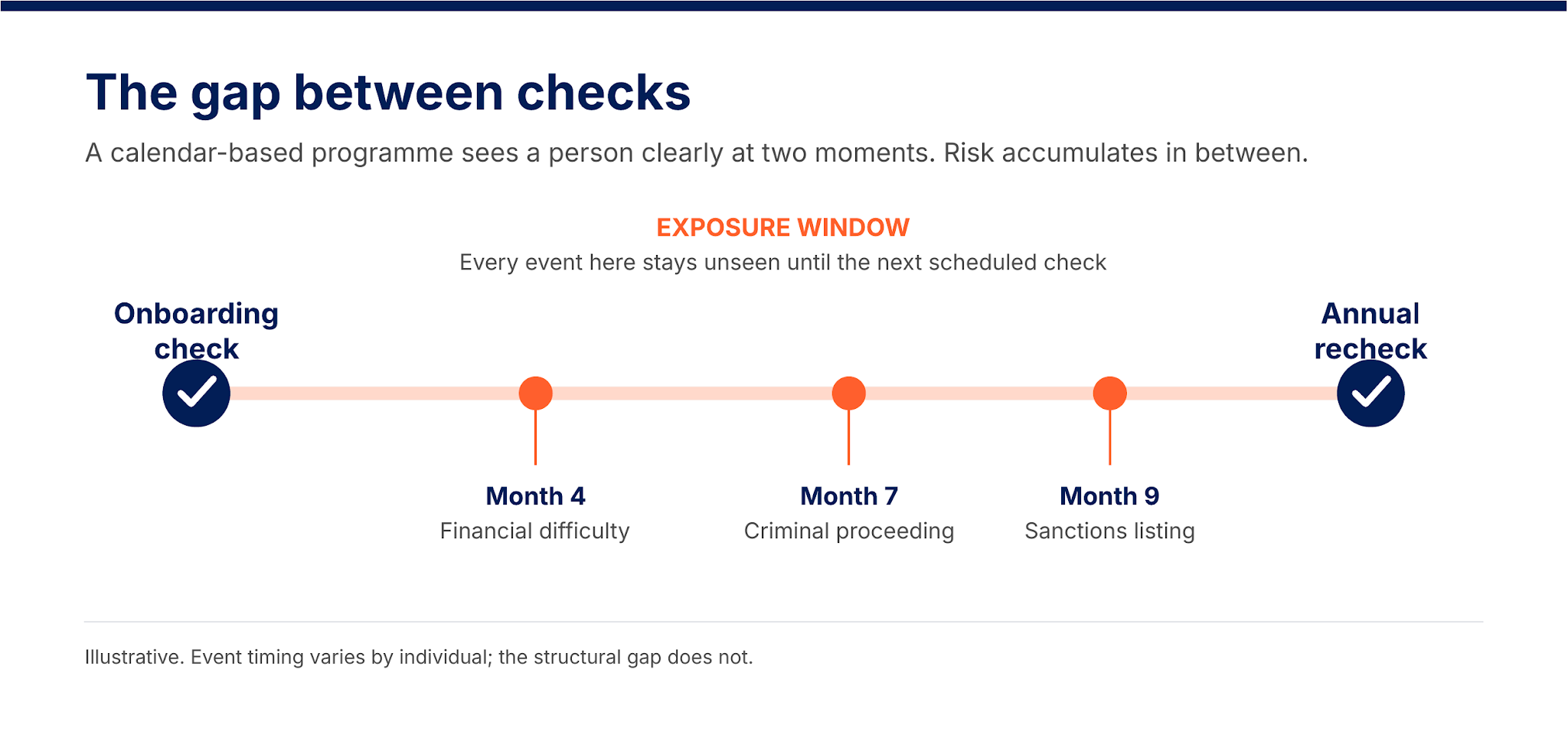
Risk doesn't follow a calendar. The events that actually drive workforce risk happen between attestation cycles, and most stay invisible to the firm until the next one comes round: a personal financial deterioration in month four, a criminal proceeding completing in month seven, a sanctions listing in month nine, an undisclosed directorship taken on mid-tenure. By the time the annual review catches any of these, the exposure has been live for months.
The onboarding check and the annual recheck are the only two moments the firm ever really sees that person clearly. Everything in between is an assumption.

What the regulators actually expect
Read the major regimes and the same expectation runs through all of them. Fit and proper is a continuing obligation rather than a point-in-time one.
The FCA's Senior Managers and Certification Regime requires annual certification of certified staff, and it also expects material changes to be disclosed and assessed as they arise. Singapore's MAS framework requires continuing fitness and re-confirmation on material change. In the US, FINRA requires U4 amendments within 30 days of any reportable event. Australia's APRA CPS 520 requires periodic review at a cadence the firm sets, routinely annual or more frequent for senior roles.
The common thread is the part most programmes underweight. The obligation runs continuously, and the firm is expected to know about material change when it happens, not at the next scheduled review.
What closes the gap
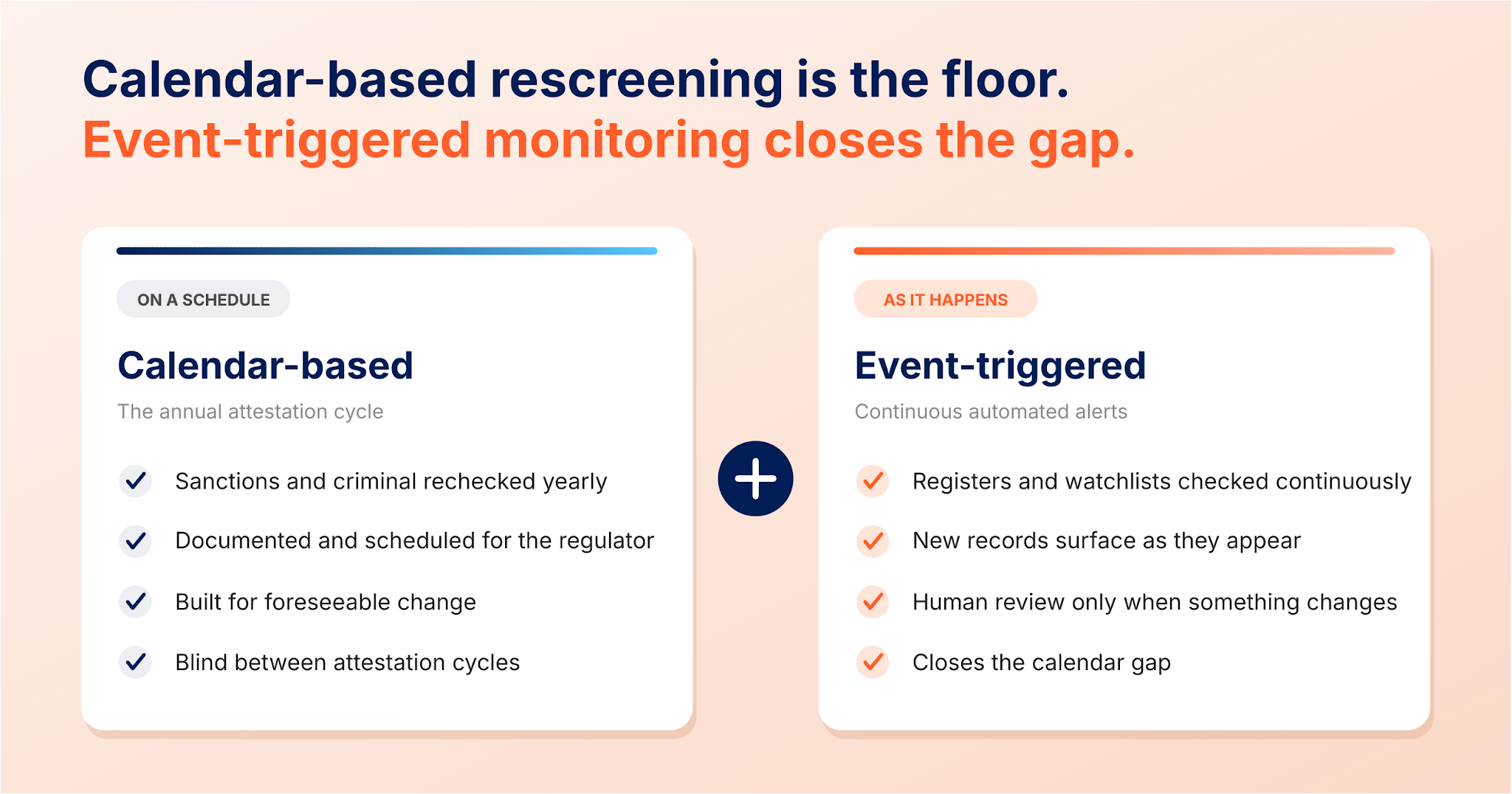
The fix is a second layer. Event-triggered monitoring runs alongside the calendar-based cycle, catching the change the calendar can't see between reviews.
Continuous monitoring runs automated checks against the relevant registers and watchlists at a much higher frequency, with human review only when something changes. A new criminal record, a fresh county court judgment, a sanctions list addition, an adverse media hit: each one surfaces when it appears, not months later. The calendar-based review keeps its place for the structured, documented attestation the regulator wants on file. The continuous layer catches what the calendar misses.
The technology to do this has been mainstream for several years, and running it across an existing population costs materially less than adding another full annual review cycle. In most firms the limiting factor is a policy decision that hasn't been made yet, rather than capability or cost.
The question worth asking
For any financial services firm, one question surfaces the gap quickly. Between annual attestations, what would actually tell you that a certified employee's circumstances had changed?
If the honest answer is nothing until the next review, the firm is running on an assumption for most of the year. The 2026 Veremark Screening Benchmark Report sets out where the rescreening gap sits widest by sub-sector, and what a continuous programme looks like in practice.
Go deeper
The full report, The true cost of a bad hire in financial services, breaks down the six-component cost framework, five real enforcement cases, and a screening stack built for the financial services hiring lifecycle.

.jpg)


FAQs

This depends on the industry and type of role you are recruiting for. To determine whether you need reference checks, identity checks, bankruptcy checks, civil background checks, credit checks for employment or any of the other background checks we offer, chat to our team of dedicated account managers.
Many industries have compliance-related employment check requirements. And even if your industry doesn’t, remember that your staff have access to assets and data that must be protected. When you employ a new staff member you need to be certain that they have the best interests of your business at heart. Carrying out comprehensive background checking helps mitigate risk and ensures a safer hiring decision.
Again, this depends on the type of checks you need. Simple identity checks can be carried out in as little as a few hours but a worldwide criminal background check for instance might take several weeks. A simple pre-employment check package takes around a week. Our account managers are specialists and can provide detailed information into which checks you need and how long they will take.
All Veremark checks are carried out online and digitally. This eliminates the need to collect, store and manage paper documents and information making the process faster, more efficient and ensures complete safety of candidate data and documents.
In a competitive marketplace, making the right hiring decisions is key to the success of your company. Employment background checks enables you to understand more about your candidates before making crucial decisions which can have either beneficial or catastrophic effects on your business.
Background checks not only provide useful insights into a candidate’s work history, skills and education, but they can also offer richer detail into someone’s personality and character traits. This gives you a huge advantage when considering who to hire. Background checking also ensures that candidates are legally allowed to carry out certain roles, failed criminal and credit checks could prevent them from working with vulnerable people or in a financial function.
Trusted by the world's best workplaces




APPROVED BY INDUSTRY EXPERTS
.png)
.png)



and Loved by reviewers


Transform your hiring process
Request a discovery session with one of our background screening experts today.