
Designing trust without creating surveillance


How organisations can balance accountability with fairness
As organisations pay more attention to workforce trust, a difficult question tends to follow. How do you strengthen accountability without making people feel watched?
This has become more important as work has become more digital and more dispersed. Monitoring tools are more capable than they used to be, data trails are easier to capture, and organisations are under greater pressure to show that standards are being applied consistently. At the same time, employees are paying closer attention to how systems affect privacy, autonomy, and fairness in everyday work. The International Labour Organisation has noted that digital technologies are expanding the scale and intensity of workplace monitoring, while also raising new questions about workers’ privacy and data rights.
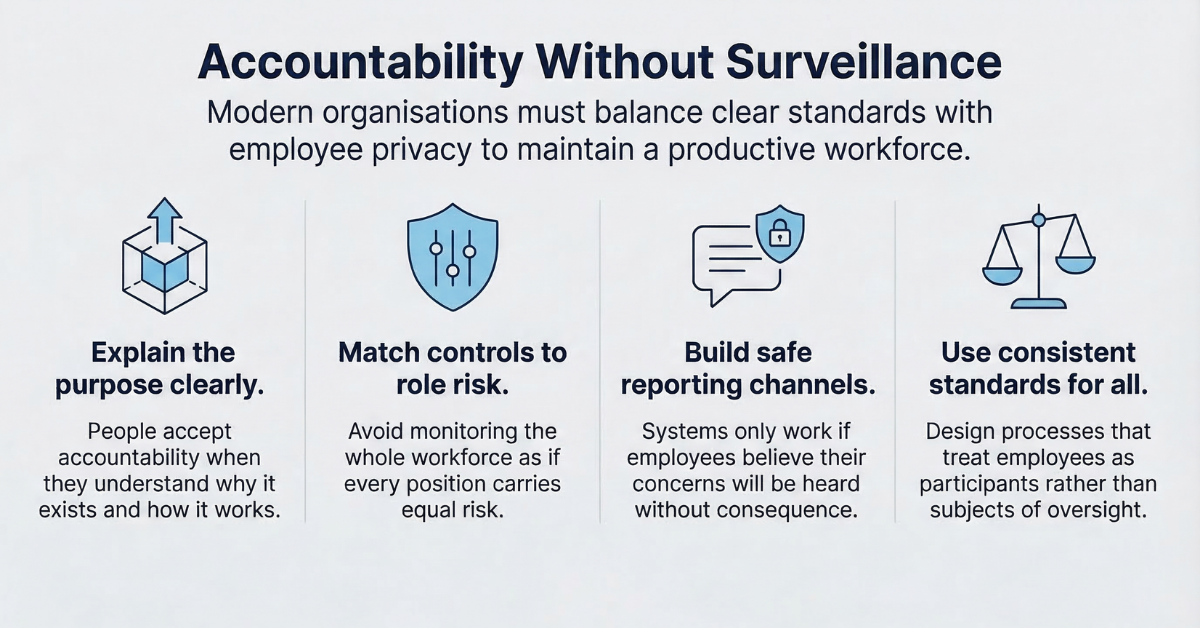
That means the design of trust systems matters just as much as the control itself. An organisation may introduce checks, reporting routes, or monitoring mechanisms with good intentions. But if those systems are poorly explained, applied too broadly, or experienced as opaque, they can weaken confidence in the process they are meant to support.
Why this tension is growing
One reason this issue is becoming harder to ignore is that the workplace itself is changing. Microsoft’s 2025 Work Trend Index found that 82% of leaders say this is a pivotal year to rethink core aspects of strategy and operations, reflecting how quickly work structures and expectations are shifting.
At the same time, employee experience is under pressure. Gallup’s State of the Global Workplace 2025 reports that global employee engagement fell in the past year, with Gallup estimating a US$438 billion productivity cost from that decline.
These shifts matter because trust systems do not operate in isolation. They sit inside a broader organisational climate. When engagement is fragile and work is changing quickly, employees tend to pay closer attention to whether new controls feel supportive, understandable, and fair, or whether they feel like oversight imposed from a distance.
Accountability can support trust, but only when people understand it
Accountability and trust are often described as if they pull in opposite directions. In practice, the relationship is more subtle than that.
Most organisations do need clear standards, clear escalation routes, and clear accountability when roles involve sensitive information, financial authority, operational safety, or responsibility for others. Employees often respond well to environments where expectations are clear and applied consistently. The difficulty begins when controls are introduced without enough explanation, or when employees cannot see how those controls relate to the realities of their role.
This is where trust programmes can start to backfire. A system may be legally sound and still feel arbitrary. A reporting channel may exist and still be ignored if people do not believe anything will happen. A monitoring practice may be technically possible and still be experienced as excessive if its purpose is unclear.
The deeper question is not only whether a control exists. It is whether the people living with that control believe it makes sense.
Four principles for designing trust well
A more useful approach is to think about trust systems through four design principles.
1. Transparency
People are more likely to accept accountability mechanisms when they understand what exists, why it exists, and how it will be used.
This does not mean disclosing every technical detail. It does mean communicating the purpose of the system clearly enough that people can judge whether it feels reasonable. Hidden logic tends to weaken confidence. Clear logic gives employees a basis for understanding the organisation’s intent.
2. Proportionality
Controls should reflect the exposure of the role rather than treating the whole workforce as if every position carries the same level of risk.
This matters even more in digital environments, where it is technically possible to monitor far more than is actually necessary. The ILO’s recent work on workers’ data rights argues that workplace monitoring needs to be proportionate and tied to a legitimate purpose, especially as new technologies make continuous observation easier to implement.
A role-based approach is therefore easier to explain and easier to defend. It shows that the organisation is aligning accountability with responsibility, rather than applying the same level of scrutiny everywhere.
3. Credibility
A trust system becomes far more effective when employees believe concerns can be raised safely and acted on appropriately.
Gallup’s 2024 work on unethical behaviour found that strong cultures of ethics create the trust and psychological safety employees need in order to collaborate, share feedback, and raise concerns. Gallup’s separate work on psychological safety makes a similar point, describing a safe workplace as one where people have permission to tell the truth.
Credibility depends on response as much as design. If reporting channels exist only formally, while employees assume nothing will happen or fear the consequences of speaking up, the system is weaker than it appears on paper.
4. Fairness by design
Fairness cannot be left as a background assumption. It needs to be built into the way decisions, processes, and controls are structured.
That includes consistency across teams, clarity of standards, and communication that treats employees like participants in the system rather than subjects of it. OECD research on workforce insights in government organisations highlights the importance of leadership quality, engagement, and organisational performance in shaping how systems are experienced.
A system can be technically robust and still fail to build confidence if employees experience it as uneven or difficult to understand.
Questions leaders should ask
When organisations review their trust systems, a few questions are especially useful.
- Do employees understand why these controls exist?
- Are controls aligned to role exposure, or have they become broader than necessary over time?
- Do reporting and escalation channels feel usable and credible?
- Would the organisation be comfortable explaining the system openly to employees, leadership, or regulators?
- Are trust-related processes experienced as part of a shared standard, or as something imposed from above?
These questions shift the discussion in a more productive direction. Instead of asking only whether a control exists, leaders are encouraged to ask whether it is doing its job in a way that people can understand and accept.
Trust needs to be sustainable to be effective
A strong trust system should help an organisation become more consistent, more explainable, and more confident in how accountability is maintained. But it also needs to be sustainable. When systems create confusion, resentment, or a lingering sense of suspicion, they are likely to weaken the very confidence they were meant to support.
That is why the most effective organisations are rarely the ones with the greatest number of controls. They tend to be the ones that design controls with more care, communicate them with more clarity, and apply them in ways that people experience as proportionate and fair.
This is what makes trust sustainable over time. It depends on the presence of accountability, but it also depends on whether the surrounding system feels credible to the people inside it.
Continue the conversation
This article is part of Veremark’s broader series on workforce trust. For the full perspective, including the six-stage trust architecture, industry patterns, and key questions for leaders, download the white paper, The Evolution of Workforce Trust and Continuous Accountability.
{{the-workforce-integrity-playbook="/components"}}



FAQs

This depends on the industry and type of role you are recruiting for. To determine whether you need reference checks, identity checks, bankruptcy checks, civil background checks, credit checks for employment or any of the other background checks we offer, chat to our team of dedicated account managers.
Many industries have compliance-related employment check requirements. And even if your industry doesn’t, remember that your staff have access to assets and data that must be protected. When you employ a new staff member you need to be certain that they have the best interests of your business at heart. Carrying out comprehensive background checking helps mitigate risk and ensures a safer hiring decision.
Again, this depends on the type of checks you need. Simple identity checks can be carried out in as little as a few hours but a worldwide criminal background check for instance might take several weeks. A simple pre-employment check package takes around a week. Our account managers are specialists and can provide detailed information into which checks you need and how long they will take.
All Veremark checks are carried out online and digitally. This eliminates the need to collect, store and manage paper documents and information making the process faster, more efficient and ensures complete safety of candidate data and documents.
In a competitive marketplace, making the right hiring decisions is key to the success of your company. Employment background checks enables you to understand more about your candidates before making crucial decisions which can have either beneficial or catastrophic effects on your business.
Background checks not only provide useful insights into a candidate’s work history, skills and education, but they can also offer richer detail into someone’s personality and character traits. This gives you a huge advantage when considering who to hire. Background checking also ensures that candidates are legally allowed to carry out certain roles, failed criminal and credit checks could prevent them from working with vulnerable people or in a financial function.
Trusted by the world's best workplaces


APPROVED BY INDUSTRY EXPERTS
.png)
.png)


and Loved by reviewers


Transform your hiring process
Request a discovery session with one of our background screening experts today.